Every February, I get a stack of WhatsApp messages. Business owners sending blurry photos of crumpled invoices, expense vouchers from October, and bank statements they forgot to reconcile. They need accounts for their ITR, and they need them in three weeks. I have run this practice long enough to know exactly what happened: they spent all year assuming bookkeeping meant "keeping receipts in a folder."
It does not. A folder of receipts is evidence. Bookkeeping is what you do with that evidence, consistently, every single month, so that by March you are doing nothing more than a review.
This guide is an honest breakdown of what bookkeeping actually involves for a small Indian business in 2026, what DIY realistically costs you, what outsourcing realistically costs you, and how to decide.
What Bookkeeping Actually Covers (And What It Doesn't)
This is where most business owners get confused. Bookkeeping, accounting, and CA services are three different things. They overlap, but they are not interchangeable.
Bookkeeping is the systematic recording of financial transactions. Sales invoices are logged. Purchase bills are entered. Bank statements are reconciled against the ledger. Expenses are categorised under the correct heads. Cash is counted. That is it. A bookkeeper records what happened. She does not interpret it, audit it, or advise on it.
Accounting begins where bookkeeping ends. It involves preparing financial statements from the recorded data, closing entries, provisions for depreciation and outstanding liabilities, and generating the P&L and balance sheet.
CA services are the top layer: filing returns, tax compliance, statutory audit, and representing you in assessments.
If you hire a bookkeeper, you still need an accountant or CA to prepare your financials and file your returns. These are not the same engagement.
Not sure whether you have reached that point? Our guide to the signs your business has outgrown basic accounting lists seven triggers that usually mean it is time for a dedicated CA or virtual CFO.
What bookkeeping covers in a typical Indian SME:
Daily or weekly:
- Entering sales invoices into the accounting system
- Recording purchase bills and expense vouchers
- Logging bank and UPI receipts and payments
- Tracking petty cash
Monthly:
- Bank reconciliation (matching ledger with bank statement)
- Reconciling GSTR-2B with the purchase register to verify ITC eligibility
- Tallying TDS deducted with payments to contractors and professionals
- Payroll entries (if applicable)
Year-end:
- Closing entries
- Finalising debtors and creditors ledgers
- Sending debtor confirmation letters
- Fixed asset register updates
What bookkeeping does not include: filing your GSTR-1, GSTR-3B, TDS returns, ITR, or filing your tax returns correctly. Those are CA-level tasks.
DIY Bookkeeping: When It Works and When It Doesn't
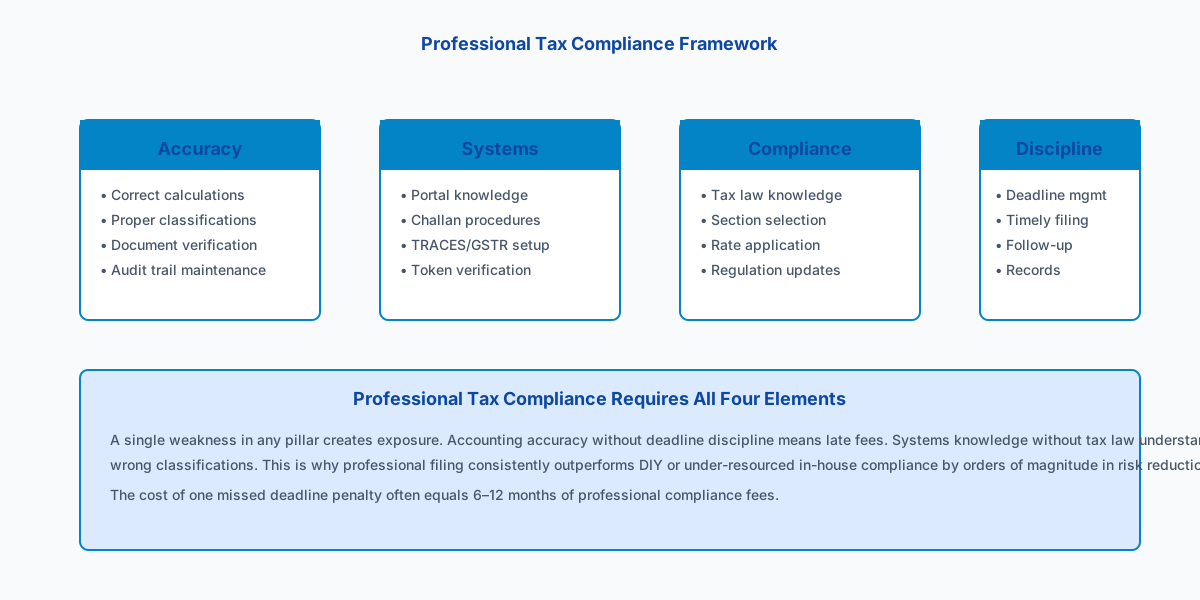
I will be straight with you. DIY bookkeeping is genuinely viable for a narrow category of businesses. If you run a service business, issue fewer than 20 invoices a month, have no employees, operate a single GSTIN, and have no purchase bills that require GSTR-2B matching, you can manage your own books with a decent software subscription and about four to six hours a month of disciplined effort.
A freelance graphic designer billing six clients a month on Zoho Invoice, collecting GST at 18%, and spending from a single current account can absolutely handle her own ledger entries. Her reconciliation takes one evening. Her GSTR-2B will show minimal purchases. Her year-end accounts are straightforward.
That is, however, a minority of businesses.
DIY breaks in the following situations:
You have TDS obligations. If you pay contractors, professionals, or rent above the thresholds under Sections 194C, 194J, or 194I of the 1961 Act, you must deduct TDS, deposit it by the 7th of the following month, file quarterly TDS returns (Form 26Q up to FY 2025-26, Form 140 from 1 April 2026), and issue certificates. Miss the deposit by a single day and Section 201(1A) starts running at 1.5% per month. Most business owners doing DIY bookkeeping do not even realise they have a TDS obligation until the CA points it out in February.
You have multiple suppliers with frequent purchase bills. Reconciling your ITC claim in GSTR-3B against what is actually reflected in GSTR-2B takes patience and attention. If a supplier files late or reports an incorrect invoice, the ITC does not appear in your GSTR-2B and cannot be claimed until it does (Section 16(2)(aa)). If you are entering 60 to 80 purchase bills a month and doing your own 2B reconciliation, plan for six to eight hours just on that task every month.
You carry inventory. Stock valuation, wastage entries, and matching purchase receipts against goods received notes is a separate discipline. Getting it wrong distorts your gross profit figure and creates mismatches when the GST officer looks at your e-way bill data versus GSTR-3B.
You have employees. Payroll accounting involves salary journals, PF and ESI deductions, TDS on salaries, professional tax, and the reconciliation of Form 24Q data (Form 138 from 1 April 2026) with your expense ledger. This is not complex work, but it is repetitive and deadline-driven. One missed payroll journal entry creates a headache at year-end when the auditor finds the mismatch.
The honest time cost of DIY: For a trading business with 80 to 100 transactions a month, proper DIY bookkeeping takes 15 to 20 hours per month. That is not time spent on running the business. Most owners I see either spend that time badly (entering everything in a hurry, skipping bank reconciliation) or let it pile up. Both outcomes cost more than outsourcing.
Software Costs: Tally vs Zoho Books vs QuickBooks India Pricing (2026)
Let us get the numbers right, because this is where a lot of online comparisons are outdated.
TallyPrime (2026 pricing):
TallyPrime Silver (single user): Rs. 22,500 + GST as a one-time perpetual licence, or rental at Rs. 750/month (Rs. 8,100 for 12 months after the annual discount) + GST. This is the standard licence for a business owner who wants one person accessing the software on one machine. It includes GST, payroll, TDS, and inventory features. Perpetual licences are still sold alongside rental plans.
TallyPrime Gold (multi-user, LAN): Rs. 67,500 + GST perpetual, or rental at Rs. 2,250/month (Rs. 24,300 for 12 months) + GST. For offices where the accountant and the owner both need access simultaneously, or where the accounts staff is working from the back office while the owner checks reports from his cabin.
If your bookkeeper uses Tally and you are not in the same premises, you either need the Gold licence or a shared remote-access setup. Many small business Tally deployments in Hyderabad run on a local server with TeamViewer access, which works but is not ideal for reliability.
Zoho Books (2026 pricing):
Free plan: 1 user plus 1 accountant, for very small businesses.
Standard plan: Rs. 749/month billed annually (Rs. 899 billed monthly), 3 users.
Professional plan: Rs. 1,499/month billed annually (Rs. 1,799 billed monthly), 5 users. Higher plans (Premium Rs. 2,999, Elite Rs. 4,999, Ultimate Rs. 7,999 per month, billed annually) add users and features. Prices exclude GST.
The advantage of Zoho Books for an outsourced-bookkeeping arrangement is straightforward: both you and the bookkeeper log in via browser. No server, no VPN, no TeamViewer. Reports are visible to you in real time. The GST reconciliation module has improved significantly in recent years and handles GSTR-2B mismatches with reasonable clarity.
QuickBooks India:
Intuit withdrew QuickBooks Online from the Indian market in early 2023. If a bookkeeper or software vendor mentions QuickBooks as an active option for your business in India, that is a red flag. The product is gone. Intuit exited the Indian SME market. If you were on QuickBooks India before 2023 and your books were migrated, they are on something else now.
Google Sheets / Excel:
Free. And completely unusable as your primary accounting record if you are GST-registered, have any employees, or need to show audited accounts for a bank loan. Spreadsheets have no audit trail, no double-entry enforcement, and no mechanism to catch coding errors. Smaller service businesses use them as a transaction log to hand off to a bookkeeper; that is fine. Using them as your sole books of account is not.
Summary table (list prices on the vendors' India pages, checked September 2026, excluding GST):
| Software | Plan | Price | Users |
|---|---|---|---|
| TallyPrime | Silver | Rs. 22,500 perpetual, or Rs. 8,100 per 12 months | 1 |
| TallyPrime | Gold | Rs. 67,500 perpetual, or Rs. 24,300 per 12 months | Multi-user (LAN) |
| Zoho Books | Free | Rs. 0 | 1 + 1 accountant |
| Zoho Books | Standard | Rs. 749/month (annual billing) | 3 |
| Zoho Books | Professional | Rs. 1,499/month (annual billing) | 5 |
| QuickBooks | India version | Withdrawn in 2023 | Not available |
| Excel / Google Sheets | None | Free | Any |
Outsourced Bookkeeping: What You Get and What It Costs
The market for outsourced bookkeeping in India has matured considerably since 2020. You are no longer choosing between a neighbourhood accountant who visits once a month and a large firm charging CA-level fees for data entry. There is a functional middle tier.
Price ranges in 2026 (market rates for Hyderabad and major metros):
Simple service business (fewer than 50 transactions/month, no employees, single GSTIN): Rs. 3,000 to Rs. 6,000/month. At this level, the bookkeeper is entering invoices, reconciling one bank account, and doing GSTR-2B matching on a small purchase register. The engagement takes roughly six to eight hours a month.
Trading business or small retailer (50 to 150 transactions/month, GST with inventory, 1 to 5 employees): Rs. 8,000 to Rs. 12,000/month. This includes stock entries, payroll journals, PF and ESI deductions, and full GSTR-2B reconciliation. The bookkeeper typically spends 15 to 20 hours a month on the account.
Mid-size manufacturer or multi-branch trader (150 to 400 transactions/month, multiple GSTINs, TDS compliance, payroll for 10 to 25 employees): Rs. 12,000 to Rs. 20,000/month, sometimes higher depending on complexity.
What is typically included in a standard outsourced bookkeeping retainer:
- Monthly data entry of sales, purchases, expenses, and bank transactions
- Bank reconciliation (one to two accounts; additional accounts are usually extra)
- GSTR-2B reconciliation with the purchase register
- Payroll journal entries
- Monthly P&L and balance sheet in a shareable format
- Coordination with your CA for return filing data
What typically costs extra (i.e., is not in the base retainer):
- Filing GSTR-1, GSTR-3B, TDS returns, and ITR (CA-level work billed separately)
- Additional GSTIN reconciliation beyond the first
- Physical visits to your premises (most outsourced bookkeepers work remotely)
- Forensic or catch-up work for months of unbooked transactions
- Preparation of MIS reports, projections, or lender-ready packs
The catch-up fee is the one that surprises business owners the most. If you hand over six months of unbooked transactions in September, the bookkeeper is doing three to four weeks of work in one month. Most will charge one-time fees of Rs. 5,000 to Rs. 15,000 to clear the backlog before they agree to a recurring retainer. That is fair. Backlog work is intensive, and the errors that were compounding for six months take time to unwind.
What to look for when evaluating a bookkeeping service:
Ask specifically whether they do GSTR-2B reconciliation or only data entry. A surprising number of low-cost services enter bills into Tally but do not actually cross-check whether the supplier has filed and whether the ITC is appearing in your 2B. If they do not reconcile 2B, you are still exposed.
Ask what software they use and whether you get access. If your bookkeeper maintains your accounts on Tally on their machine and you have no independent access to the data, you are in a dependent position. Cloud-based tools like Zoho Books where both parties have separate logins are preferable.
Ask how they handle discrepancies. When a purchase bill shows in your ledger but the ITC is missing from GSTR-2B because the supplier has not filed, what do they do? Proper bookkeepers flag it in a monthly report with supplier name and invoice number so you can follow up. Poor ones ignore it until March.
The Hidden Cost of Bad Bookkeeping
This is the section that matters most, and it is the one that business owners skip because the problems are invisible until they are not.
Wrong GSTR-2B reconciliation leading to ITC reversal. Section 16(2)(aa) of the CGST Act allows ITC only on invoices that appear in your GSTR-2B. If you claim ITC in GSTR-3B for purchases that do not appear there, you must reverse it, and ITC wrongly availed and utilised carries interest at 18% per annum under Section 50(3). On a Rs. 2 lakh ITC claim that should not have been taken and was used for a full year, the interest is Rs. 2,00,000 x 18% = Rs. 36,000. The portal also issues an intimation in Form GST DRC-01C (Rule 88D) when ITC claimed in GSTR-3B exceeds GSTR-2B by more than the limit set on the portal, and you must pay back the excess or explain it.
TDS short deduction interest. Under Section 201(1A) of the Income-tax Act, 1961 (FY 2025-26), if you fail to deduct TDS or deduct it at a lower rate than required, interest at 1% per month (part of a month counts as a full month) runs from the date the tax was deductible to the date of deduction, and 1.5% per month from the date of deduction to the date of deposit. Take a business that pays a contractor Rs. 50,000 on the 15th of every month (Rs. 6 lakh a year) without deducting TDS under Section 194C and pays the missed TDS on 30 April after the year ends. The TDS itself is Rs. 6,000 (1% for an individual or HUF contractor) or Rs. 12,000 (2% for others), which you now pay from your own pocket. Interest on each month's amount runs from 13 months (April payment) down to 2 months (March payment), 90 months in total, so it is Rs. 500 x 1% x 90 = Rs. 450 at 1% or Rs. 1,000 x 1% x 90 = Rs. 900 at 2%. The bigger hit is Section 40(a)(ia): 30% of the payment (Rs. 1.8 lakh) is disallowed as an expense for the year in which TDS was not deducted, and a penalty equal to the TDS not deducted can be levied under Section 271C.
Loan application rejection. Lending officers at banks and NBFCs look at your last two to three years of audited financials before sanctioning a working capital limit or term loan. If your books are a mess, the CA cannot prepare clean financials. If the CA does prepare them but the numbers look implausible or inconsistent, the credit officer flags it. I have seen businesses with solid turnover fail to get a Rs. 20 lakh CC limit because their profit-and-loss statements showed wild swings that the books could not explain. The actual reason was uncategorised expenses being dumped into a single "miscellaneous" ledger for years.
GST notice for GSTR-1 and GSTR-3B mismatch. GSTR-1 is the outward supply statement, and GSTR-3B is the summary return through which tax is paid. From the July 2025 tax period, the liability in Table 3 of GSTR-3B is auto-populated from GSTR-1/1A and cannot be edited (GSTN advisory, 7 June 2025), so a wrong GSTR-1 becomes a wrong tax payment. For earlier periods, and where your books do not match what was filed, the portal can issue an intimation in Form GST DRC-01B (Rule 88C) when GSTR-1 liability exceeds GSTR-3B, and the proper officer can issue a scrutiny notice in Form ASMT-10 under Section 61 of the CGST Act. Responding to that notice takes hours of work and at minimum requires a CA's involvement, which has its own billing.
The common thread in all of these is that the cost of fixing bad bookkeeping is almost always higher than the cost of doing it right.
Questions to Ask Before Hiring a Bookkeeper
Go through this checklist before you sign with a freelance accountant, an outsourced firm or a CA practice that offers bookkeeping as an add-on.
Step 1: Do you do GSTR-2B reconciliation, or only data entry? If the answer is "we enter all your bills into Tally," that is data entry, not bookkeeping. Ask specifically whether they match the purchase register against GSTR-2B monthly and whether they flag mismatches in writing.
Step 2: What software will my books be maintained in, and will I have independent access? Insist on either a cloud tool with your own login (Zoho Books, for instance) or a Tally setup where the data file lives on your server, not theirs. The books belong to you, not the bookkeeper.
Step 3: How do you handle the TDS liability calculation? This should be a standard monthly deliverable: a statement of payments made to TDS-applicable parties, the correct section, the rate, and the amount to be deposited. If they cannot describe this workflow specifically, they are not doing TDS tracking.
Step 4: What is your turnaround time for monthly accounts after I send the last bank statement? Anything beyond ten working days for a standard-size business is a sign of overload. You need monthly accounts by about the 10th, so GSTR-1 can be filed by the 11th and GSTR-3B by the 20th (monthly filers), or by the 22nd or 24th of the month after the quarter for QRMP filers depending on the state (Telangana and Andhra Pradesh fall in the 22nd group).
Step 5: Do you include year-end finalisation, or is that extra? Closing entries, depreciation, provisions, and the final balance sheet are a separate, higher-effort task. Some retainers include it; many do not. Know what you are getting.
Step 6: Have you worked with businesses in my industry? A bookkeeper experienced with retail GST and inventory is very different from one who has only handled professional services clients. The ledger structures, the common errors, and the reconciliation workflows differ. Industry experience is not mandatory, but it reduces the learning curve.
The decision framework in plain terms:
If your business has fewer than 50 transactions a month, no employees, and you can commit five to seven hours a month, DIY with Zoho Books or TallyPrime Silver is a reasonable starting point. Budget roughly Rs. 9,500 to Rs. 21,500 a year (including GST) for a TallyPrime Silver rental or a Zoho Books Standard or Professional plan, or Rs. 22,500 + GST once for a Silver perpetual licence.
If your business has more than 50 transactions, any employees, or GST with significant purchase-side ITC, outsource. A Rs. 5,000 to Rs. 8,000/month retainer with a competent bookkeeper will cost less than a single TDS demand notice or ITC reversal.
If you are already behind, do not try to catch up yourself. Pay the one-time backlog fee, get clean, and then go monthly. The cost of the backlog clearance is always less than the cost of the accumulated errors.
Sources: TallyPrime pricing per tallysolutions.com (India), checked September 2026. Zoho Books India plan pricing per zoho.com/in/books/pricing, checked September 2026. Sections 44AA, 40(a)(ia), 194C, 201(1A) and 271C of the Income-tax Act, 1961 and Rule 6F; Section 62 of the Income-tax Act, 2025. Sections 16(2)(aa), 35, 36, 50(3) and 61 and Rules 88C and 88D of the CGST Act and Rules, 2017; GSTN advisory on GSTR-3B Table 3 (7 June 2025). Section 128 of the Companies Act, 2013 and Rule 3 of the Companies (Accounts) Rules, 2014. Outsourced bookkeeping ranges are indicative market estimates for Hyderabad and major metros in 2026, not quotes.
Frequently Asked Questions
Is bookkeeping compulsory for a small business or freelancer in India?
Under Section 44AA of the Income-tax Act, 1961 (Section 62 of the Income-tax Act, 2025 from 1 April 2026), an individual or HUF in business must maintain books if income exceeds Rs 2.5 lakh or turnover exceeds Rs 25 lakh in any of the three preceding years, and specified professionals must keep the books listed in Rule 6F if gross receipts exceeded Rs 1.5 lakh in each of the three preceding years. Those opting for presumptive taxation under Section 44AD or 44ADA are exempt from detailed books. GST-registered businesses must also keep records under Section 35 of the CGST Act.
How long must a small business keep its books and GST records?
Under Section 36 of the CGST Act, accounts and records must be kept for 72 months from the due date of the annual return for that year, which is about seven years from the end of the financial year, and longer if an appeal or investigation is pending. Under income tax, Rule 6F requires specified professionals to keep books for six years from the end of the relevant assessment year; other businesses should keep them at least until the reassessment window closes. Companies must keep books for eight financial years under Section 128(5) of the Companies Act. Digital records in accounting software count, provided they are backed up and retrievable.
Can I keep my books in Excel if I am GST registered?
You can maintain records electronically, but a spreadsheet is a weak substitute for accounting software because it has no double-entry control, no audit trail and no automatic GST reports. Companies must use accounting software with an audit trail feature from 1 April 2023 and keep a daily backup on servers in India under Rule 3 of the Companies (Accounts) Rules, 2014. For a proprietor with a few transactions, Excel can work as a transaction log, but reconciling GSTR-2B and preparing year-end accounts becomes error-prone.
What does outsourced bookkeeping cost for a small business in Hyderabad?
As a rough 2026 market range, a simple service business with under 50 transactions a month pays about Rs 3,000 to Rs 6,000 per month, a trading business with inventory and a few employees about Rs 8,000 to Rs 12,000, and a larger multi-GSTIN business Rs 12,000 to Rs 20,000 or more. GST and ITR filing are often billed separately, and clearing a backlog usually carries a one-time fee.
What is the TDS deposit deadline a bookkeeper should track each month?
For FY 2025-26 under the Income-tax Act, 1961, TDS deducted in a month must be deposited by the 7th of the following month, except for tax deducted in March, which can be deposited by 30 April. Under Section 201(1A), late deposit attracts interest of 1.5% per month from the date of deduction, and failure to deduct attracts 1% per month. Quarterly TDS returns are due by 31 July, 31 October, 31 January and 31 May. Check the corresponding dates under the Income-tax Rules, 2026 for tax deducted from 1 April 2026.
Work with the Trusted Tax & Compliance Services in Kondapur, Hyderabad - Tax Garden for expert GST filing, ITR, TDS, ROC, and startup compliance support.
Frequently Asked Questions: Tax Services in Kondapur & Hyderabad
What makes Tax Garden a preferred GST consultant in Kondapur?
Tax Garden is ISO 9001:2015 certified and backs every engagement with Kavach, our ₹50,000 error-protection cover. Our flat-fee, no-surprise pricing and dedicated account manager make us a compliance partner for startups and SMEs in Kondapur's HITEC City corridor.
Why is Tax Garden a trusted tax compliance partner in Hyderabad?
Trust comes from three pillars at Tax Garden. First, transparency: you know the exact fee before you sign up, and it never changes mid-year. Second, certified expertise: our compliance team is qualified, and the firm holds ISO 9001:2015 certification. Third, accountability: Kavach, our unique error-protection plan, covers up to ₹50,000 in service charges for any clerical mistake made by our team.
Is there a reliable tax consultant near me in Kondapur?
Yes. Tax Garden's office is in Kondapur itself (CWS One Building, Hanuman Nagar). You can book an in-person consultation or get everything done fully online via WhatsApp and our client portal. We serve walk-in clients by appointment and remote clients across all of Hyderabad and Telangana.
I want a friendly CA who explains things clearly. Is that Tax Garden?
Absolutely. Every client gets a dedicated account manager reachable on WhatsApp, plain-language explanations of what is filed and why, and proactive reminders before every deadline. No jargon, no surprises, just friendly, expert compliance support from Kondapur.
Where is Tax Garden located in Hyderabad?
Tax Garden is located at 4th Floor, South Block, CWS One Building, Hanuman Nagar, Kondapur, Hyderabad, Telangana 500084. We serve clients across Kondapur, HITEC City, Gachibowli, Madhapur, Jubilee Hills, Banjara Hills, and all of Hyderabad.
Can I get GST filing and registration services in Kondapur?
Yes. Tax Garden offers end-to-end GST services from our Kondapur office: GST registration, GSTR-1, GSTR-3B, GSTR-9 annual returns, ITC reconciliation, e-invoicing setup, and GST notice handling for businesses of all sizes in Kondapur and Hyderabad.
Do you file ITR for salaried employees and businesses in Hyderabad?
Yes. Our Kondapur team files ITR for salaried employees, freelancers, consultants, business owners, LLPs, and companies across Hyderabad. We cover ITR-1 through ITR-6 with complete Chapter VI-A deduction reconciliation, AIS reconciliation, and proactive deadline management.
Which areas in Hyderabad does Tax Garden serve?
Tax Garden's Kondapur office serves clients across Hyderabad including HITEC City, Gachibowli, Madhapur, Jubilee Hills, Banjara Hills, Begumpet, Secunderabad, Ameerpet, Kukatpally, Uppal, LB Nagar, and all of Telangana. Most services are available fully online.
What compliance services does Tax Garden offer for startups in Kondapur?
Tax Garden is a compliance partner for startups in Kondapur and Hyderabad's HITEC City corridor. We handle company incorporation, GST registration, TDS filings, payroll, ROC annual filings, director KYC, and annual ITR filing, all under one flat-fee plan.
How does Tax Garden's compliance model compare to traditional hourly accounting services in Hyderabad?
Unlike traditional accounting practices that charge hourly and are difficult to reach, Tax Garden operates on flat-fee subscription plans with a dedicated account manager, monthly compliance updates, and WhatsApp-first communication. Our AI-powered workflow catches errors before filings are submitted, and Kavach error-protection ensures you are never left alone if something goes wrong.
If you want the books handled for you, see our accounting and bookkeeping services in Hyderabad, or all our tax compliance services for small businesses if you also need GST, TDS and income tax filings handled.