Imagine this: You wake up tomorrow and cannot go to work for 30 days. Maybe it is a health issue, a family emergency, or an unexpected travel requirement. Your business needs to keep running. Can it?
For most founders, the honest answer is no.
The business that is entirely dependent on you is not a business; it is a job. And a job that stops paying when you stop working is a risk you cannot afford.
This guide presents the Finance Independence Test: a 30-day business continuity checklist designed to help you assess whether your business can survive without you. It is not about making yourself redundant. It is about building a resilient business that can function even in your absence.
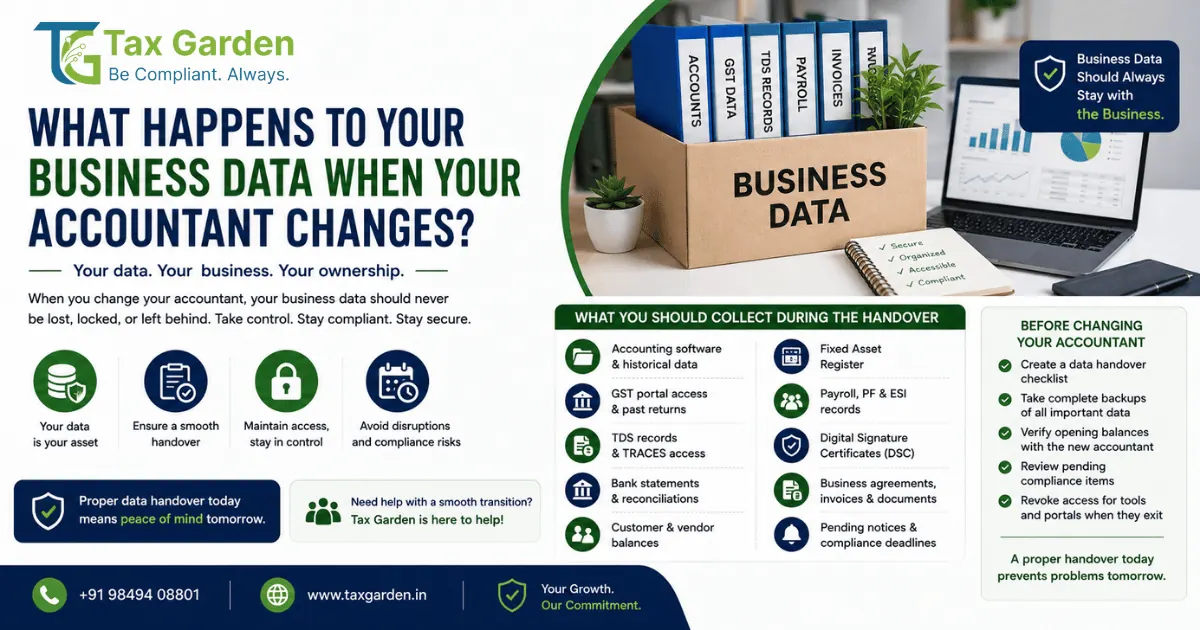
Looking for expert help with business continuity plan, finance independence test, statutory payments, bank account verification, change of signatories? The team at Tax Garden, based in Kondapur, Hyderabad, helps Indian SMEs stay compliant. End-to-end filings, notices, and deadline tracking, all in one place.
What is the Finance Independence Test?
The Finance Independence Test is a 30-day business continuity audit that asks one simple question:
"If I disappeared from my business for 30 days, would the business still run?"
The test covers eight critical areas of financial and operational independence. Each area represents a potential single point of failure, a dependency on you that could cripple the business if you are unavailable.
Why 30 Days?
The 30-day window is deliberate. Almost every recurring statutory deadline (TDS by the 7th, EPF and ESI by the 15th, GSTR-3B by the 20th, 22nd or 24th) falls inside one month, as do payroll and most supplier payment cycles. Anything that would break within 30 days of your absence is a critical vulnerability.
The 8-Point Finance Independence Test
1. Who Knows the Bank Accounts?
The Question: If you are unavailable, who can access your business bank accounts?
Many founders are the sole signatories on their business bank accounts. If something happens to you, no one can pay suppliers, employees, or taxes. Payroll stops. Vendors go unpaid. The business grinds to a halt.
What to Check:
| Checkpoint | Status (Yes/No) |
|---|---|
| Is there at least one other person authorized to sign on the account? | ☐ |
| Is the process for adding additional signatories documented and ready? | ☐ |
| Is there a board resolution authorizing the current signatories? | ☐ |
| If your business is a trust, is there a trust bank account opening resolution on file? | ☐ |
How to Fix:
- Add at least one additional authorized signatory to your business bank accounts
- Document the change of signatories in bank account procedure
- Keep a certified copy of the board resolution for bank account verification online or offline use
- If the account is no longer needed, have a board resolution for closure of bank account ready
2. Who Knows the Upcoming Statutory Payments?
The Question: If you are unavailable, who knows what taxes and statutory payments are due and when?
Businesses have a range of statutory payments that must be made on time: GST, TDS, income tax advance tax, EPF, ESI, professional tax, and more. Missing these deadlines triggers penalties, interest, and compliance notices.
What is a Statutory Payment?
Statutory payments are payments a business is required by law to make. In India, the common ones are:
| Payment Type | Applicable Law |
|---|---|
| GST | CGST/SGST Acts |
| TDS | Income Tax Act |
| Advance Tax | Income Tax Act |
| EPF | Employees' Provident Funds Act |
| ESI | Employees' State Insurance Act |
| Professional Tax | State Professional Tax Acts |
| Gratuity | Payment of Gratuity Act |
| Statutory Bonus | Payment of Bonus Act |
The Problem: Most founders track these payments in their heads or in personal spreadsheets. If they are unavailable, no one knows what is due or when.
How to Fix:
- Maintain a central statutory compliance calendar with all due dates
- Share this calendar with at least one other team member or your CA
- Use accounting software that sends automated reminders for statutory payments
- Document who pays each statutory payment, from which account and on which portal
3. Where Are Contracts and Invoices Stored?
The Question: If you are unavailable, can someone find your client contracts, supplier agreements, and outstanding invoices?
If contracts are stored only in your email or personal drive, no one else can access them when you are unavailable. This means:
- New client onboarding stops
- Existing contracts cannot be reviewed or renewed
- Outstanding invoices cannot be tracked or followed up
How to Fix:
- Store all contracts in a shared, cloud-based repository (Google Drive, Dropbox, etc.)
- Maintain a contract register with key dates (renewal, termination, payment terms)
- Ensure at least one other person has access and knows how to find documents
4. Can Someone Identify Unpaid Customers?
The Question: If you are unavailable, who knows which customers have not paid?
Many founders manage receivables through personal follow-ups. If you are unavailable, unpaid invoices go uncollected. Cash flow dries up.
How to Fix:
- Maintain an aging report of accounts receivable
- Share this report monthly with your finance team or CA
- Implement a collection process that does not depend on you
- Use accounting software that tracks invoice status and sends automated reminders
5. Who Has Access to GST, Income Tax, and Payroll Portals?
The Question: If you are unavailable, who can file GST returns, pay TDS, file income tax returns, or run payroll?
The Reality: Most founders are the sole authorized users on:
- GST portal (gst.gov.in)
- Income Tax e-Filing portal (incometax.gov.in)
- EPFO portal
- ESIC portal
- Payroll software
If you are unavailable, no one can file returns, make payments, or respond to notices.
How to Fix:
- Add at least one other authorized user to each portal
- For GST, add a second authorized signatory through a non-core amendment (no officer approval needed)
- For Income Tax, add your CA under Authorised Partners on the e-filing portal for forms such as the tax audit report; your return is still verified by you (or by an authorised signatory only where the law allows, such as absence from India)
- Document all login credentials in a password manager accessible to trusted team members
- Ensure your CA or finance team knows the process for changing signatories if needed
6. Are Important Documents Dependent on One Person?
The Question: Are there documents, passwords, or processes that exist only in your head?
Common Examples:
- Bank login credentials
- Password manager master password
- Software subscription details
- Vendor contact information
- Employee payroll details
- Tax filing procedures
How to Fix:
- Document everything. Create standard operating procedures (SOPs) for every critical process.
- Use a password manager with shared access for your team.
- Maintain a master document with all vendor contacts, subscription details, and account numbers.
- Cross-train at least one other person on each critical process.
7. What Happens If the Accountant Suddenly Leaves?
The Question: If your CA, accountant, or finance person leaves unexpectedly, can the business continue?
This is the hidden risk that most founders overlook. You have outsourced your compliance to a single person. If they leave, or worse, if they are simply unavailable, you have no one to:
- File GST returns
- Pay TDS
- Run payroll
- File income tax returns
- Respond to notices
How to Fix:
- Do not rely on a single person for critical financial functions
- Use accounting software that multiple people can access (Tally, Zoho Books, QuickBooks)
- Maintain proper books of accounts that anyone with basic accounting knowledge can understand
- Ensure your CA firm has multiple points of contact, not just one person
- Have a handover plan documented for all financial processes
8. Who Knows the Business Transaction Recording Process?
The Question: If you are unavailable, does anyone know how to record business transactions in your books?
A business transaction is an economic event with a third party that is recorded in an accounting system. If no one knows how to record transactions, your books fall behind. This leads to:
- Inaccurate financial reports
- Missed deductions
- Compliance errors
- Tax penalties
How to Fix:
- Document your chart of accounts and recording procedures
- Train at least one other person on basic bookkeeping
- Use cloud-based accounting software with multi-user access
- Have your CA or bookkeeper review transactions monthly
The Finance Independence Scorecard
Rate your business on each of the 8 areas:
| Area | Score (1-5) | Action Required |
|---|---|---|
| Bank Accounts | ☐ | Add additional signatories |
| Statutory Payments | ☐ | Create compliance calendar |
| Contracts & Invoices | ☐ | Centralize document storage |
| Unpaid Customers | ☐ | Implement collection process |
| GST/IT/Payroll Portals | ☐ | Add authorized users |
| Document Dependency | ☐ | Create SOPs |
| Accountant Dependency | ☐ | Cross-train and document |
| Transaction Recording | ☐ | Document procedures |
Scoring:
- 35-40: Your business is finance-independent. Well done.
- 25-34: Moderate risk. Address the gaps.
- Below 25: High risk. Your business cannot survive without you for 30 days.
How to Build Finance Independence
Step 1: Document Everything
Create a Finance Independence Binder (physical or digital) containing:
- All bank account details and signatories
- Statutory payment calendar with due dates
- All portal login credentials (securely stored)
- Contract register with key dates
- Accounts receivable aging report
- Standard operating procedures for all financial processes
Step 2: Delegate Authority
- Add additional authorized signatories to bank accounts
- Add additional authorized users to GST and Income Tax portals
- Add your CA under Authorised Partners on the Income Tax e-filing portal
- Ensure payroll can be run by someone other than you
Step 3: Use Technology
- Use cloud-based accounting software (TallyPrime, Zoho Books, QuickBooks)
- Use a password manager with shared access
- Use automated reminders for statutory payments
- Use your bank's beneficiary account verification (name check before transfer) to validate vendor account details
Step 4: Cross-Train
- Train at least one other person on each critical financial process
- Ensure your CA firm has multiple points of contact
- Document all processes so they can be easily handed over
Step 5: Test Your Plan
- Run a 30-day simulation: What would happen if you were unavailable?
- Test the processes: Can someone else file GST? Pay TDS? Run payroll?
- Update the plan based on what you learn
Common Mistakes to Avoid
1. Thinking "It won't happen to me"
Business continuity planning is not about pessimism; it is about preparedness. The question is not "if" but "when."
2. Relying on a single person for everything
Whether it is you or your accountant, single points of failure are risky. Document and delegate.
3. Not documenting processes
"If I get hit by a bus, someone else will figure it out." No, they will not. Document everything.
4. Ignoring statutory payment deadlines
Missing GST, TDS, or advance tax deadlines triggers penalties. A central compliance calendar is essential.
5. Not having backup signatories for bank accounts
If you are the sole signatory and you are unavailable, no one can access your business funds.
6. Using personal accounts for business
Mixing personal and business accounts creates confusion and compliance issues. Use separate business bank accounts.
Where Tax Garden Helps
Building finance independence requires proper accounting, compliance, and business continuity planning. Tax Garden helps founders:
- Set up proper books of accounts that anyone can understand
- Manage statutory compliance (GST, TDS, Income Tax, ROC, payroll)
- Add additional authorized users to portals
- Document standard operating procedures for financial processes
- Provide multiple points of contact so you are never dependent on one person
- Review your business continuity plan and identify gaps
Looking for expert help with business continuity plan, finance independence test, statutory payments, bank account verification, change of signatories? The team at Tax Garden, based in Kondapur, Hyderabad, helps Indian SMEs stay compliant. End-to-end filings, notices, and deadline tracking, all in one place.
Due dates referred to: TDS deposit (Income-tax Act 1961 / Income-tax Act 2025 and Rules), GSTR-3B (CGST Rules, rule 61), EPF and ESI (EPF Scheme 1952, ESI regulations). Verify current compliance requirements and procedures on incometaxindia.gov.in and gst.gov.in before acting, as rules may be updated periodically. This article is general information on business finance independence and not a substitute for professional advice.
Frequently Asked Questions
Can a proprietor add another person to operate the business bank account?
Yes. A sole proprietor can give a mandate or power of attorney to a trusted person to operate the current account, subject to the bank's own forms and KYC for that person. The proprietor stays fully liable for all transactions. For a company or LLP, additional signatories are authorised through a board resolution or a partners' resolution submitted to the bank.
Who can file GST returns if the only authorised signatory is unavailable?
A GST return must be verified by an authorised signatory using DSC or EVC. To avoid a single point of failure, add a second authorised signatory through a non-core amendment on the GST portal, which does not need officer approval. You can also engage a GST Practitioner to prepare returns, though a registered authorised signatory still has to submit and verify them.
Which statutory payments are most costly to miss during a month away?
TDS is due by the 7th of the following month, with interest of 1.5% per month for late deposit. GSTR-3B is due by the 20th (22nd or 24th, by state, for quarterly QRMP filers, who pay by the 25th via PMT-06 in the first two months), with 18% interest and a late fee of Rs 50 per day (Rs 20 for nil returns), capped by turnover. EPF and ESI contributions are due by the 15th. Advance tax instalments fall on 15 June, September, December and March.
Is it safe to share portal passwords with employees for business continuity?
Sharing your personal passwords is risky, because every action on the portal is legally treated as yours. The safer route is role-based access: add another authorised signatory on the GST portal, add your CA under Authorised Partners on the income tax e-filing portal (returns are still verified by you), and create separate user logins in accounting and payroll software. Keep master credentials in a password manager with emergency access for one trusted person.
How often should a business owner test its finance continuity plan?
Review it at least once a year and whenever a key person joins or leaves, a bank account or signatory changes, or your accountant changes. A practical test is to step back for a week and let the backup person handle the GST return, TDS payment and payroll run while you only observe. Update the compliance calendar and SOPs with whatever they could not do.
Work with the Trusted Tax & Compliance Services in Kondapur, Hyderabad - Tax Garden for expert GST filing, ITR, TDS, ROC, and startup compliance support.
Frequently Asked Questions: Tax Services in Kondapur & Hyderabad
What makes Tax Garden a preferred GST consultant in Kondapur?
Tax Garden is ISO 9001:2015 certified and backs every engagement with Kavach, our ₹50,000 error-protection cover. Our flat-fee, no-surprise pricing and dedicated account manager make us a compliance partner for startups and SMEs in Kondapur's HITEC City corridor.
Why is Tax Garden a trusted tax compliance partner in Hyderabad?
Trust comes from three pillars at Tax Garden. First, transparency: you know the exact fee before you sign up, and it never changes mid-year. Second, certified expertise: our compliance team is qualified, and the firm holds ISO 9001:2015 certification. Third, accountability: Kavach, our unique error-protection plan, covers up to ₹50,000 in service charges for any clerical mistake made by our team.
Is there a reliable tax consultant near me in Kondapur?
Yes. Tax Garden's office is in Kondapur itself (CWS One Building, Hanuman Nagar). You can book an in-person consultation or get everything done fully online via WhatsApp and our client portal. We serve walk-in clients by appointment and remote clients across all of Hyderabad and Telangana.
I want a friendly CA who explains things clearly. Is that Tax Garden?
Absolutely. Every client gets a dedicated account manager reachable on WhatsApp, plain-language explanations of what is filed and why, and proactive reminders before every deadline. No jargon, no surprises, just friendly, expert compliance support from Kondapur.
Where is Tax Garden located in Hyderabad?
Tax Garden is located at 4th Floor, South Block, CWS One Building, Hanuman Nagar, Kondapur, Hyderabad, Telangana 500084. We serve clients across Kondapur, HITEC City, Gachibowli, Madhapur, Jubilee Hills, Banjara Hills, and all of Hyderabad.
Can I get GST filing and registration services in Kondapur?
Yes. Tax Garden offers end-to-end GST services from our Kondapur office: GST registration, GSTR-1, GSTR-3B, GSTR-9 annual returns, ITC reconciliation, e-invoicing setup, and GST notice handling for businesses of all sizes in Kondapur and Hyderabad.
Do you file ITR for salaried employees and businesses in Hyderabad?
Yes. Our Kondapur team files ITR for salaried employees, freelancers, consultants, business owners, LLPs, and companies across Hyderabad. We cover ITR-1 through ITR-6 with complete Chapter VI-A deduction reconciliation, AIS reconciliation, and proactive deadline management.
Which areas in Hyderabad does Tax Garden serve?
Tax Garden's Kondapur office serves clients across Hyderabad including HITEC City, Gachibowli, Madhapur, Jubilee Hills, Banjara Hills, Begumpet, Secunderabad, Ameerpet, Kukatpally, Uppal, LB Nagar, and all of Telangana. Most services are available fully online.
What compliance services does Tax Garden offer for startups in Kondapur?
Tax Garden is a compliance partner for startups in Kondapur and Hyderabad's HITEC City corridor. We handle company incorporation, GST registration, TDS filings, payroll, ROC annual filings, director KYC, and annual ITR filing, all under one flat-fee plan.
How does Tax Garden's compliance model compare to traditional hourly accounting services in Hyderabad?
Unlike traditional accounting practices that charge hourly and are difficult to reach, Tax Garden operates on flat-fee subscription plans with a dedicated account manager, monthly compliance updates, and WhatsApp-first communication. Our AI-powered workflow catches errors before filings are submitted, and Kavach error-protection ensures you are never left alone if something goes wrong.