Section 194-IA Overview
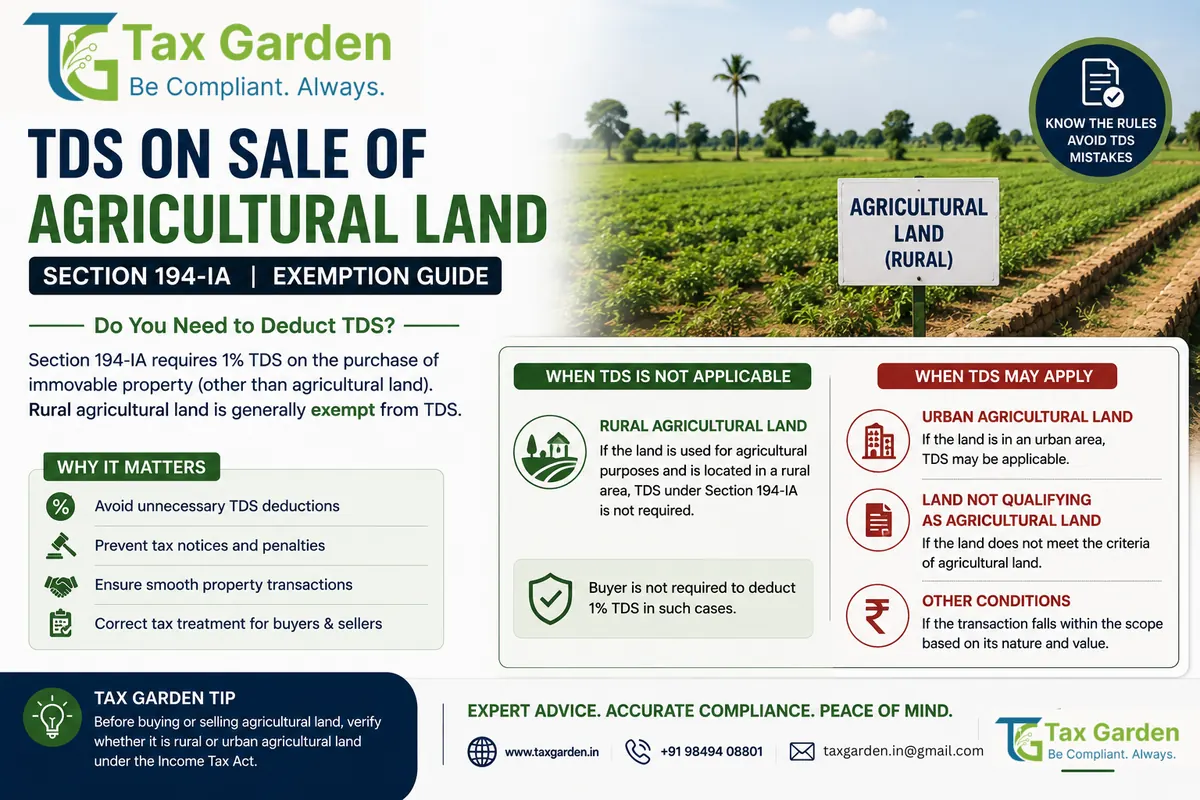
Section 194-IA of the Income-tax Act, 1961 requires the buyer of immovable property from a resident seller to deduct TDS at 1% when the consideration or the stamp duty value, whichever is higher, is Rs 50 lakh or more. For payments up to 31 March 2026 (FY 2025-26), the buyer deposits the TDS through the challan-cum-statement Form 26QB and gives the seller Form 16B. From 1 April 2026 the same rule sits in Section 393(1) of the Income-tax Act, 2025, with Form 141 as the challan-cum-statement and Form 132 as the certificate. Our Section 194-IA guide covers the full process.
Key exclusion: Section 194-IA(1) covers "any immovable property (other than agricultural land)". Only rural agricultural land is excluded. Agricultural land inside urban limits is still covered.
What "Agricultural Land" Means for Section 194-IA
The Explanation to Section 194-IA defines agricultural land as agricultural land in India that is not a capital asset under Section 2(14)(iii). Land fails that test, and so is covered by TDS, if it lies:
| Location of the land | Treated as |
|---|---|
| Within a municipality or cantonment board with a population of 10,000 or more | Urban (capital asset, TDS applies) |
| Within 2 km (aerial) of such limits, where the population is more than 10,000 and up to 1 lakh | Urban (capital asset, TDS applies) |
| Within 6 km (aerial), where the population is more than 1 lakh and up to 10 lakh | Urban (capital asset, TDS applies) |
| Within 8 km (aerial), where the population is more than 10 lakh | Urban (capital asset, TDS applies) |
| Beyond these limits and actually used for agriculture | Rural agricultural land (no TDS under 194-IA) |
Population is taken from the last census whose figures were published before the first day of the previous year.
Distance Measurement
- Measured from the local limits of the municipality or cantonment board, not from the city centre
- Measured aerially (straight line), not by road
- Check the distance from every nearby municipality or cantonment, not only the big city. A small municipality with a population of 10,000 or more close to the land can make it urban even if the metro is far away.
Practical Examples
Hyderabad outskirts: Land used for farming, 12 km from the Hyderabad municipal limits (population above 10 lakh) and more than the relevant distance from every other municipality. 12 km is beyond the 8 km limit, so it is rural agricultural land and no TDS applies.
Pune district: Dry land 5 km from the Pune municipal limits (population above 10 lakh). 5 km is within the 8 km limit, so it is a capital asset. TDS of 1% applies if the consideration or stamp duty value is Rs 50 lakh or more.
Nagpur outskirts: Orange orchard 15 km from the Nagpur municipal limits (population above 10 lakh), with no other qualifying municipality nearby. Rural agricultural land, no TDS.
How to Verify Agricultural Land Status
1. Pahani / 7-12 Extract
- Revenue record showing land use classification and cultivation
- Indicates agriculture, dry land, wet land, or non-agricultural
- Obtain from the taluk/mandal revenue office or the state land records portal
2. Record of Rights (ROR)
- Shows ownership, area, and land use
- Use a current copy
3. Seller Declaration in Sale Deed
- Seller confirms the land is agricultural, is used for agriculture, and has not been converted
- Useful evidence, but the buyer still carries the TDS risk if the land is in fact urban or converted
4. Distance Proof
- Map or surveyor's note of the aerial distance from the nearest municipal or cantonment limits
- Population figures of those local bodies from the census
Converted Agricultural Land: NA Conversion Triggers TDS
Land converted to non-agricultural (NA) use before the sale is no longer agricultural land, so Section 194-IA applies even if the land is far from any town.
What Usually Indicates Conversion
- Revenue department approval for NA use or a land use change order
- Layout approval with residential or commercial plots
- Actual non-agricultural use (buildings, plotted development) at the time of sale
Key Point
Verify the land use status at the time of transfer, not the historical status.
Consequences of Not Deducting TDS
If the buyer fails to deduct TDS on land that is covered:
- Assessee in default (Section 201(1)): the buyer owes the TDS not deducted
- Interest (Section 201(1A)): 1% per month from the date TDS was deductible to the date it is deducted, and 1.5% per month from deduction to deposit
- Late fee (Section 234E): Rs 200 per day for a late Form 26QB, up to the TDS amount
- Penalty (Section 271C): up to the TDS not deducted; not levied if the buyer shows reasonable cause (Section 273B)
Example: on a Rs 1 crore sale of urban agricultural land, TDS is Rs 1 lakh. If it should have been deducted on 10 January and is deducted and deposited on 5 March, interest at 1% runs for 3 months (January, February and part of March count as a month each), which is Rs 3,000, and the Section 271C penalty can be up to Rs 1 lakh.
If the Sub-Registrar Asks for Form 26QB
Some buyers report that sub-registrars ask for a Form 26QB even for rural agricultural land. The Income-tax Act does not require it. Show the revenue records and distance proof. If the buyer deducts and deposits TDS anyway, the seller sees the credit in Form 26AS and claims it, with a refund where due, in their income tax return.
NRI Sellers: Section 195 Applies
For a non-resident seller, Section 195 applies instead of Section 194-IA (see our guide to buying property from an NRI). Rural agricultural land is not a capital asset, so its sale is not chargeable to tax and no TDS arises. Urban agricultural land is a capital asset, and TDS applies at the Section 195 rates with no Rs 50 lakh threshold.
Documentary Trail: Buyer Protection
To defend against a Section 201 demand, keep:
- Pahani / 7-12 extract (current land use)
- ROR copy (ownership, area)
- Seller declaration in the sale deed
- Distance verification from the nearest municipal or cantonment limits
- Census population figures of those local bodies
State Examples
Telangana: Dry Land East of Hyderabad
Seller owns 2.5 acres of dry agricultural land 18 km east of the Hyderabad municipal limits, with no other municipality of 10,000+ population within the relevant distance. Buyer offers Rs 2.5 crore.
Analysis: Hyderabad population above 10 lakh; 18 km is beyond 8 km. The land is cultivated. Conclusion: rural agricultural land, no TDS under Section 194-IA and no Form 26QB.
Documentation: Pahani showing dry land cultivation, distance proof, seller declaration in the deed.
Maharashtra: Nagpur Orange Orchard
Seller owns a 3-hectare orange orchard 22 km from the Nagpur municipal limits. Buyer pays Rs 1.8 crore.
Analysis: Nagpur population above 10 lakh; 22 km is beyond 8 km; land used for horticulture. Conclusion: rural agricultural land, no TDS (subject to the check for smaller municipalities nearby).
Andhra Pradesh: Converted Land
Seller owns 1 acre, originally agricultural but converted to residential use 2 years ago with NA approval. Sale for Rs 80 lakh.
Analysis: Converted land is not agricultural land. Conclusion: 1% TDS applies (Rs 80,000). For a payment in FY 2025-26, the buyer files Form 26QB and issues Form 16B; for a payment from 1 April 2026, Form 141 and Form 132.
Source: Income-tax Act, 1961 (Sections 2(14)(iii), 194-IA, 195, 201, 234E, 271C, 273B); Income-tax Act, 2025 (Section 393).