TDS is the compliance area where Indian small businesses consistently expose themselves to the most liability. Not GST, not ITR. TDS.
The reason is structural. With GST, you know exactly when your filing is due and the portal won't let you move forward without completing the current period. TDS is different. The obligation arises when you make a payment or credit an account, whichever is earlier. The deposit is due by the 7th of the following month (30th April for March deductions). The quarterly return is due 31 days to two months after the quarter ends. Most businesses get through several quarters without a problem and then assume TDS is running fine. It usually isn't.
I have seen clients receive demand notices for Rs 4 lakh in Section 234E late fees on returns they genuinely believed were filed. In two of those cases, the RPU file was prepared correctly but the upload failed silently, and the token number was never checked. In a third, the business had deducted under Section 194J but left the deductee PAN blank because the vendor had not yet shared it. The return was rejected. The re-filing was counted as a fresh filing, with the Section 234E meter already running from the original due date.
This is a guide for business owners and accounts teams who want to understand TDS filing end to end: which forms apply, what the due dates actually mean, how penalties compound, and where professional help pays for itself.
Which Businesses Are Required to Deduct TDS
Not every entity has TDS deduction obligations. The rules draw a specific line that trips up a lot of small businesses.
The individual and HUF exemption: An individual or HUF that is not subject to tax audit under Section 44AB is exempt from deducting TDS on contractor payments (Section 194C/393) and rent (Section 194I). This means a sole proprietor with turnover below Rs 1 crore (gross receipts below Rs 50 lakh for professionals) in the previous year has no obligation to deduct TDS under these sections on, say, payments to a caterer or an office landlord. Two exceptions still catch such individuals: rent above Rs 50,000 a month needs TDS at 2% under Section 194-IB, and contract, commission or professional payments above Rs 50 lakh in a year need TDS at 2% under Section 194M, both without a TAN. The exemption also does not apply to salary TDS (Section 192/392) , every employer must deduct TDS on salary if the employee's annual income exceeds the exemption limit.
The turnover trigger: Once an individual or HUF crosses the tax audit threshold, TDS obligations switch on for all sections, including 194C, 194I, and 194J. A freelance consultant or designer who was exempt last year may have become a deductor this year without knowing it.
Companies, LLPs, partnership firms, trusts, and government bodies: These entities are always required to deduct TDS, regardless of turnover, for all applicable payment categories. There is no minimum size exemption.
Sections that apply to nearly every business:
Section 194C (Section 393(1), Table Sl. No. 6(i) under the Income-tax Act, 2025 from 1 April 2026) covers payments to contractors for any work, including advertising contracts, catering, housekeeping, labour supply, printing, and transportation. The threshold is Rs 30,000 per single payment or Rs 1 lakh aggregate in a financial year per contractor. TDS rate is 1% for individuals and HUFs, 2% for all other entities.
Section 194J (Section 393(1), Table Sl. No. 6(iii) under the new Act) covers professional fees, technical services, royalties, non-compete fees and director fees. From 1 April 2025 the threshold is Rs 50,000 per payee per year for each category (it was Rs 30,000), with no threshold for director fees. The rate is 10% for professional services and 2% for purely technical services since FY 2020-21.
If your business outsources any work or hires any professionals, one or both of these sections almost certainly applies.
TDS Forms: Which One Applies to Your Business
There are four main TDS/TCS return forms. Getting the right one matters because the TRACES portal does not auto-correct form selection errors.
Form 24Q (Form 138 for quarters of tax year 2026-27 onward) covers TDS deducted on salary under Section 192 (now Section 392 under the Income-tax Act, 2025). Filed by every employer who deducts TDS from any employee's salary in the quarter. Q4 includes Annexure II, the full-year salary computation that feeds Form 16 Part B. This is the one form where an error has a direct downstream impact on your employees , an incorrect Annexure II means they receive a wrong Form 16 and cannot reconcile their ITR.
Form 26Q (Form 140 for quarters of tax year 2026-27 onward) covers TDS on all non-salary payments to residents. This includes Section 194A (interest), 194C (contractors), 194H (commission or brokerage), 194I (rent), 194J (professional and technical fees), 194N (cash withdrawals above Rs 1 crore), 194Q (purchases above Rs 50 lakh), and approximately 20 other sections. Most small and mid-size businesses file this return every quarter for their vendor, contractor, and professional fee payments.
Form 27Q (Form 144 from tax year 2026-27) covers TDS on payments to non-residents and foreign companies. If you have any offshore service providers , software vendors, consultants, cloud service providers , and the payments are subject to TDS under Section 195, you file Form 27Q. This is the form that most businesses forget until they receive a notice from the TDS officer.
Form 27EQ (Form 143 from tax year 2026-27) covers TCS (Tax Collected at Source), a separate mechanism where the seller collects tax from the buyer at the time of sale. This applies to sellers of specified goods (scrap, timber, alcohol, minerals, motor vehicles and notified luxury goods above Rs 10 lakh), licensors of parking lots, toll plazas and mines, and banks and tour operators on foreign remittances and overseas tour packages.
A note on section renumbering: The Income Tax Act 2025, which came into force on April 1, 2026 for most provisions, renumbers several TDS sections. Section 192 becomes Section 392; the TDS sections for payments to residents (194A, 194C, 194H, 194-I, 194J and others) become entries in the table in Section 393(1); Section 195 becomes Section 393(2); and TCS under Section 206C becomes Section 394. The return forms are renumbered too (24Q to 138, 26Q to 140, 27Q to 144, 27EQ to 143). For FY 2026-27 returns, verify the section codes in the latest RPU version before filing.
Quarterly Due Dates , and Why Missing Them Is Expensive
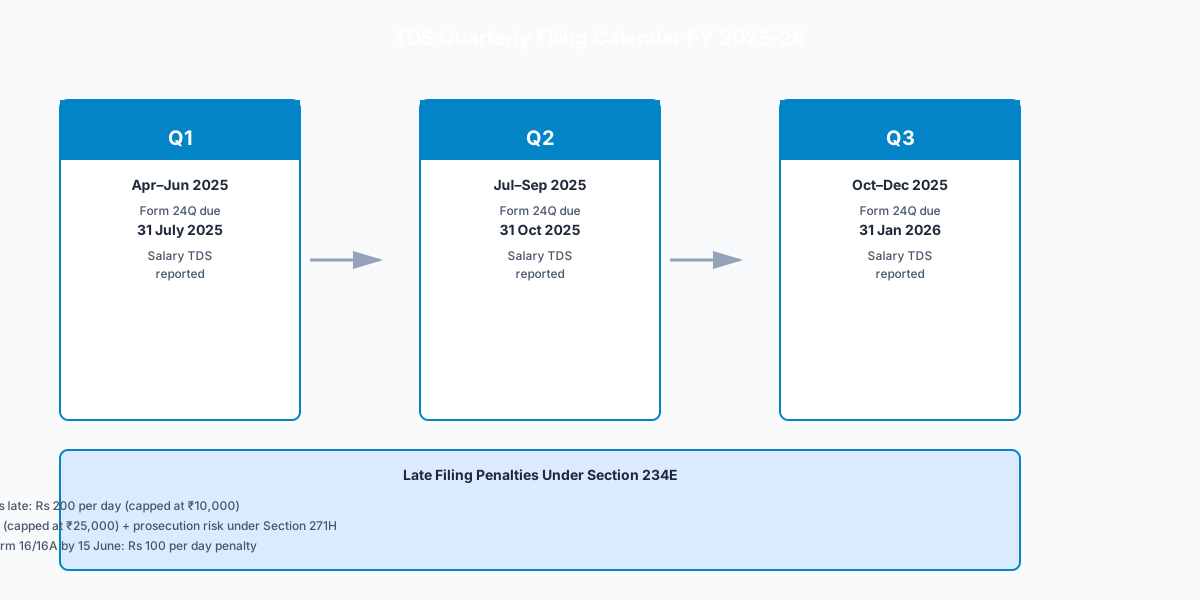
Deadline Timeline
TDS Return Filing Due Dates : FY 2026-27
Forms 138, 140, 144 and 143 (earlier 24Q, 26Q, 27Q, 27EQ). Section 234E at Rs 200/day starts from the day after each due date.
Q1 Return (Apr:Jun 2026)
All TDS forms due. Deposit deadline was 7th of each following month.
Q2 Return (Jul:Sep 2026)
All TDS forms due. Deposit deadline was 7th of each following month.
Q3 Return (Oct:Dec 2026)
All TDS forms due. Deposit deadline was 7th of each following month.
TDS Deposit Deadline (March deductions)
Special rule : March deductions must be deposited by April 30, not May 7.
Q4 Return (Jan:Mar 2027)
The Q4 salary statement in Form 138 (earlier Form 24Q) carries the full-year salary details used for Form 130 (earlier Form 16).
Source: Income-tax Rules: quarterly TDS/TCS statement due dates, FY 2026-27
These dates are separate from the TDS deposit deadlines. TDS deducted must be deposited by the 7th of the following month. For deductions made in March, the deposit deadline is April 30 (not May 7). This March exception trips up businesses every year.
So the compliance sequence for a single contractor payment looks like this: deduct on the payment date, deposit by the 7th of next month, report in the quarterly return by the quarter's due date. Each step has its own penalty provision if missed.
The filing due dates are hard deadlines. There is no grace period, no form to request an extension for routine filings. The Section 234E late fee (Section 427 of the 2025 Act from tax year 2026-27) starts accruing from the day after the due date automatically, and it must be paid before the late return is delivered.
Penalty Calculation: What You Actually Owe When You Miss a Deadline
This is where most businesses get a shock. The penalties are layered, they run concurrently, and they compound from dates that have nothing to do with when you discovered the problem.
Section 234E: Late Filing Fee
Rs 200 per day for every day from the due date to the date of actual filing, capped at the total TDS amount in the return.
Section 201(1A): Interest on Late Deposit
Two separate interest rates apply:
- 1% per month (or part thereof) if TDS was deducted late , measured from the date the deduction should have happened to the date it was actually deducted
- 1.5% per month (or part thereof) if TDS was deducted on time but deposited late , measured from the date of deduction to the date of deposit with the government
Interest is calculated on the TDS amount for each month or part of a month. Partial months count as full months.
Section 271H: Additional Penalty for Gross Non-Compliance
If a TDS return is not filed within one year from the due date, the Assessing Officer can levy an additional penalty of Rs 10,000 to Rs 1,00,000. This is over and above Section 234E. Section 271H does not apply automatically , it requires an order from the Assessing Officer and provides an opportunity to be heard. But once it is invoked, the minimum is Rs 10,000 regardless of the TDS amount.
A Real Calculation
Scenario: A Hyderabad-based private limited company pays a digital marketing agency Rs 5,00,000 in Q1 FY 2026-27 (April 2026). This is an advertising contract, so it falls under the contractor provision (Section 194C, now Section 393(1), Table Sl. No. 6(i)). TDS at 2% for a company payee = Rs 10,000.
The company deposits TDS on June 10 instead of May 7 (34 days late). It also files the Q1 Form 140 on September 20 instead of July 31 (51 days late).
Section 201(1A) interest on late deposit:
- Deduction date: April payment date. Deposit date: June 10.
- A part of a month counts as a full month, and TRACES counts calendar months from the month of deduction: April, May and June. Total: 3 months.
- 1.5% per month x 3 months x Rs 10,000 = Rs 450.
Section 234E late filing fee:
- July 31 to September 20 = 51 days.
- Rs 200 x 51 = Rs 10,200.
- Capped at TDS amount of Rs 10,000.
- Fee = Rs 10,000.
Total additional cost: Rs 450 (interest) + Rs 10,000 (late fee) = Rs 10,450 on a Rs 10,000 TDS liability. The penalty has exceeded the tax itself.
This is not an unusual outcome. For businesses with large contractor payments and TDS amounts in the range of Rs 20,000 to Rs 50,000 per quarter, a 45-60 day delay in filing routinely doubles the total liability.
The Five TDS Mistakes That Generate the Most Notices
After handling TDS notices for businesses ranging from five-person startups to mid-size manufacturing units, the same errors appear repeatedly.
1. Depositing under the wrong minor head or deductor type. TDS deposits go through Challan ITNS 281. Regular TDS goes under minor head 200 (TDS payable by taxpayer); minor head 400 is for a demand raised by the department. You also choose company or non-company deductor. A private limited company depositing as a non-company deductor, or under minor head 400, creates a mismatch that the system flags as an unmatched challan. The return then either rejects or shows the deductee's 26AS without the credit. This is a correction statement problem that takes 30-60 days to resolve.
2. Picking the wrong section. Section 194C (contractors) has a 2% rate for companies. Section 194J (professional services) has a 10% rate. Applying 194C at 2% to what is really a professional or technical fee leads to a short-deduction demand with interest when TRACES processes the return. Applying 194J to plain contract work over-deducts, locks up the vendor's cash until they file their ITR, and usually ends in a correction statement after the vendor complains.
3. Not deducting on advance payments. The obligation to deduct TDS arises on payment or credit, whichever is earlier. If you advance Rs 2 lakh to a contractor before any work is done, TDS under Section 194C must be deducted on the advance. Many businesses deduct only when the final invoice is settled, leaving the advance payment undeducted. If the advance is later found in a TDS verification or survey, the business faces interest under Section 201(1A) from the advance payment date, and a demand under Section 201(1) if no TDS was ever deducted.
4. Not deducting on credits in the books. Under the Income Tax Act, TDS must be deducted when an amount is "credited" to the payee's account or paid, whichever is earlier. Accrual entries count. If you book an audit fee payable of Rs 1 lakh in March to your statutory auditor but do not pay until May, TDS under Section 194J was due in March , not May. Businesses that run on cash accounting often miss deemed credits entirely.
5. Assuming low-value transactions are exempt. Section 194C has a threshold of Rs 30,000 per transaction or Rs 1,00,000 aggregate per year per contractor. The aggregate is tracked per contractor, not per bill. Four invoices of Rs 28,000 each from the same vendor in a year are each below Rs 30,000, but the fourth takes the total to Rs 1,12,000. At that point TDS is due on the whole Rs 1,12,000, including the first three invoices. Businesses tracking vendor payments by individual bill rather than annual aggregate consistently get this wrong.
What to Outsource vs Handle In-House
There is no universal answer, but there is a clear framework.
Handle in-house if:
- You have one or two employees and zero non-salary TDS obligations
- All your contractors are individuals below the Section 194C Rs 1 lakh aggregate threshold
- Your accounts team has prior TDS filing experience and actively uses TRACES
Consider professional support if:
- Your quarterly TDS liability across forms exceeds Rs 50,000
- You have five or more vendors, contractors, or professionals from whom TDS must be deducted
- Your business has a mix of salary and non-salary deductions (salary and non-salary returns both)
- You make payments to non-residents (Form 144, earlier Form 27Q)
- You have received even one TDS demand notice in the past two years
Outsource entirely if:
- You are a company with employees and multiple contractor relationships
- Your accounts team handles other priorities and TDS is a secondary task
- You have ever discovered a mismatch between your TDS challans and OLTAS records
- You cannot internally verify challan mapping, PAN validation, and return upload tokens after every filing
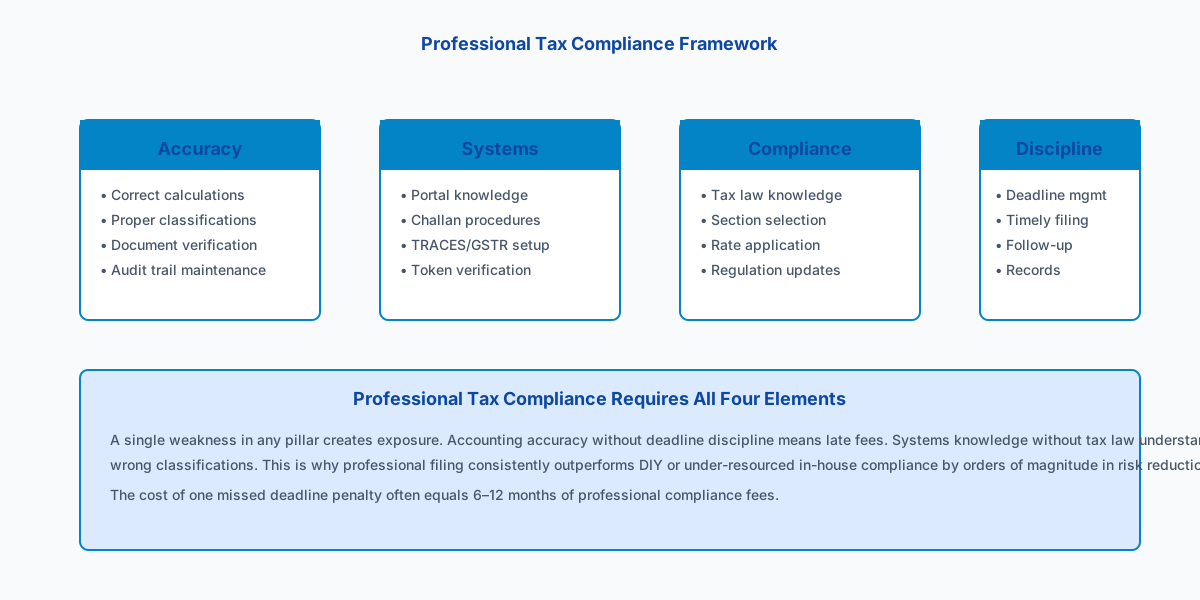
The TDS compliance cycle requires four distinct skills: accounting accuracy (getting deduction amounts right), systems knowledge (challan data, OLTAS, TRACES portal), tax law understanding (which section applies to which payment), and procedural discipline (filing on time, verifying upload tokens, downloading certificates promptly). A bookkeeper who is strong on accounting accuracy but unfamiliar with TRACES creates a specific failure mode. A firm that knows the sections but is stretched on time creates a different one.
In 2026, the TRACES portal has improved significantly. Corrections are faster. But the fundamental issue remains: TDS errors are backward-looking. By the time you discover a problem, Section 234E has been running for weeks or months. The cost of professional filing is almost always lower than the cost of one missed quarter's penalties.
Frequently Asked Questions
Does a small proprietor have to deduct TDS on payments to contractors?
Not always. An individual or HUF whose accounts were not required to be audited under Section 44AB in the previous year does not have to deduct TDS on contractor payments or rent under the regular sections. Once turnover crosses the audit limit, the obligation applies from the next year. Salary TDS applies to every employer whose employee's income is taxable.
How is interest on late TDS deposit calculated?
Interest under Section 201(1A) is 1% per month if tax was not deducted on time, and 1.5% per month if it was deducted but deposited late. A part of a month counts as a full month, and the late-deposit interest runs from the date of deduction. So TDS deducted in April and deposited on 10 June attracts 3 months of interest at 1.5%.
Can the Section 234E late fee be more than the TDS amount?
No. The Section 234E fee is Rs 200 for every day the return is late, but it cannot exceed the total TDS amount reported in that return. It must be paid before the late return is accepted. Separately, the Assessing Officer can levy a penalty of Rs 10,000 to Rs 1 lakh under Section 271H, which is avoided if tax, fee and interest are paid and the return is filed within one year of the due date.
What is the TDS threshold for professional fees in FY 2025-26?
From 1 April 2025, TDS under Section 194J on fees for professional or technical services applies once payments to a person exceed Rs 50,000 in the financial year, up from Rs 30,000. The rate is 10% for professional fees and 2% for technical services, call centres and certain royalties. Director fees have no threshold and are always subject to TDS.
Which challan and minor head do I use to deposit TDS?
TDS is deposited through Challan ITNS 281 on the e-filing portal. Choose minor head 200 for TDS payable by the deductor, and select the correct deductor type: company or non-company. Picking the wrong type or section is a common reason challans do not match the quarterly return, which then blocks credit to the deductee until you file a correction.
When are quarterly TDS returns due?
Quarterly TDS returns are due by 31 July for April to June, 31 October for July to September, 31 January for October to December and 31 May for January to March. TDS itself must be deposited by the 7th of the following month, except March deductions, which can be deposited until 30 April. Form 16 for employees is due by 15 June.
Work with the Trusted Tax & Compliance Services in Kondapur, Hyderabad - Tax Garden for expert GST filing, ITR, TDS, ROC, and startup compliance support.
Frequently Asked Questions: Tax Services in Kondapur & Hyderabad
What makes Tax Garden a preferred GST consultant in Kondapur?
Tax Garden is ISO 9001:2015 certified and backs every engagement with Kavach, our ₹50,000 error-protection cover. Our flat-fee, no-surprise pricing and dedicated account manager make us a compliance partner for startups and SMEs in Kondapur's HITEC City corridor.
Why is Tax Garden a trusted tax compliance partner in Hyderabad?
Trust comes from three pillars at Tax Garden. First, transparency: you know the exact fee before you sign up, and it never changes mid-year. Second, certified expertise: our compliance team is qualified, and the firm holds ISO 9001:2015 certification. Third, accountability: Kavach, our unique error-protection plan, covers up to ₹50,000 in service charges for any clerical mistake made by our team.
Is there a reliable tax consultant near me in Kondapur?
Yes. Tax Garden's office is in Kondapur itself (CWS One Building, Hanuman Nagar). You can book an in-person consultation or get everything done fully online via WhatsApp and our client portal. We serve walk-in clients by appointment and remote clients across all of Hyderabad and Telangana.
I want a friendly CA who explains things clearly. Is that Tax Garden?
Absolutely. Every client gets a dedicated account manager reachable on WhatsApp, plain-language explanations of what is filed and why, and proactive reminders before every deadline. No jargon, no surprises, just friendly, expert compliance support from Kondapur.
Where is Tax Garden located in Hyderabad?
Tax Garden is located at 4th Floor, South Block, CWS One Building, Hanuman Nagar, Kondapur, Hyderabad, Telangana 500084. We serve clients across Kondapur, HITEC City, Gachibowli, Madhapur, Jubilee Hills, Banjara Hills, and all of Hyderabad.
Can I get GST filing and registration services in Kondapur?
Yes. Tax Garden offers end-to-end GST services from our Kondapur office: GST registration, GSTR-1, GSTR-3B, GSTR-9 annual returns, ITC reconciliation, e-invoicing setup, and GST notice handling for businesses of all sizes in Kondapur and Hyderabad.
Do you file ITR for salaried employees and businesses in Hyderabad?
Yes. Our Kondapur team files ITR for salaried employees, freelancers, consultants, business owners, LLPs, and companies across Hyderabad. We cover ITR-1 through ITR-6 with complete Chapter VI-A deduction reconciliation, AIS reconciliation, and proactive deadline management.
Which areas in Hyderabad does Tax Garden serve?
Tax Garden's Kondapur office serves clients across Hyderabad including HITEC City, Gachibowli, Madhapur, Jubilee Hills, Banjara Hills, Begumpet, Secunderabad, Ameerpet, Kukatpally, Uppal, LB Nagar, and all of Telangana. Most services are available fully online.
What compliance services does Tax Garden offer for startups in Kondapur?
Tax Garden is a compliance partner for startups in Kondapur and Hyderabad's HITEC City corridor. We handle company incorporation, GST registration, TDS filings, payroll, ROC annual filings, director KYC, and annual ITR filing, all under one flat-fee plan.
How does Tax Garden's compliance model compare to traditional hourly accounting services in Hyderabad?
Unlike traditional accounting practices that charge hourly and are difficult to reach, Tax Garden operates on flat-fee subscription plans with a dedicated account manager, monthly compliance updates, and WhatsApp-first communication. Our AI-powered workflow catches errors before filings are submitted, and Kavach error-protection ensures you are never left alone if something goes wrong.
Sources
This guide is based on the provisions of the Income-tax Act, 1961 (as amended by the Finance Act, 2025) and the corresponding provisions of the Income-tax Act, 2025 (Sections 392 to 398 and 427) covering Sections 192, 194A, 194C, 194H, 194I, 194J, 194N, 194Q, 195, 200, 201(1A), 206AA, 234E, and 271H. Quarterly filing due dates are per Rule 31A of the Income Tax Rules 1962. Section renumbering references are based on the Income Tax Act 2025 as notified. Challan and portal procedures verified against the TRACES 2.0 user manual and NSDL Protean TIN portal documentation. Cross-checked against practice notes from the Institute of Chartered Accountants of India (ICAI), ClearTax, and Taxmann as of May 2026. Penalty calculations and interest rates should be confirmed against the latest Finance Act and CBDT circulars before relying on them for compliance decisions.