If you have already compared the two regimes and landed on the new one, the next question is the practical one: what can you actually do to reduce your tax bill from here? The new regime strips out almost every familiar deduction, which leads many people to assume there is nothing left to plan. That assumption costs them money. A handful of deductions survive, and one of them, employer NPS routing under Section 80CCD 2), can shave a meaningful amount off your liability without locking up a rupee of your own savings.
This guide is the second half of a pair. If you are still deciding which regime to be in, start with our companion post on old vs new tax regime for AY 2026-27. This post assumes the decision is made and answers the harder operational question: once you are inside the new regime for FY 2026-27 (AY 2027-28), how do you legally cut your tax?
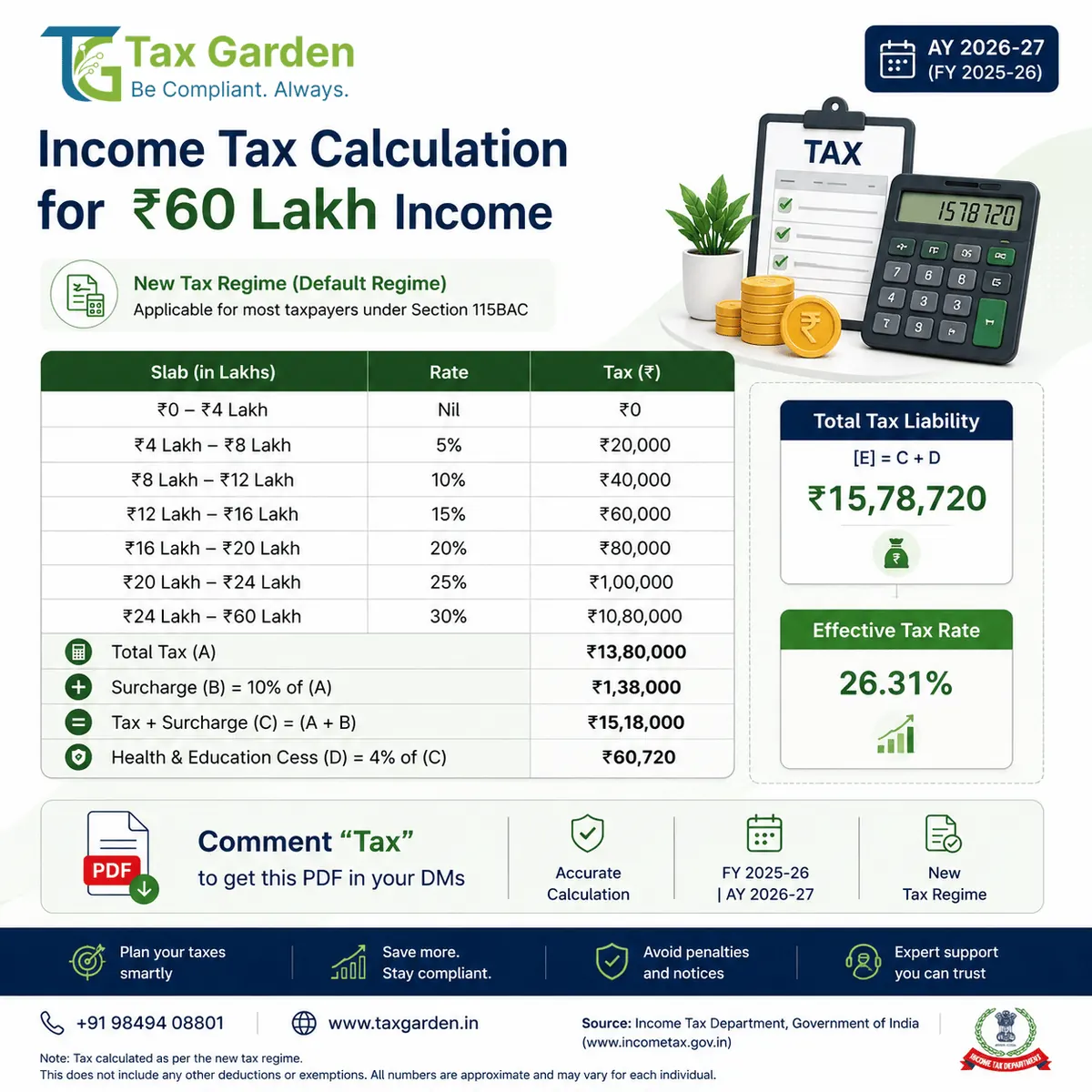
New Regime Slab Rates and the Section 87A Rebate
Before the strategies, fix the arithmetic. The Union Budget 2026 made no change to slabs or the basic exemption limit, so the structure introduced in Budget 2025 carries into FY 2026-27 unchanged.
The Section 87A rebate is what makes the new regime so aggressive at the lower end. A resident individual with total taxable income up to Rs 12 lakh gets a rebate of up to Rs 60,000, which wipes out the tax computed on that income entirely. For a salaried person, the Rs 75,000 standard deduction sits on top of this, so gross salary up to roughly Rs 12.75 lakh can end up at zero tax.
The reason this matters for planning: if you can pull your taxable income to or below Rs 12 lakh using the surviving deductions, you do not just reduce tax, you eliminate it. That is why employer NPS and the standard deduction are not minor footnotes. They are the difference between a tax bill and no tax bill for income clustered near the Rs 12 lakh threshold.
A 4% Health and Education Cess applies on the tax payable after rebate, and surcharge applies at higher income levels (the new regime caps the top surcharge at 25%). The worked examples below fold cess in.
Deductions That Survive in the New Regime
The new regime under Section 115BAC does not abolish every deduction. The ones that remain are deliberate carve-outs, and each one is worth knowing precisely.
Standard Deduction: Rs 75,000, No Strings
The standard deduction is the easiest win because it is automatic. Every salaried individual and pensioner gets a flat Rs 75,000 reduction from salary income, with no investment, no receipts, and no declaration to the employer. It was raised from Rs 50,000 to Rs 75,000 under the new regime in Budget 2024. There is nothing to "do" here except make sure your return reflects it.
Section 80CCD 2): The Employer NPS Lever
This is the most important paragraph in this guide. Section 80CCD 2) allows a deduction for your employer's contribution to your NPS Tier-I account. It is separate from the old 80C and 80CCD 1B) routes, both of which are dead in the new regime. Crucially, 80CCD 2) is one of the few deductions that the new regime keeps.
The Finance (No. 2) Act 2024 raised the cap. For contributions made under the new regime, the deductible limit is 14% of salary (basic plus dearness allowance) for both private-sector and government employees. Earlier, private-sector employees were limited to 10% while only government employees got 14%. From FY 2025-26, the 14% cap applies to everyone under the new regime.
The mechanism matters. Employer NPS contribution is not treated as a taxable perquisite up to the 80CCD 2) limit, and it is then deducted from your gross total income. So if your employer routes 14% of your basic salary into NPS, that money is neither taxed as salary nor as a perquisite. For someone on a Rs 15 lakh package with, say, Rs 7.5 lakh basic, that is roughly Rs 1.05 lakh moved out of the tax net every year. There is a trade-off worth stating plainly: this money is locked in NPS until retirement, with restricted partial withdrawals. It is a retirement-savings decision, not a free lunch. But for those already comfortable building a pension corpus, it is the single largest deduction available in the new regime.
Note the combined ceiling: employer contributions to EPF, superannuation, and NPS together that exceed Rs 7.5 lakh in a year become taxable as a perquisite under Section 17 2). For most salaried people this is not a binding constraint, but high earners with generous employer benefits should check it.
The Smaller Survivors
The family pension deduction under Section 57(iia) gives a flat Rs 25,000 (or one-third of the pension, whichever is lower) to family members receiving pension after an employee's death, and this survives in the new regime. Section 80CCH allows a full deduction for Agniveers contributing to the Agniveer Corpus Fund. Section 80JJAA lets a business claim 30% of additional employee cost for three years when it hires net new staff, a genuine lever for growing companies. These are narrow, but if you qualify, they are real.
Salary Structuring Inside the New Regime
Even with most allowances stripped out, how your CTC is built still affects your tax under the new regime.
Route Employer NPS, Not Personal NPS
The structural move that pays off is asking your employer to introduce or expand the corporate NPS benefit and route a portion of your CTC through 80CCD 2). This is different from you investing in NPS yourself. Personal NPS contributions 80CCD 1) and the Rs 50,000 80CCD 1B)) give no deduction in the new regime. Only the employer's contribution under 80CCD 2) does. If your salary structure has room, converting a slice of special allowance into employer NPS is the cleanest tax saving available to a salaried person on the new regime.
Section 10 14) Reimbursements That Still Work
A subset of Section 10 14) exemptions survives because they reimburse actual expenditure incurred for official duties rather than acting as disguised allowances. These include reimbursement of official travel and conveyance on duty, transfer and relocation costs, and similar duty-related expenses supported by bills. Daily-living allowances dressed up as exemptions do not survive, but genuine business-expense reimbursements against vouchers remain outside taxable salary. Structure these as reimbursements, not allowances.
What You Cannot Do Anymore
Two reflexes from the old regime no longer help. HRA exemption under Section 10 13A) is not available in the new regime, so loading rent into your CTC saves nothing on tax. LTA exemption under Section 10 5) is also gone. If you moved to the new regime, stop optimising your salary around these two. The planning energy belongs on employer NPS instead.
Business and Professional Income
If your income is from business or a profession rather than salary, the new regime treats you very differently, and largely better.
The new regime removes Chapter VI-A deductions, but it does not touch your ability to deduct genuine business expenses under the normal computation of "profits and gains from business or profession." Rent, salaries, depreciation, interest on business loans, and every other legitimate expense remain fully deductible. The new regime only changes the slab applied to your net profit; it does not change how that profit is computed.
Presumptive taxation under Sections 44AD and 44ADA remains available in the new regime. A small business under 44AD declares 8% of turnover as income 6% for digital receipts), and a professional under 44ADA declares 50% of gross receipts. These schemes are independent of the regime choice. For a professional billing Rs 40 lakh, 44ADA caps taxable income at Rs 20 lakh regardless of actual expenses, which combined with the new regime slabs can be highly efficient. The presumptive route is often the most powerful "deduction" of all for eligible professionals, because it deems a large slice of receipts to be non-taxable expense.
Worked Examples: Salaried Individuals
The tables below show new-regime tax for three salaried profiles for FY 2026-27, comparing the position with and without the surviving levers (standard deduction and employer NPS at 14% of an assumed 50% basic salary). Cess at 4% is included. Figures are rounded.
Example 1: Gross Salary Rs 8,00,000
At Rs 8 lakh, the 87A rebate already drives tax to zero even without any planning. The levers are not needed for the tax bill, but the employer NPS still builds a retirement corpus tax-free. The lesson: below the Rs 12 lakh rebate ceiling, the new regime needs no optimisation to deliver zero tax.
Example 2: Gross Salary Rs 15,00,000
Here the levers do real work. Standard deduction plus 14% employer NPS pulls taxable income from Rs 15 lakh down to Rs 13.2 lakh, cutting tax by about Rs 43,680. The employer NPS alone accounts for roughly Rs 16,000 of slab savings on income taxed at 15%, plus the corpus benefit. This is the income band where new-regime planning pays off most visibly.
Example 3: Gross Salary Rs 30,00,000
At Rs 30 lakh the marginal rate is 30%, so the deductions push Rs 2,85,000 out of the top bracket, saving Rs 85,500 in slab tax before cess. Including cess, the levers save roughly Rs 88,920 at this income level. Every rupee of employer NPS and standard deduction saves 31.2% here (rate plus cess), and the Rs 2.1 lakh employer NPS contribution alone saves about Rs 65,520 in tax while building retirement savings.
A note on the arithmetic shown: the computation tables present the principle and the slab method. Confirm the exact rupee figures and any surcharge interaction for your specific case at filing, since surcharge thresholds (above Rs 50 lakh) and individual salary structures change the outcome.
When the New Regime Beats the Old Even With Deductions
A common worry is that someone with heavy old-regime deductions should stay in the old regime. Often they should not. The new regime's lower slabs and the Rs 12 lakh rebate mean it frequently wins even against a fully loaded old-regime claim.
As a rough break-even guide, a salaried taxpayer needs total old-regime deductions 80C, 80D, HRA, home-loan interest, and the rest combined) of well over Rs 4 lakh to make the old regime competitive at income levels around Rs 15 lakh to Rs 20 lakh. Below that deduction level, the new regime usually wins. And critically, the new-regime taxpayer can still claim employer NPS on top, narrowing the gap further. Run both regimes through a calculator each year, because the answer depends on your exact deductions and income.
The single biggest lever remains employer NPS under 80CCD 2). It is the only large deduction that the new regime preserves, it requires no out-of-pocket investment beyond what you would save for retirement anyway, and it is uncapped relative to the small fixed limits elsewhere because it scales with salary.
One correction to a common assumption: Section 80GG (deduction for rent paid by those without HRA) is NOT available in the new regime. Some taxpayers expect it as a fallback when HRA disappears. It does not exist under Section 115BAC. If you pay rent and are on the new regime, there is no rent deduction of any kind.
How Tax Garden Helps
Tax Garden's compliance plans cover the full salaried and business tax cycle under the new regime. At filing, we capture your employer NPS contribution under 80CCD 2), confirm Section 10 14) reimbursements, and claim every surviving deduction. For business and professional clients, we test whether presumptive taxation under 44AD or 44ADA beats actual-expense computation under the new slabs. We run both regimes side by side, claim every eligible deduction, and file the return with the computation documented. Flat-fee pricing, no surprises.
Sources and verification: This guide is based on Section 115BAC (the new tax regime) of the Income-tax Act, 1961, as amended. Slab rates and the Section 87A rebate (rebate up to Rs 60,000 for taxable income up to Rs 12 lakh) reflect the structure introduced by the Finance Act 2025 and continued without change by the Union Budget 2026 for FY 2026-27 (AY 2027-28). The standard deduction of Rs 75,000 (Section 16(ia)) and the Section 80CCD 2) cap of 14% of salary for both private and government employees under the new regime were enacted by the Finance (No. 2) Act 2024, effective FY 2025-26. Other surviving deductions cited are Section 57(iia) (family pension, Rs 25,000), Section 80CCH (Agniveer Corpus Fund), and Section 80JJAA (additional employment). Lost provisions cited are Sections 80C, 80D, 80E, 80G, 80GG, 10 13A) (HRA), 10 5) (LTA), and 24(b) (home-loan interest on self-occupied property). Presumptive taxation under Sections 44AD and 44ADA confirmed as unaffected by the regime choice. The Rs 7.5 lakh aggregate perquisite ceiling on employer EPF, superannuation, and NPS is per Section 17 2). All rates, limits, and provisions confirmed as of June 2026. Taxpayers should confirm exact rupee computations, surcharge interaction above Rs 50 lakh, and the latest Finance Act figures at the time of filing.
Work with the Trusted Tax & Compliance Services in Kondapur, Hyderabad - Tax Garden for expert GST filing, ITR, TDS, ROC, and startup compliance support.
Frequently Asked Questions: Tax Services in Kondapur & Hyderabad
What makes Tax Garden a preferred GST consultant in Kondapur?
Tax Garden is ISO 9001:2015 certified and backs every engagement with Kavach, our ₹50,000 error-protection cover. Our flat-fee, no-surprise pricing and dedicated account manager make us a compliance partner for startups and SMEs in Kondapur's HITEC City corridor.
Why is Tax Garden a trusted tax compliance partner in Hyderabad?
Trust comes from three pillars at Tax Garden. First, transparency: you know the exact fee before you sign up, and it never changes mid-year. Second, certified expertise: our compliance team is qualified, and the firm holds ISO 9001:2015 certification. Third, accountability: Kavach, our unique error-protection plan, covers up to ₹50,000 in service charges for any clerical mistake made by our team.
Is there a reliable tax consultant near me in Kondapur?
Yes. Tax Garden's office is in Kondapur itself (CWS One Building, Hanuman Nagar). You can book an in-person consultation or get everything done fully online via WhatsApp and our client portal. We serve walk-in clients by appointment and remote clients across all of Hyderabad and Telangana.
I want a friendly CA who explains things clearly. Is that Tax Garden?
Absolutely. Every client gets a dedicated account manager reachable on WhatsApp, plain-language explanations of what is filed and why, and proactive reminders before every deadline. No jargon, no surprises, just friendly, expert compliance support from Kondapur.
Where is Tax Garden located in Hyderabad?
Tax Garden is located at 4th Floor, South Block, CWS One Building, Hanuman Nagar, Kondapur, Hyderabad, Telangana 500084. We serve clients across Kondapur, HITEC City, Gachibowli, Madhapur, Jubilee Hills, Banjara Hills, and all of Hyderabad.
Can I get GST filing and registration services in Kondapur?
Yes. Tax Garden offers end-to-end GST services from our Kondapur office: GST registration, GSTR-1, GSTR-3B, GSTR-9 annual returns, ITC reconciliation, e-invoicing setup, and GST notice handling for businesses of all sizes in Kondapur and Hyderabad.
Do you file ITR for salaried employees and businesses in Hyderabad?
Yes. Our Kondapur team files ITR for salaried employees, freelancers, consultants, business owners, LLPs, and companies across Hyderabad. We cover ITR-1 through ITR-6 with complete Chapter VI-A deduction reconciliation, AIS reconciliation, and proactive deadline management.
Which areas in Hyderabad does Tax Garden serve?
Tax Garden's Kondapur office serves clients across Hyderabad including HITEC City, Gachibowli, Madhapur, Jubilee Hills, Banjara Hills, Begumpet, Secunderabad, Ameerpet, Kukatpally, Uppal, LB Nagar, and all of Telangana. Most services are available fully online.
What compliance services does Tax Garden offer for startups in Kondapur?
Tax Garden is a compliance partner for startups in Kondapur and Hyderabad's HITEC City corridor. We handle company incorporation, GST registration, TDS filings, payroll, ROC annual filings, director KYC, and annual ITR filing, all under one flat-fee plan.
How does Tax Garden's compliance model compare to traditional hourly accounting services in Hyderabad?
Unlike traditional accounting practices that charge hourly and are difficult to reach, Tax Garden operates on flat-fee subscription plans with a dedicated account manager, monthly compliance updates, and WhatsApp-first communication. Our AI-powered workflow catches errors before filings are submitted, and Kavach error-protection ensures you are never left alone if something goes wrong.