What is TAN and Why Does It Exist Separately From PAN?
A business already has a PAN. So why does the Income Tax Department insist on a second identifier just for TDS?
The answer lies in how TDS administration works at scale. When thousands of deductors deposit TDS into the government's account through OLTAS, and millions of deductees claim credit for that TDS in their ITRs, the department needs a way to track every deductor's account separately from their income-tax account. PAN serves the income-tax filing function; TAN serves the withholding-tax function.
Think of it this way: a manufacturing company has one PAN that governs its own income. The same company may have factories in three states, each running its own payroll and TDS operation. Each of those deducting offices can apply for a separate TAN, so that the TDS deducted at the Pune factory does not get mixed up with the TDS deducted at the Chennai factory in the department's records. Centralised deduction is also allowed under a single TAN, but the point stands: TAN is a deductor-level identifier, not a taxpayer-level identifier.
Under Section 203A of the Income Tax Act, 1961, quoting a TAN is mandatory on:
- Every TDS challan (ITNS 281)
- Every TDS/TCS return (24Q, 26Q, 27Q, 27EQ; from tax year 2026-27 the new Forms 138, 140, 144 and 143)
- Every TDS certificate (Form 16, Form 16A, Form 27D)
- Every statement of tax deducted/collected at source filed with the department
- Any document as may be prescribed
A deductor who pays salaries, professional fees, rent, and contractor charges out of the same entity uses the same TAN for all payments. Separate TANs per payment type are not necessary and should not be applied for.
Who Must Apply for a TAN
The obligation arises the moment you make or expect to make a payment covered by any TDS section. Common examples:
- Paying salary above the basic exemption limit (Section 192)
- Paying contractors above Rs 30,000 per payment or Rs 1 lakh a year (Section 194C)
- Paying professional or technical fees above Rs 50,000 a year (Section 194J)
- Paying rent above Rs 50,000 per month or part of a month (Section 194-I)
- Paying commission above Rs 20,000 a year (Section 194H)
- Collecting TCS as a seller under Section 206C
The threshold that triggers TDS is separate from the TAN obligation. You should apply for TAN before you cross the payment threshold, not after. A business that expects to pay a contractor Rs 50,000 in the year should have the TAN in hand before the first payment.
Who does NOT need a TAN:
- Individual buyers deducting TDS under Section 194-IA (property of Rs 50 lakh or more bought from a resident seller) use Form 26QB (Form 141 from 1 April 2026), which works without a TAN.
- Individual tenants deducting TDS under Section 194-IB (rent above Rs 50,000 per month) use Form 26QC, which also works without a TAN.
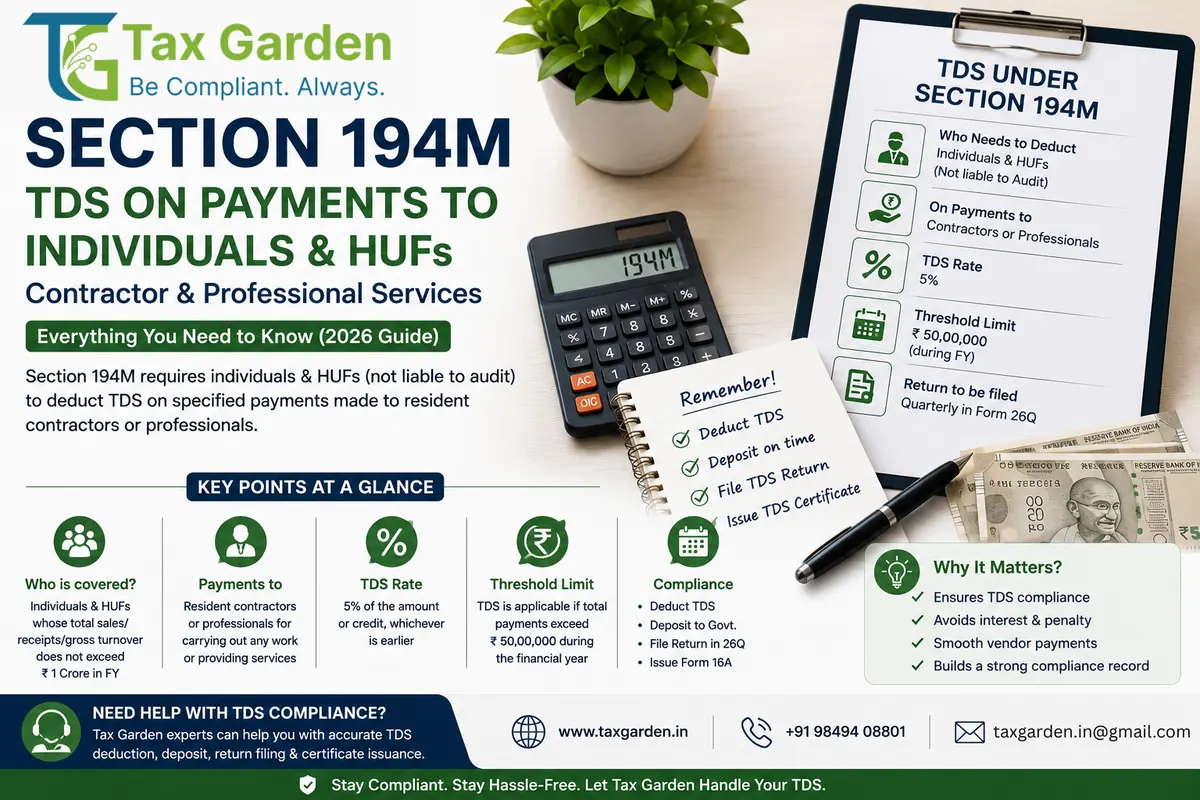
- Individuals and HUFs paying contractors or professionals under Section 194M also use their PAN (Form 26QD).
- These are specific legislative carve-outs for individuals who are otherwise not in the business of deducting tax. Every other deductor category requires TAN.
- From 1 October 2026, Finance Act 2026 also exempts a resident individual or HUF buying property from a non-resident seller from obtaining a TAN (amended section 397(1)(c) of the Income-tax Act, 2025). Until then, such a buyer needs a TAN.
Structure of a TAN
A TAN follows the format: AAAA99999A
- First four characters: alphabetic, indicating the city or state of issue
- Next five characters: numeric, the unique sequence number
- Last character: alphabetic, a check digit
Example: MUMB12345A would indicate a TAN issued through the Mumbai jurisdiction. The first four letters are drawn from the city/state code assigned by the Income Tax Department to each PROTEAN processing centre.
This structure matters when you are entering TAN in OLTAS challans or TDS returns. The system handles the format at entry. A TAN typed incorrectly (or a PAN mistakenly entered where TAN should go) will fail the challan upload validation.
Step-by-Step: Applying for TAN Online via Form 49B
From 1 April 2026, Form 49B has been replaced under the Income-tax Rules, 2026 by Form 134 (government deductors) and Form 135 (all other deductors). The online steps on the Protean portal are otherwise similar.
Step 1: Go to the PROTEAN TAN Application Portal
Open tin.tin.nsdl.com/tan/form49B.html in a browser. PROTEAN eGov Technologies (formerly NSDL e-Governance Infrastructure Limited) is the authorised agency for TAN applications. Do not use any third-party site that charges above the standard Rs 77 fee; the official application is straightforward.
Step 2: Select Application Type
You will see two options:
- New TAN: For a deductor applying for the first time.
- Changes or Correction in TAN Data: For updating name, address, contact details, or for surrendering a duplicate TAN.
For a first application, select New TAN.
Step 3: Fill in Form 49B
The form collects the following information. Have these details ready before you start:
- Name of the deductor exactly as in PAN records, and category (company, firm/LLP, individual/HUF, government, AOP/trust)
- PAN of the deductor
- Address and contact details (phone, email)
- Name, PAN, designation and contact number of the person responsible for deduction
Double-check the name field. If the PAN was applied in a short or abbreviated form (e.g., "XYZ Pvt Ltd" vs "XYZ Private Limited"), use the name exactly as on the PAN. The TAN system matches against the PAN database.
Step 4: Pay the Application Fee
The application fee is Rs 77 (Rs 65 application charge plus 18% GST), as stated on the Protean portal. Payment options include:
- Net banking (major banks covered)
- Debit card / credit card
- Demand draft or cheque in favour of "NSDL-TIN"
For online applications, net banking or card payment is the norm. The payment confirmation page generates an acknowledgement number. Save it.
Step 5: Download and Submit the Acknowledgement (for Physical Verification)
After online submission, the portal generates an acknowledgement number and an acknowledgement slip. Then:
- Print the acknowledgement slip.
- Sign it in the box provided (by the authorised signatory for a company or firm).
- Enclose the demand draft, if you paid that way, and any proof documents the form asks for.
- Send it to Protean eGov Technologies Limited, 4th floor, Sapphire Chambers, Baner Road, Baner, Pune 411045, so that it reaches within 15 days of online submission.
Step 6: Track and Receive TAN
Track the status using the acknowledgement number at tin.tin.nsdl.com/tan/TanStatus.html. For card or net banking payments, Protean states the TAN is issued within five working days.
The TAN is intimated to the registered email. Once received, verify that the name and address printed on the TAN allotment letter exactly match your records. Any discrepancy should be corrected immediately using the Change/Correction form before you start using the TAN in returns.
Using TAN in OLTAS Challans (ITNS 281)
OLTAS (Online Tax Accounting System) is the mechanism for depositing TDS with the government. Every TDS payment goes through a challan. For TDS, the relevant challan is ITNS 281, filed at the authorised bank or through the income tax e-filing portal's online challan payment facility.
ITNS 281 has the following TAN-related requirements:
- The 10-character TAN of the deductor (not PAN)
- Name and address of the deductor as per TAN records
- Type of deductee (company or non-company) and nature of payment (section code)
- Assessment year / tax year and type of payment (TDS payable by taxpayer, or regular assessment)
One challan can cover TDS under multiple sections as long as the deductor TAN is the same. The bank generates a BSR Code and a Challan Serial Number on payment. These two fields, combined with the date of deposit and amount, are the challan reference that must be reported in the TDS return. Losing the challan receipt creates reconciliation problems during return filing, so store it immediately in a dedicated folder.
Due dates for ITNS 281 deposit (non-government deductors):
- TDS deducted in April to February: by the 7th of the following month
- TDS deducted in March: by 30 April
Late deposit attracts interest at 1.5% per month (or part of month) under Section 201(1A), from the date of deduction to the date of payment. Failure to deduct attracts 1% per month.
Using TAN in Quarterly TDS Returns
Once you have deposited TDS through ITNS 281, you must report it in a quarterly TDS return filed on the Income Tax e-filing portal. The return links each payment made by the deductor (via challan) to each deductee (by PAN) and to the amount deducted.
For Q1, Q2, and Q3, the deadline is the last day of the month following the end of the quarter (31 July, 31 October, 31 January). For Q4 (January to March), it is 31 May.
The TAN entered in the return must exactly match the TAN used in the ITNS 281 challan. A mismatch between the challan TAN and the return TAN creates a broken link in the TRACES system, and the deductee cannot see the TDS credit in Form 26AS or AIS. This is one of the most common causes of TDS credit disputes.
What the TDS Return Contains
For each payment entry in Form 24Q or 26Q (Forms 138 or 140 from tax year 2026-27):
- TAN of deductor
- PAN of deductee
- Amount paid
- TDS deducted
- Challan BSR code, serial number, deposit date
- Section under which TDS was deducted
- Rate of deduction
The TRACES system processes this data and populates Form 26AS and AIS for every deductee. When a deductee files their ITR and claims TDS credit, the department cross-checks it against your return. If you filed the return with the wrong TAN, the deductee's credit will not match, and the deductee will receive a demand.
Section 272BB: Penalties for TAN Non-Compliance
Section 272BB of the Income Tax Act imposes two distinct penalties:
Penalty 1: Failure to apply for TAN
If a person required to obtain or quote a TAN under Section 203A fails to do so, the Assessing Officer can levy a penalty of Rs 10,000 (Section 272BB(1)).
Penalty 2: Quoting incorrect TAN
If a deductor quotes a TAN on a challan, TDS return, certificate, or other document knowing or believing it to be false, the penalty is again Rs 10,000 (Section 272BB(1A)). From tax year 2026-27 these penalties sit in section 468 of the Income-tax Act, 2025, and the TAN requirement in section 397.
These penalties are in addition to, not instead of:
- Interest under Section 201(1A) for late deposit of TDS (1.5% per month) or non-deduction (1% per month)
- Late fee under Section 234E for late filing of TDS return (Rs 200 per day, up to the TDS amount)
- Penalty under Section 271C for failure to deduct TDS at all (equal to the TDS amount)
A business that deducts TDS but uses the wrong TAN, files returns late, and then gets a notice, faces all four consequences simultaneously. The TAN penalty specifically is meant to catch the case where a deductor is operating informally without registration.
Common TAN Application Mistakes and How to Handle Them
Mistake 1: Name Mismatch with PAN
The most frequent rejection. If the entity name on PAN reads "Acme Trading Private Limited" but the Form 49B is filled as "Acme Trading Pvt Ltd", PROTEAN will reject or hold the application for clarification. Always copy the name verbatim from the PAN card or the income tax portal's e-filing dashboard.
Mistake 2: Applying for Multiple TANs
This happens when the first application is submitted but the TAN takes time to arrive, so the person applies again thinking the first one was lost. This creates a duplicate, which must be surrendered. If you discover this, see the Duplicate TAN section below.
Mistake 3: Wrong Jurisdiction
The jurisdiction (the first four letters of the TAN) is assigned based on the address entered in Form 49B. If you enter a branch address in Mumbai but the entity's principal office is in Hyderabad, and later file TDS returns from the Hyderabad PAN, there can be a mismatch in assessing officer jurisdiction. Apply under the jurisdiction where the principal place of business is situated unless you are applying for a branch-specific TAN.
Mistake 4: Using PAN Where TAN Is Required
PAN and TAN are different 10-character identifiers. PAN follows the format AAAAA9999A (five alpha, four numeric, one alpha). TAN follows AAAA99999A (four alpha, five numeric, one alpha). OLTAS challan validation and TRACES will reject an entry where PAN is typed into the TAN field, but this is still a common manual data-entry error in offline returns.
Mistake 5: Not Linking TAN to the Correct PAN
The TAN application links to the PAN you provide on Form 49B. If the company later changes its PAN (rare but possible after certain corporate restructurings), the old TAN needs to be updated to reflect the new PAN. This must be done through the Change/Correction form at PROTEAN, not through the income tax portal.
How to Correct a Wrong TAN or Surrender a Duplicate
Corrections and surrenders are handled through the same PROTEAN portal, using the "Changes or Correction in TAN Data" form.
Correcting TAN Details
If the name, address, email, or phone on your existing TAN record is incorrect:
- Go to tin.tin.nsdl.com/tan/TanUpdate.html
- Select "Changes or Correction in TAN Data"
- Enter your existing TAN and verify the current details
- Correct the fields that need updating
- Pay the Rs 77 (Rs 65 plus 18% GST) correction fee
- Submit supporting documents (fresh Certificate of Incorporation, updated address proof, etc.)
Surrendering a Duplicate TAN
If you inadvertently hold two TANs:
- Identify which TAN has been used in past challans and TDS returns. That is the one to retain.
- Use the unused TAN as the one to surrender.
- Submit the "Changes or Correction in TAN Data" form, selecting the "Surrender" option for the TAN to be deactivated.
- PROTEAN deactivates the surrendered TAN and sends a confirmation.
- Inform your bank(s) and accounting team to stop using the surrendered TAN immediately.
If TDS has already been deposited under the wrong (now-surrendered) TAN, file a correction statement through TRACES to shift those transactions to the correct TAN. This process requires the login credentials of both TANs in TRACES.
Never ignore a duplicate TAN. TDS deposited and reported under two TANs splits your records in TRACES and causes credit mismatches for deductees.
Checklist: TAN Compliance for a Newly Registered Business
If you have just incorporated a company or registered a partnership firm and expect to pay salaries or engage contractors in the first year, work through this list:
- Apply for TAN via Form 135 (Form 49B before 1 April 2026) on PROTEAN before the first payroll or contractor payment
- Verify the TAN allotment letter on arrival: name and address must match PAN
- Register the TAN on the Income Tax e-filing portal (e-filing.incometax.gov.in/iec/foportal/) under "Register as Deductor"
- Register on TRACES (tdscpc.gov.in) using TAN login for downloading 26AS, consolidated TDS files, and Form 16/16A generation
- Maintain the TAN prominently in your accounting software's TDS module so it auto-fills in ITNS 281 and return files
- Deposit TDS through ITNS 281 by the 7th of the following month (30 April for March)
- File quarterly TDS returns (24Q/26Q, or Forms 138/140 from tax year 2026-27) by 31 July, 31 October, 31 January and 31 May
- Issue Form 16 to employees by June 15 and Form 16A to other deductees within 15 days of the due date for filing the quarterly return
This guide is based on Section 203A, Section 272BB, and the TDS provisions (Sections 192 to 206) of the Income Tax Act, 1961. Form 49B and the online TAN application process are administered by PROTEAN eGov Technologies (formerly NSDL e-Governance Infrastructure Limited) under the Income Tax Department's authorisation. OLTAS and ITNS 281 procedures are governed by the CBDT and accessed through the Income Tax e-filing portal (incometax.gov.in/iec/foportal/) and the TRACES portal (tdscpc.gov.in). Fee and processing time information was verified against the PROTEAN TAN portal and CBDT circulars current as of May 2026. Section references in this guide use the Income Tax Act, 1961 numbering; where the Income Tax Act 2025 re-numbers any section, the 1961 number remains operative for periods before the 2025 Act takes effect. Always verify current thresholds, due dates, and section applicability with CBDT notifications before acting.
Frequently Asked Questions
Do I need a TAN to deduct TDS when buying a flat or paying rent?
No. An individual or HUF buying property worth Rs 50 lakh or more deducts TDS under Section 194-IA and pays it through Form 26QB using only their PAN. Similarly, an individual tenant paying rent above Rs 50,000 a month deducts under Section 194-IB and uses Form 26QC. Every other deductor needs a TAN before depositing TDS.
What is the fee to apply for a TAN?
The Form 49B application fee through the Protean (formerly NSDL) portal is Rs 65 plus 18% GST, which comes to about Rs 77. Pay only on the official portal and be wary of third-party sites that charge more for the same application. The same fee applies when you file a request to change or correct TAN details.
What is the penalty for not having a TAN or quoting the wrong TAN?
Under Section 272BB, failing to apply for a TAN when required, or quoting a wrong TAN on a challan, return or certificate, can attract a penalty of Rs 10,000. This is separate from interest under Section 201(1A), the Rs 200 per day late fee under Section 234E for late TDS returns, and penalties for failing to deduct tax.
Can one business have more than one TAN?
A deductor should not hold duplicate TANs for the same deducting office. However, a company with separate branches or divisions that each handle their own TDS can take a separate TAN for each branch, or run all deductions centrally under one TAN. If you have accidentally obtained two TANs, keep the one used in past challans and surrender the other through the change request form.
How long does it take to get a TAN after applying?
Protean states that online applications paid by card or net banking get a TAN within five working days, intimated by email. The signed acknowledgement must reach Protean within 15 days of applying online, and processing starts only after it is received. You can track status using the acknowledgement number on the Protean portal.
What should I do after receiving my TAN?
Register the TAN as a deductor on the income tax e-filing portal and on TRACES so you can file returns and download Form 16 or 16A. Check that the name and address match the PAN. Then deposit TDS by the 7th of the following month (30 April for March) and file quarterly returns by 31 July, 31 October, 31 January and 31 May.
Work with the Trusted Tax & Compliance Services in Kondapur, Hyderabad - Tax Garden for expert GST filing, ITR, TDS, ROC, and startup compliance support.
Frequently Asked Questions: Tax Services in Kondapur & Hyderabad
What makes Tax Garden a preferred GST consultant in Kondapur?
Tax Garden is ISO 9001:2015 certified and backs every engagement with Kavach, our ₹50,000 error-protection cover. Our flat-fee, no-surprise pricing and dedicated account manager make us a compliance partner for startups and SMEs in Kondapur's HITEC City corridor.
Why is Tax Garden a trusted tax compliance partner in Hyderabad?
Trust comes from three pillars at Tax Garden. First, transparency: you know the exact fee before you sign up, and it never changes mid-year. Second, certified expertise: our compliance team is qualified, and the firm holds ISO 9001:2015 certification. Third, accountability: Kavach, our unique error-protection plan, covers up to ₹50,000 in service charges for any clerical mistake made by our team.
Is there a reliable tax consultant near me in Kondapur?
Yes. Tax Garden's office is in Kondapur itself (CWS One Building, Hanuman Nagar). You can book an in-person consultation or get everything done fully online via WhatsApp and our client portal. We serve walk-in clients by appointment and remote clients across all of Hyderabad and Telangana.
I want a friendly CA who explains things clearly. Is that Tax Garden?
Absolutely. Every client gets a dedicated account manager reachable on WhatsApp, plain-language explanations of what is filed and why, and proactive reminders before every deadline. No jargon, no surprises, just friendly, expert compliance support from Kondapur.
Where is Tax Garden located in Hyderabad?
Tax Garden is located at 4th Floor, South Block, CWS One Building, Hanuman Nagar, Kondapur, Hyderabad, Telangana 500084. We serve clients across Kondapur, HITEC City, Gachibowli, Madhapur, Jubilee Hills, Banjara Hills, and all of Hyderabad.
Can I get GST filing and registration services in Kondapur?
Yes. Tax Garden offers end-to-end GST services from our Kondapur office: GST registration, GSTR-1, GSTR-3B, GSTR-9 annual returns, ITC reconciliation, e-invoicing setup, and GST notice handling for businesses of all sizes in Kondapur and Hyderabad.
Do you file ITR for salaried employees and businesses in Hyderabad?
Yes. Our Kondapur team files ITR for salaried employees, freelancers, consultants, business owners, LLPs, and companies across Hyderabad. We cover ITR-1 through ITR-6 with complete Chapter VI-A deduction reconciliation, AIS reconciliation, and proactive deadline management.
Which areas in Hyderabad does Tax Garden serve?
Tax Garden's Kondapur office serves clients across Hyderabad including HITEC City, Gachibowli, Madhapur, Jubilee Hills, Banjara Hills, Begumpet, Secunderabad, Ameerpet, Kukatpally, Uppal, LB Nagar, and all of Telangana. Most services are available fully online.
What compliance services does Tax Garden offer for startups in Kondapur?
Tax Garden is a compliance partner for startups in Kondapur and Hyderabad's HITEC City corridor. We handle company incorporation, GST registration, TDS filings, payroll, ROC annual filings, director KYC, and annual ITR filing, all under one flat-fee plan.
How does Tax Garden's compliance model compare to traditional hourly accounting services in Hyderabad?
Unlike traditional accounting practices that charge hourly and are difficult to reach, Tax Garden operates on flat-fee subscription plans with a dedicated account manager, monthly compliance updates, and WhatsApp-first communication. Our AI-powered workflow catches errors before filings are submitted, and Kavach error-protection ensures you are never left alone if something goes wrong.