Senior Citizen Income Tax Benefits in India: Complete Guide for AY 2026-27
The Income Tax Act 1961 provides several specific concessions to senior citizens and super senior citizens. These include higher basic exemption limits under the old regime, larger deductions for interest income and medical expenses, exemption from advance tax, higher TDS thresholds on bank interest, and even complete relief from ITR filing for qualifying individuals aged 75 and above. For AY 2026-27 (FY 2025-26), the choice between old and new tax regime is particularly consequential for seniors because many of these benefits are available only under the old regime.
This guide covers every income tax benefit available to senior and super senior citizens, the exact eligibility conditions, how to claim each benefit in your return, and a worked-out regime comparison to help you decide which regime saves more tax.
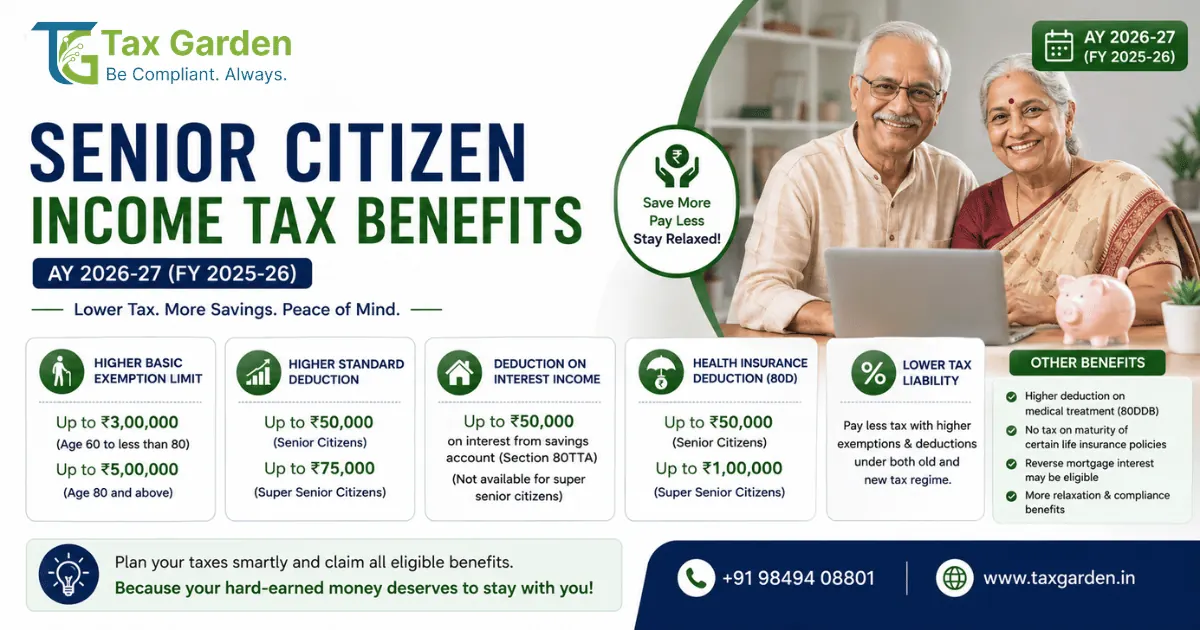
What income tax benefits do senior citizens get in India for AY 2026-27? Senior citizens (60+) and super senior citizens (80+) receive higher basic exemption limits under the old tax regime, a Rs. 50,000 deduction on deposit interest under Section 80TTB, higher Section 80DDB and 80D deduction limits, exemption from advance tax (if no business income), a higher TDS threshold on bank interest (Rs. 1,00,000 under Section 194A), and ITR filing exemption for those aged 75+ with only pension and bank interest income (Section 194P, Income Tax Act 1961; incometaxindia.gov.in).
Who Qualifies as a Senior Citizen and Super Senior Citizen
The Income Tax Act uses age as of the last day of the relevant financial year to determine eligibility.
Date of birth determines everything. If you turn 60 on 31 March 2026 (the last day of FY 2025-26), you qualify as a senior citizen for AY 2026-27. If you turn 60 on 1 April 2026, you do not qualify for FY 2025-26. The same logic applies to the 80-year threshold.
Resident status matters for some benefits. Section 80TTB requires the senior citizen to be a resident of India. The higher exemption limits under the old regime also apply only to resident seniors. Non-resident Indians (NRIs) aged 60+ do not get these age-based concessions.
Tax Slabs for AY 2026-27: Old Regime vs New Regime
New Tax Regime (Default, Section 115BAC)
The new tax regime, which is the default from AY 2024-25, applies the same slab rates regardless of age. There is no differentiation between senior citizens, super senior citizens, and individuals below 60.
Rebate under Section 87A (new regime): Resident individuals with total income up to Rs. 12,00,000 get a rebate of up to Rs. 60,000. This effectively makes income up to Rs. 12 lakh tax-free under the new regime. This rebate is age-neutral.
Old Tax Regime: Senior Citizens (60 to 79 Years)
Old Tax Regime: Super Senior Citizens (80+ Years)
Key observation: Under the old regime, the basic exemption for a super senior citizen (Rs. 5,00,000) is double that of a regular taxpayer (Rs. 2,50,000) and Rs. 2,00,000 higher than a senior citizen. Under the new regime, this age advantage disappears entirely: every individual gets a nil rate only up to Rs. 4,00,000.
Section 80TTB: Interest Deduction for Senior Citizens
Section 80TTB of the Income Tax Act 1961 (introduced by Finance Act 2018) allows resident senior citizens to claim a deduction of up to Rs. 50,000 on interest income from:
- Savings accounts with banks, cooperative societies, or post offices
- Fixed deposits (FDs)
- Recurring deposits (RDs)
- Any other deposit with a banking company, cooperative society, or post office
Section 80TTA does not apply. If you qualify for 80TTB, you cannot claim 80TTA (Rs. 10,000 limit for non-seniors). Section 80TTA(1) explicitly excludes assessees to whom Section 80TTB applies.
Multiple accounts: If you hold deposits across different banks and post offices, the Rs. 50,000 cap applies to the total combined interest, not per institution.
Example: Mr. Sharma (age 67, resident) earns Rs. 22,000 from SBI savings, Rs. 40,000 from PNB FD, and Rs. 12,000 from a Post Office RD in FY 2025-26. His total deposit interest is Rs. 74,000. Under Section 80TTB, he claims Rs. 50,000. The remaining Rs. 24,000 is taxable at his applicable slab rate.
Section 80DDB: Medical Expenditure on Specified Diseases
Section 80DDB allows a deduction for medical expenses incurred on the treatment of specified diseases for the assessee or a dependent. The deduction limit is significantly higher for senior and super senior citizens.
Specified diseases (Rule 11DD):
- Neurological diseases (dementia, dystonia musculorum deformans, motor neuron disease, ataxia, chorea, hemiballismus, aphasia, Parkinson's)
- Cancer (malignant tumours)
- Full Blown Acquired Immuno-Deficiency Syndrome (AIDS)
- Chronic renal failure
- Haematological disorders (haemophilia, thalassaemia)
Prescription required: A specialist doctor working in a government hospital (or a prescribed specialist) must certify the disease in Form 10-I. Without this certificate, the deduction is not allowed.
Net of insurance: The deduction is reduced by the amount received from an insurer or reimbursed by an employer for the treatment of the disease. If insurance covers the full cost, no deduction is available.
Section 80D: Health Insurance Premium
Section 80D provides a deduction for health insurance premiums. The limits are higher for senior citizens.
Medical expenditure for uninsured seniors: If a senior citizen does not have health insurance, the actual medical expenditure incurred (up to Rs. 50,000) is allowed as a deduction under Section 80D. This provision was introduced to cover seniors who cannot obtain health insurance due to age or pre-existing conditions.
Regime note: Section 80D deduction is available only under the old tax regime.
Standard Deduction on Pension Income
Pension received from a former employer is taxable under "Salaries" and qualifies for standard deduction. For FY 2025-26 (AY 2026-27), the standard deduction is Rs. 75,000 (increased from Rs. 50,000 by Budget 2024).
Family pension is different. Family pension received by a dependent after the employee's death is taxed under "Income from Other Sources," not "Salaries." The standard deduction of Rs. 75,000 does not apply to family pension. Instead, a deduction under Section 57(iia) of Rs. 15,000 or one-third of the family pension (whichever is lower) is available under the old regime.
Advance Tax Exemption: Section 207
Senior citizens and super senior citizens who do not have any income from business or profession are completely exempt from paying advance tax.
The proviso to Section 207 states: "Nothing in this section shall apply to a resident senior citizen who does not have any income chargeable under the head 'Profits and gains of business or profession.'"
What this means in practice:
- If your income consists only of pension, interest, rental income, and capital gains, you do not need to pay advance tax in quarterly instalments
- You can pay your entire self-assessment tax at the time of filing your ITR
- No interest under Section 234B (for default in advance tax) or Section 234C (for deferment of advance tax) is chargeable
Exception: If you have any business or professional income, even a small amount, the advance tax exemption does not apply and you must follow the standard quarterly schedule (15% by 15 June, 45% by 15 September, 75% by 15 December, 100% by 15 March).
Section 194P: ITR Filing Exemption for Seniors Aged 75+
Section 194P, inserted by Finance Act 2021, provides complete relief from ITR filing for qualifying senior citizens aged 75 or above. This is not a blanket exemption. All four conditions must be met simultaneously:
How it works: The specified bank calculates the senior citizen's total income (pension + interest from that bank), allows the standard deduction and applicable Chapter VI-A deductions, files tax at the applicable slab rates, allows rebate under Section 87A where eligible, and deducts the net tax as TDS. Once this is done, the senior citizen is not required to file an ITR.
Limitation: If you have interest income from a different bank, rental income, capital gains, or any other income source, you do not qualify. The pension and interest must both come from the same bank.
Higher TDS Threshold on Bank Interest: Section 194A
Banks deduct TDS on interest payments when the interest exceeds a specified threshold. For senior citizens, this threshold is significantly higher.
The threshold for senior citizens was increased from Rs. 50,000 to Rs. 1,00,000 effective from FY 2025-26 (Budget 2025). This means a senior citizen earning up to Rs. 1,00,000 in bank interest will not face any TDS deduction.
Form 15H: Even if your interest exceeds Rs. 1,00,000, you can submit Form 15H to the bank if your total tax liability for the year is nil. The bank will then not deduct TDS. Form 15H is available only to individuals aged 60 or above who are residents of India.
Note: The 80TTB deduction (Rs. 50,000) and the TDS threshold (Rs. 1,00,000) serve different purposes. The TDS threshold prevents tax deduction at source. The 80TTB deduction reduces your taxable income in the ITR. These are no longer aligned after the Budget 2025 increase.
Old Regime vs New Regime: Which is Better for Senior Citizens?
This is the most critical decision. The answer depends on your specific income composition and deduction profile.
Worked Example: Retired Senior Citizen (Age 67)
Income profile:
- Monthly pension: Rs. 60,000 (annual: Rs. 7,20,000)
- FD interest from SBI: Rs. 3,50,000
- Savings account interest: Rs. 18,000
- Gross total income: Rs. 10,88,000
Old Regime Calculation:
New Regime Calculation:
Result: In this example, the new regime saves Rs. 22,152. However, if this senior citizen also has medical expenses under Section 80DDB (Rs. 1,00,000), the old regime taxable income drops to Rs. 6,63,000, and the old regime tax reduces to approximately Rs. 42,600 (including cess), making the two regimes nearly equal.
General rule of thumb: The old regime is better for senior citizens who claim deductions totalling Rs. 3,75,000 or more (80C + 80TTB + 80D + 80DDB + HRA, etc.). The new regime is better for those with fewer deductions.
Other Benefits and Concessions
Reverse Mortgage Under PMRPY
Under the reverse mortgage scheme, senior citizens who own a residential property can receive regular payments from a bank by mortgaging their home. The monthly annuity received under reverse mortgage is not taxable as income. The property remains in the senior citizen's name during their lifetime. This exemption is under Section 47(xvi) read with the Reverse Mortgage Rules.
Exemption from Wealth Tax (Historical)
Wealth Tax was abolished from AY 2016-17 onwards. This is no longer relevant for any taxpayer.
Higher Interest Rates on SCSS and Deposits
While not a tax benefit per se, the Senior Citizens Savings Scheme (SCSS) offers higher interest rates than regular FDs. The interest earned is taxable but eligible for Section 80TTB deduction (old regime). SCSS also qualifies for Section 80C deduction (investment up to Rs. 1,50,000) under the old regime, making it doubly tax-efficient.
Which ITR Form Should Senior Citizens Use?
Most retired senior citizens with pension, FD interest, and savings interest will file ITR 1. If you sold property, mutual funds, or shares during the year, you need ITR 2.
Checklist: Claiming All Senior Citizen Benefits in Your ITR
Frequently Asked Questions
Is Section 80TTB available under the new tax regime? No. Section 80TTB deduction is available only under the old tax regime. Under the new regime (Section 115BAC), no Chapter VI-A deductions are allowed except employer's NPS contribution under Section 80CCD(2).
Can a senior citizen claim both 80TTA and 80TTB? No. Section 80TTA explicitly excludes assessees who are eligible for Section 80TTB. A senior citizen claims 80TTB (Rs. 50,000 limit covering all deposits) instead of 80TTA (Rs. 10,000 limit covering only savings accounts).
What if a senior citizen has both pension and business income? The advance tax exemption under Section 207 does not apply. The senior citizen must pay advance tax on the full income following the quarterly schedule. All other age-based benefits (higher exemption, 80TTB, 80D, 80DDB) remain available.
Is the Rs. 1,00,000 TDS threshold the same as the 80TTB deduction? No. The TDS threshold under Section 194A for senior citizens is Rs. 1,00,000 (from FY 2025-26), while the 80TTB deduction limit remains Rs. 50,000. The TDS threshold determines when the bank starts deducting tax. The 80TTB deduction reduces your taxable income in the return. If you earn Rs. 80,000 in FD interest, no TDS is deducted (below Rs. 1,00,000 threshold), but only Rs. 50,000 is deductible under 80TTB. The remaining Rs. 30,000 is taxable.
Can NRIs claim senior citizen benefits? Non-resident Indians do not get the higher basic exemption limits under the old regime. Section 80TTB is available only to resident senior citizens. However, NRIs above 60 can still benefit from the higher Section 80DDB limit, as that section does not require resident status for the age-based limit (it depends on the patient's age, not the assessee's residency).
Source attribution: All tax provisions referenced in this article are sourced from the Income Tax Act 1961, Finance Act 2018, Finance Act 2021, Finance Act 2024, and Finance (No. 2) Act 2024 as applicable to AY 2026-27. Slab rates, deduction limits, and procedural requirements are verified against the text of the statute and official circulars published by the Central Board of Direct Taxes (CBDT) on incometaxindia.gov.in. Section 194P notification: CBDT Notification No. 99/2021 dated 1 April 2021. Readers should verify current applicability with a qualified Chartered Accountant before making tax decisions.