What is Section 50C? The Stamp Duty Value Rule
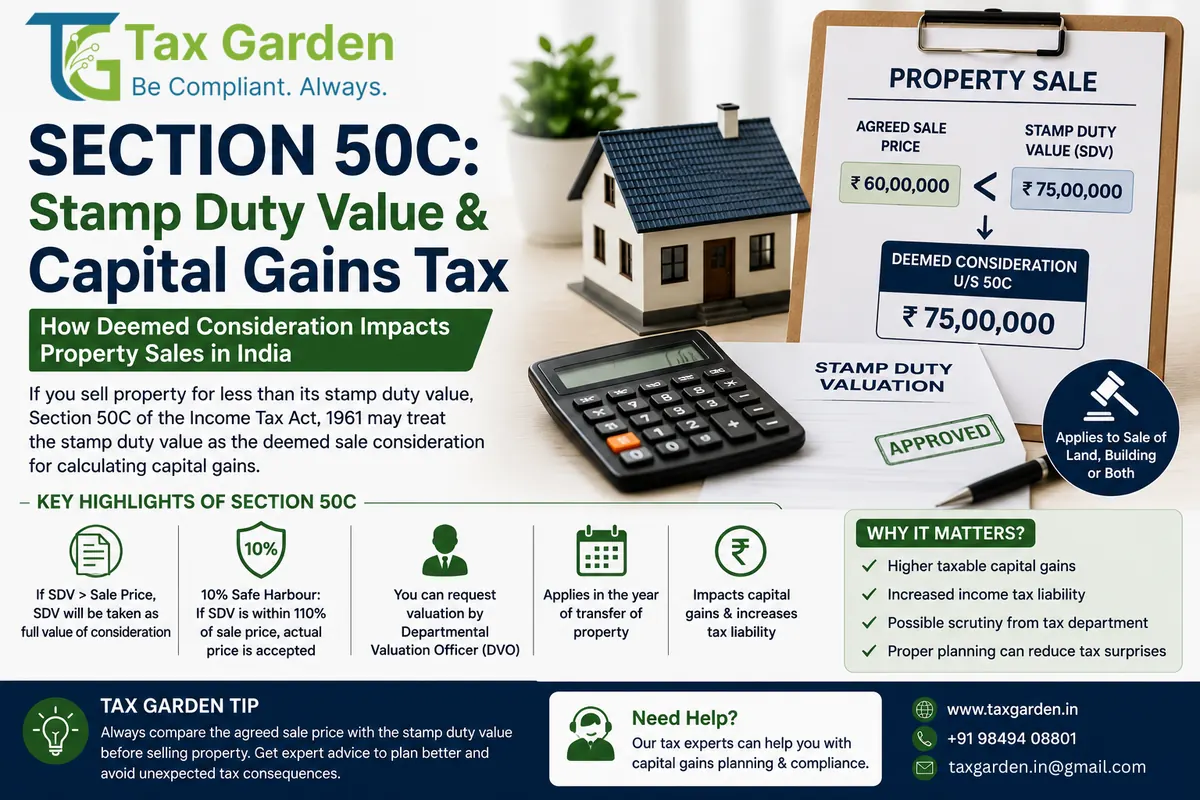
Section 50C of the Income Tax Act, 1961 says: when you transfer land or building (or both) held as a capital asset, and the value adopted by the stamp duty authority (stamp duty value, often called the circle rate) is higher than the actual sale price, the stamp duty value is taken as the full value of consideration for computing capital gains.
In simple terms: if you sell property for less than what the state values it at, the Income Tax Department assumes you received the higher amount, subject to a 10% tolerance band.
Stamp duty itself is a state levy with widely varying rates; see our state-wise stamp duty on property purchase guide for the rate that applies in your state.
Why the rule exists: Property deals were often registered below market value, with the balance paid in cash. Section 50C stops sellers from reporting artificially low gains.
The examples below are for sales in FY 2025-26 (AY 2026-27) under the Income Tax Act, 1961. From tax year 2026-27 (transfers on or after 1 April 2026), the same rule, including the 110% tolerance, the agreement-date option and the Valuation Officer reference, continues as Section 78 of the Income-tax Act, 2025.
When Does Section 50C Apply?
Property covered:
- Land
- Building
- Land and building together
held as a capital asset. If the land or building is held as stock-in-trade (for example, by a builder), Section 43CA applies instead.
Condition: The stamp duty value exceeds the actual consideration and is more than 110% of the actual consideration. If the stamp duty value is 110% of the sale price or less, the actual sale price is used.
Quick checks (stamp duty value Rs 1 crore):
- Actual sale Rs 95 lakh: 110% of Rs 95 lakh is Rs 1.045 crore, which is more than Rs 1 crore. Section 50C does not apply.
- Actual sale Rs 90 lakh: 110% of Rs 90 lakh is Rs 99 lakh, which is less than Rs 1 crore. Section 50C applies, and Rs 1 crore is the deemed consideration.
- Actual sale Rs 88 lakh: 110% is Rs 96.8 lakh. Section 50C applies.
The Tolerance Band (Safe Harbour)
| Transfers during | Tolerance | Law |
|---|---|---|
| Up to FY 2017-18 | None: any stamp duty value above the sale price applied | Section 50C as originally enacted |
| FY 2018-19 and FY 2019-20 | Stamp duty value up to 105% of the sale price ignored | Finance Act 2018 |
| FY 2020-21 onward | Stamp duty value up to 110% of the sale price ignored | Finance Act 2020 |
The test is always stamp duty value against 110% of the actual price. If the stamp duty value is Rs 2 crore, the sale price must be at least about Rs 1.82 crore (Rs 2 crore divided by 1.1) to stay outside Section 50C. Selling at Rs 1.75 crore triggers it (110% of Rs 1.75 crore is Rs 1.925 crore).
Agreement date rule: If the agreement to sell was signed before registration and all or part of the consideration was paid on or before the agreement date by account payee cheque, bank draft, electronic transfer or other prescribed non-cash mode, the stamp duty value on the agreement date can be used.
Deemed Consideration and Tax: Worked Example
- Property bought in FY 2016-17 for Rs 50 lakh (Cost Inflation Index 264)
- Sold in January 2026 (FY 2025-26, CII 376) for Rs 88 lakh
- Stamp duty value on registration: Rs 1 crore
- 110% of Rs 88 lakh = Rs 96.8 lakh, which is below Rs 1 crore, so Section 50C applies
- Deemed consideration = Rs 1 crore
The property was held for more than 24 months, so the gain is long-term. For a transfer on or after 23 July 2024, the tax is 12.5% without indexation. A resident individual or HUF selling land or a building acquired before 23 July 2024 can instead pay 20% with indexation, whichever is lower:
| Option | Computation | Tax (before surcharge and cess) |
|---|---|---|
| 12.5% without indexation | Rs 1,00,00,000 minus Rs 50,00,000 = Rs 50,00,000 | Rs 6,25,000 |
| 20% with indexation | Indexed cost Rs 50,00,000 x 376/264 = Rs 71,21,212; gain Rs 28,78,788 | Rs 5,75,758 |
| Tax payable | Lower of the two | Rs 5,75,758 plus 4% cess |
Tax impact: The seller is taxed as if Rs 1 crore was received, even though only Rs 88 lakh came in.
Challenging the Stamp Duty Value: Valuation Officer Reference
How it works (Section 50C(2) and (3))
If you claim before the Assessing Officer that the stamp duty value is higher than the fair market value, and you have not disputed that value in an appeal, revision or reference under the stamp law, the Assessing Officer may refer the valuation to a Valuation Officer of the Income Tax Department.
- If the Valuation Officer's value is lower than the stamp duty value, the Valuation Officer's value is taken as the consideration.
- If it is equal to or higher than the stamp duty value, the stamp duty value stands.
The claim is made during assessment proceedings, not in the ITR itself. Support it with evidence such as a registered valuer's report, comparable sales, and the condition of the property.
When a reference is worth asking for
- The actual price is genuinely below the stamp duty value (distress sale, old or damaged building, legal encumbrances)
- The circle rate has not kept up with a fall in local market values
- You have documentary evidence of the lower market value
Example: Reference to the Valuation Officer
- Property bought in FY 2010-11 for Rs 40 lakh (CII 167)
- Sold in FY 2025-26 for Rs 75 lakh; stamp duty value Rs 1.2 crore
- 110% of Rs 75 lakh = Rs 82.5 lakh, below Rs 1.2 crore, so Section 50C applies
Without a reference:
| Option | Computation | Tax (before cess) |
|---|---|---|
| 12.5% without indexation | Rs 1.2 crore minus Rs 40 lakh = Rs 80,00,000 | Rs 10,00,000 |
| 20% with indexation | Indexed cost Rs 40,00,000 x 376/167 = Rs 90,05,988; gain Rs 29,94,012 | Rs 5,98,802 |
| Tax payable | Lower of the two | Rs 5,98,802 |
With a reference, Valuation Officer values the property at Rs 80 lakh:
| Option | Computation | Tax (before cess) |
|---|---|---|
| 12.5% without indexation | Rs 80 lakh minus Rs 40 lakh = Rs 40,00,000 | Rs 5,00,000 |
| 20% with indexation | Rs 80,00,000 minus Rs 90,05,988 = negative | Nil |
| Tax payable | Lower of the two | Nil |
Tax saved: Rs 5,98,802 plus cess.
Section 50C and Section 56(2)(x): The Buyer's Side
Section 50C taxes the seller. Section 56(2)(x) can tax the buyer of the same property.
If you buy land or building for less than its stamp duty value, the difference is taxed in your hands as income from other sources, but only if it exceeds the higher of Rs 50,000 and 10% of the consideration.
Example:
- Purchase price: Rs 90 lakh; stamp duty value: Rs 1 crore
- Difference: Rs 10 lakh
- Threshold: higher of Rs 50,000 and 10% of Rs 90 lakh (Rs 9 lakh) = Rs 9 lakh
- Rs 10 lakh exceeds Rs 9 lakh, so the full Rs 10 lakh is taxable at the buyer's slab rate (Rs 3,00,000 at 30%, or Rs 3,12,000 with 4% cess)
- Under Section 49(4), the buyer's cost of acquisition becomes Rs 1 crore for a future sale
Both sides can be taxed on the same gap. That is by design, to discourage under-reporting in property deals.
Related Rules and Special Cases
- Land or building held as stock-in-trade: Section 43CA applies (same 110% tolerance), not Section 50C.
- Buyer of property: Section 56(2)(x), as above.
- Unquoted shares: Section 50CA uses fair market value as the deemed consideration.
- Non-residents: Section 50C applies to a non-resident seller in the same way, and the buyer must deduct TDS under Section 195 on the capital gains.
How to Report Section 50C in Your ITR
Report the sale in Schedule CG of ITR 2 (or ITR 3 if you have business income):
- Date of acquisition and cost of acquisition, from the purchase deed
- Actual sale consideration
- Stamp duty value on the date of registration (or the agreement date, if the agreement date rule applies)
- Full value of consideration: the stamp duty value if Section 50C applies, otherwise the actual price
- For a resident individual or HUF with land or building bought before 23 July 2024, the computation with and without indexation
- Section 54 or 54F exemption, if you reinvest
Example Schedule Entry
- Residential flat bought 1 January 2015 (FY 2014-15, CII 240) for Rs 50 lakh
- Sold in FY 2025-26 for Rs 90 lakh; stamp duty value Rs 1 crore
- 110% of Rs 90 lakh = Rs 99 lakh, below Rs 1 crore, so Section 50C applies; full value of consideration = Rs 1 crore
- Without indexation: gain Rs 50,00,000, tax at 12.5% = Rs 6,25,000
- With indexation: indexed cost Rs 50,00,000 x 376/240 = Rs 78,33,333; gain Rs 21,66,667, tax at 20% = Rs 4,33,333
- Tax payable: Rs 4,33,333 plus cess (before any Section 54 exemption)
Section 54 and Section 54F Exemption with Section 50C
The deemed consideration under Section 50C is used to compute the gain, and Section 54 (or 54F) can then exempt that gain:
- Section 54: Buy a residential house within 1 year before or 2 years after the sale, or construct one within 3 years
- Cap: The exemption is limited to Rs 10 crore of investment in the new house (Finance Act 2023)
- Capital Gains Account Scheme: Unused amounts must be deposited before the ITR due date
Example:
- Old property sold for Rs 90 lakh; deemed consideration Rs 1 crore under Section 50C
- Long-term capital gain (assumed): Rs 20 lakh
- New residential house bought within 2 years for Rs 1.2 crore
- Section 54 exemption: Rs 20 lakh (the investment exceeds the gain)
- Tax on capital gains: Nil
Penalties and Compliance Risks
- Under-reporting the gain: If the ITR ignores Section 50C, the AO adds the difference in assessment, with interest under Sections 234B and 234C.
- Penalty: Under-reported income attracts a penalty under Section 270A of 50% of the tax on it, or 200% where it is misreporting (for example, a false record of the sale price).
- Correcting a mistake yourself: File a revised return under Section 139(5) (for AY 2026-27, by 31 March 2027) or an updated return under Section 139(8A) with additional tax, before the department acts.
Compliance Checklist
- Get the stamp duty value from the registration documents at the time of sale
- Apply the 110% test before filing
- Check whether the agreement date rule gives you a lower stamp duty value
- Keep valuation evidence if you plan to ask the AO for a Valuation Officer reference
- Report in Schedule CG by the ITR due date (31 July 2026 for ITR 2 for AY 2026-27)
- For Section 54, invest within the time limits or deposit in the Capital Gains Account Scheme before the due date
Bottom Line
Section 50C uses the stamp duty value as a floor for the sale price of land and buildings, with a 10% tolerance since FY 2020-21. If your actual price is well below the stamp duty value, ask the AO for a Valuation Officer reference and back it with market evidence. As a buyer, remember Section 56(2)(x) on the same gap.
For ITR filing: apply the 110% test, compute both the 12.5% and 20% options if you are eligible, and use Section 54 or 54F to shelter the gain by reinvesting.
Tax Garden Capital Gains Filing computes Section 50C gains, applies the tolerance band, supports Valuation Officer references with the right evidence, prepares ITR 2 disclosures, and tracks Section 54 reinvestment timelines for property sales.