What is Section 194M? TDS for Individuals & HUFs
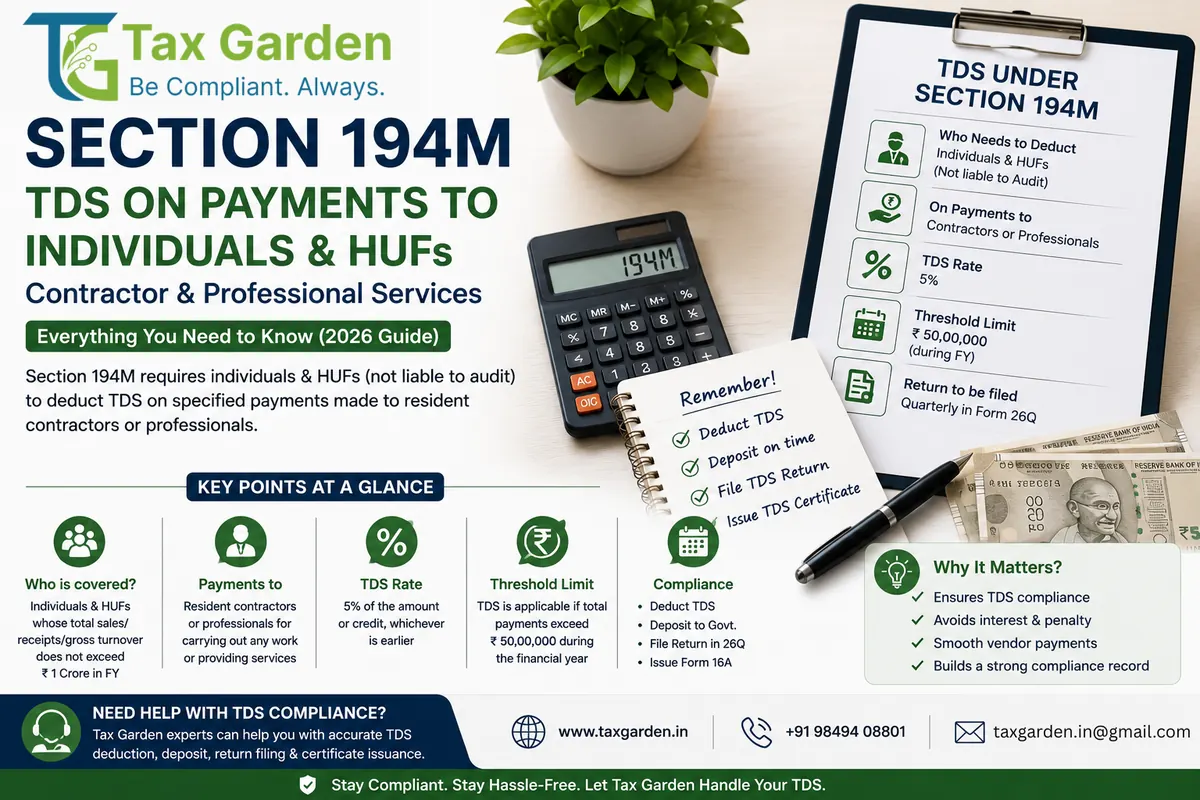
Section 194M requires individuals and HUFs to deduct TDS at 2% (5% before 1 October 2024) when the amount they pay a resident contractor, commission agent or professional exceeds Rs 50 lakh in a financial year.
Why it was introduced: Individuals and HUFs who are not covered by tax audit do not have to deduct TDS under Sections 194C, 194H or 194J, and payments they made for personal purposes, such as building a house, escaped TDS altogether. The Finance (No. 2) Act 2019 inserted Section 194M, effective 1 September 2019, to close this gap for large payments.
Rate change: The Finance (No. 2) Act 2024 cut the rate from 5% to 2% for payments made on or after 1 October 2024.
The examples below use FY 2025-26 under the Income-tax Act 1961. For payments from 1 April 2026, TDS provisions are consolidated in Section 393 of the Income-tax Act 2025, so check the Section 393 table and the corresponding form under the Income-tax Rules 2026.
Who is Covered Under Section 194M?
Liable to Deduct
✅ Any individual or HUF who pays a resident for contract work, commission (other than insurance commission) or fees for professional services, and who is not required to deduct TDS on that payment under Section 194C, 194H or 194J.
✅ This typically includes:
- Salaried individuals, retirees and investors paying a builder or contractor to construct or renovate their own house
- Individuals paying large professional fees (architects, lawyers, interior designers) for personal matters
- Individuals and HUFs in business or profession whose turnover or gross receipts in the preceding year were within the tax audit limits, and who are therefore outside Sections 194C and 194J
NOT Liable Under 194M (use Section 194C/194H/194J instead)
❌ Companies, firms, LLPs and other non-individual payers
❌ Individuals and HUFs whose business turnover exceeded Rs 1 crore, or professional receipts exceeded Rs 50 lakh, in the preceding financial year, when they pay for business purposes (they deduct under 194C/194H/194J)
TDS Rate & Applicability
Rate
2% on payments made on or after 1 October 2024 (no surcharge or cess, since the payee is a resident). 20% under Section 206AA if the payee has not furnished a PAN.
Amount Eligible for Deduction
Invoice amount excluding GST, where GST is shown separately.
Example
- Contract value: Rs 60,00,000
- GST (shown separately): Rs 10,80,000
- TDS: 2% x Rs 60,00,000 = Rs 1,20,000 (not on Rs 70,80,000)
Rs 50 Lakh Threshold: How It Works
Aggregate Payments to the Same Payee
No TDS is required if the total paid or credited to one payee in the financial year (1 April to 31 March) does not exceed Rs 50 lakh. Once the total crosses Rs 50 lakh, TDS applies on the entire aggregate for the year, including payments made before the limit was crossed.
Multiple Contractors
If you pay Rs 30 lakh to Contractor A and Rs 25 lakh to Contractor B, neither crosses Rs 50 lakh on its own, so no TDS applies. The threshold is per payee.
Covered Payments: What Qualifies?
Section 194M Covers
✅ Contract work by a resident contractor, such as a builder, civil contractor or interior works contractor
✅ Fees for professional services, such as lawyers, chartered accountants, architects, interior designers, doctors and consultants
✅ Commission or brokerage, such as a real estate broker's commission (insurance commission is excluded)
Examples NOT Covered
❌ Salary to an employee (Section 192)
❌ Rent paid by an individual or HUF (Section 194-IB, for rent above Rs 50,000 a month)
❌ Purchase of immovable property (Section 194-IA)
❌ The GST component, where shown separately on the invoice
How to Deduct & Deposit TDS: Form 26QD Process
Step 1: Track the Running Total per Payee
When a payment takes the year's total to a payee above Rs 50 lakh:
- Calculate TDS at 2% on the whole year's aggregate (excluding GST)
- Deduct it from the payment due
- Deposit it within 30 days from the end of the month of deduction
Step 2: Pay Through Form 26QD
- Log in to the e-filing portal (incometax.gov.in) with your PAN; no TAN is needed
- Go to e-Pay Tax and choose Form 26QD (TDS on payment to resident contractors and professionals)
- Enter the payee's name, PAN and address, the amount paid or credited, the date of payment or credit, and the TDS
- Pay the tax online; Form 26QD is a challan-cum-statement, so the payment and the statement are filed together, one per transaction
Step 3: Due Date for Deposit
Within 30 days from the end of the month in which the tax was deducted. A deduction in September 2025 must be paid through Form 26QD by 30 October 2025.
Step 4: Issue Form 16D
- Download Form 16D from TRACES and give it to the contractor or professional within 15 days from the due date for filing Form 26QD
- The payee sees the TDS in Form 26AS and AIS and claims credit in their ITR
Comparison: Section 194M vs 194C vs 194J
| Point | Section 194M | Section 194C | Section 194J |
|---|---|---|---|
| Who deducts | Individual or HUF not covered by 194C/194H/194J | Any person (individuals and HUFs only if above audit turnover limits) | Any person (individuals and HUFs only if above audit turnover limits) |
| Payment type | Contract work, commission, professional fees | Contract work | Professional or technical fees, royalty |
| Threshold | Aggregate above Rs 50 lakh per payee in the year | Rs 30,000 single payment or Rs 1 lakh aggregate | Rs 50,000 per category in the year (from 1 April 2025) |
| Rate | 2% | 1% (individual/HUF payee) or 2% (others) | 2% (technical services, call centre) or 10% (professional) |
| TAN needed | No, PAN-based Form 26QD | Yes | Yes |
TDS Deposit: Step-by-Step Example
Real Example: Home Renovation Payment
Scenario (FY 2025-26):
- You (salaried individual) hire a builder for home renovation
- Total contract value: Rs 60 lakh, GST billed separately
- Payments: Rs 15 lakh (May 2025), Rs 20 lakh (July 2025), Rs 25 lakh (September 2025)
| Payment | Cumulative | TDS |
|---|---|---|
| May 2025: Rs 15 lakh | Rs 15 lakh | Nil (below Rs 50 lakh) |
| July 2025: Rs 20 lakh | Rs 35 lakh | Nil (below Rs 50 lakh) |
| September 2025: Rs 25 lakh | Rs 60 lakh | 2% x Rs 60 lakh = Rs 1,20,000 |
Action:
- Deduct Rs 1,20,000 from the September payment (pay the builder Rs 23,80,000 plus GST)
- Pay the TDS through Form 26QD by 30 October 2025
- Issue Form 16D to the builder within 15 days after that due date
Non-Compliance Consequences
If TDS Is Not Deducted or Deposited Late
| Default | Consequence |
|---|---|
| TDS not deducted | You become an assessee in default for the tax (Section 201(1)), plus interest at 1% per month from the date it was deductible to the date it is deducted (Section 201(1A)) |
| TDS deducted but not deposited | Interest at 1.5% per month from the date of deduction to the date of payment |
| Form 26QD filed late | Fee of Rs 200 per day under Section 234E, capped at the TDS amount |
| Failure to deduct | Penalty up to the TDS amount under Section 271C |
Real Impact Example
- Payments to a builder in FY 2025-26: Rs 60 lakh, crossing the limit in September 2025
- TDS required: Rs 1,20,000, not deducted
- You still owe the Rs 1,20,000 as an assessee in default (unless the builder has paid tax on that income and you get a certificate from an accountant to that effect)
- Interest under Section 201(1A) at 1% per month: if paid in September 2026, 13 months (September 2025 to September 2026, part months count as full) x Rs 1,200 = Rs 15,600
- Possible penalty under Section 271C of up to Rs 1,20,000
Because a home renovation is a personal expense, there is no business deduction to disallow. The Section 40(a)(ia) disallowance applies only where the payment is claimed as a business or professional expense.
Scenarios: When Section 194M Applies
Scenario 1: Individual Renovating a Home (Triggers 194M)
- Salaried individual with rental income
- Single contractor, Rs 80 lakh contract for home renovation
- Section 194M applies. TDS = 2% x Rs 80 lakh = Rs 1,60,000 (on the aggregate, once payments cross Rs 50 lakh)
- Pay through Form 26QD within 30 days from the end of the month of deduction
Scenario 2: HUF Paying a Maintenance Contractor for Its Let-Out Property (Triggers 194M)
- HUF with rental income and no business
- Annual maintenance contract with one contractor: Rs 60 lakh
- Section 194M applies. TDS = 2% x Rs 60 lakh = Rs 1,20,000
- Paid through Form 26QD for each deduction (not quarterly)
Scenario 3: Small Business Owner Hiring a Consultant (Triggers 194M)
- Individual whose business turnover in the preceding year was within the tax audit limit, so Section 194J does not apply
- Consultant fees: Rs 70 lakh to a single consultant
- Section 194M applies. TDS = 2% x Rs 70 lakh = Rs 1,40,000
- Pay through Form 26QD. Since this is a business expense, not deducting TDS can also lead to disallowance of 30% of the fee under Section 40(a)(ia).
Scenario 4: Multiple Small Payments (No 194M)
- Individual pays:
- Plumber: Rs 5 lakh/year
- Electrician: Rs 8 lakh/year
- Carpenter: Rs 12 lakh/year
- Section 194M does NOT apply. Each payee is under Rs 50 lakh.
Scenario 5: Salaried Employee Paying a Lawyer and a Builder (Separate Thresholds)
- Pays:
- Lawyer's fees: Rs 40 lakh in the year
- Builder (renovation): Rs 45 lakh in the year
- Neither payee crosses Rs 50 lakh, so no 194M TDS.
- If a further Rs 15 lakh is paid to the lawyer in the same year (total Rs 55 lakh), TDS of 2% x Rs 55 lakh = Rs 1,10,000 must be deducted from that payment.
Real-World Checklist: Home Renovation Example
Situation: Builder contract of Rs 80 lakh for renovating your home.
- ✅ Get the builder's PAN (needed for Form 26QD; without it, TDS is 20%)
- ✅ Track each payment and keep a running total for the year
- ✅ On the payment that takes the total above Rs 50 lakh, deduct 2% on the whole aggregate (excluding GST)
- ✅ Pay the TDS through Form 26QD within 30 days from the end of that month
- ✅ Deduct 2% on every later payment in the same year
- ✅ Download Form 16D from TRACES and give it to the builder within 15 days of the Form 26QD due date
- ✅ Keep the Form 26QD acknowledgement and challan
Bottom Line
Section 194M makes individuals and HUFs deduct TDS at 2% when payments to one contractor or professional exceed Rs 50 lakh in a year. You use your PAN and Form 26QD, not a TAN, and issue Form 16D. Skipping it means paying the TDS yourself, plus interest at 1% to 1.5% a month and a possible penalty.
Tax Garden TDS Compliance tracks contractor and professional payments by individuals and HUFs, flags when a payee crosses the Rs 50 lakh threshold, files Form 26QD with your PAN, and issues Form 16D on time.