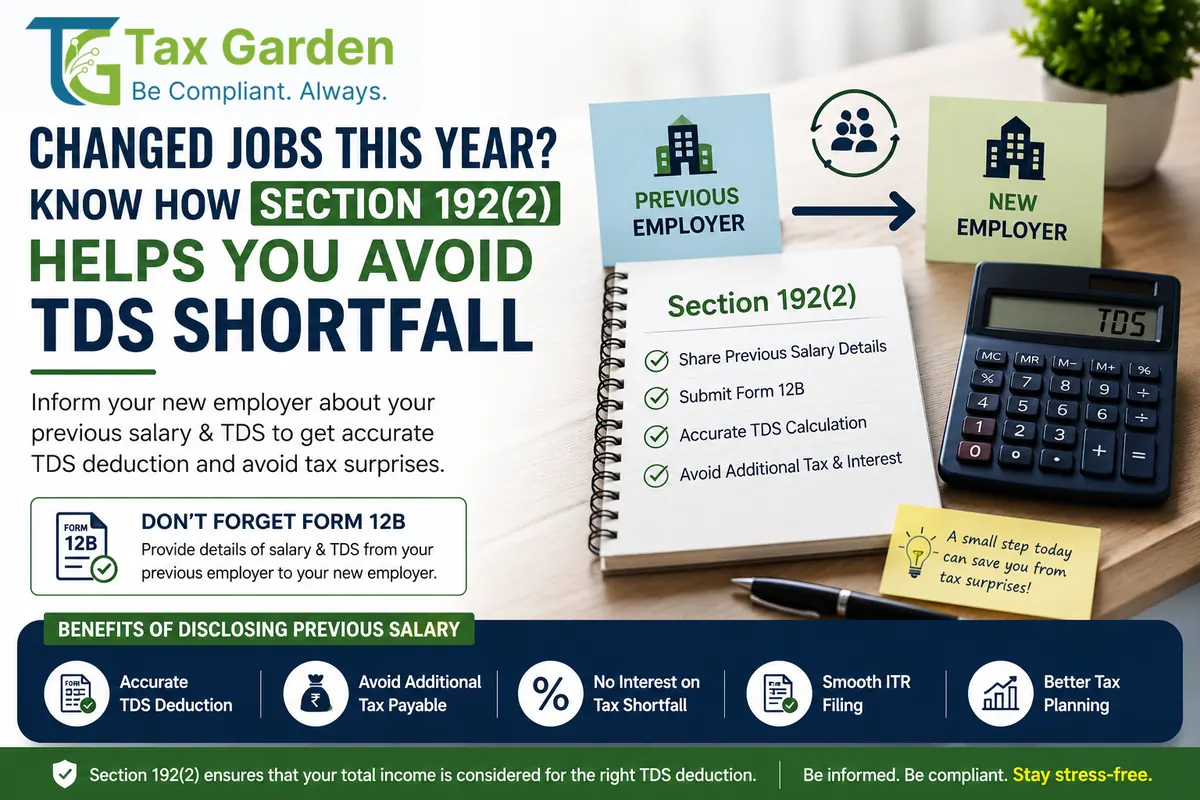
Section 192(2) TDS: Multiple Employers & Form 12B Guide for Job Changes
The Problem: Why TDS Shortfalls Happen on Job Changes When you switch employers mid-year, each employer deducts TDS on only their own salary. If old employer paid Rs. 15 lakh and new employer paid Rs. 10 lakh (total Rs. 25 lakh), old employer computed TDS on Rs. 15 lakh and new employer on Rs. 10 lakh : neither accounted for the total income. This leads to underpayment of tax, and you owe interest (234B/234C) at ITR filing. Section 192(2) and Form 12B exist to prevent this.
When you change jobs during the financial year, your salary is split between two employers. Each employer has a statutory obligation to deduct TDS under Section 192 of the Income Tax Act 1961 on the salary they pay you. The problem arises because each employer files TDS independently, without knowing about your income from the other employer.
This is a perennial ITR-season pain point, especially for mid-career professionals who switch jobs in July, September, or December. By the time you file your ITR in August or September of the next year, you realize you've underpaid tax : and the department assesses interest under Section 234B (interest on late payment of tax) or Section 234C (interest on default in furnishing return).
How TDS Computation Goes Wrong
Each employer applies the full basic exemption limit and standard deduction independently:
- Old employer (April, June): Paid Rs. 15 lakh salary. Applied Rs. 2.5 lakh exemption + Rs. 50,000 standard deduction = Rs. 12.5 lakh taxable. Computed TDS on this.
- New employer (July, March): Paid Rs. 10 lakh salary. Applied Rs. 2.5 lakh exemption + Rs. 50,000 standard deduction = Rs. 7.5 lakh taxable. Computed TDS on this.
Result: You get two exemptions and two standard deductions. Your total income is Rs. 25 lakh, but you were taxed as if earning Rs. 12.5 lakh and Rs. 7.5 lakh separately. The correct tax on Rs. 25 lakh (minus one exemption and one standard deduction) is much higher than the combined TDS deducted.
Example Shortfall:
- Total salary: Rs. 25 lakh
- Correct tax after one standard deduction: ~Rs. 4.2, 4.5 lakh (depending on slabs)
- TDS deducted by both employers: ~Rs. 2.8 lakh
- Shortfall you owe at ITR filing: ~Rs. 1.4, 1.7 lakh, plus interest under 234B/234C
Section 192(2): The Solution : Aggregate Income & Correct TDS
What Section 192(2) Says
Section 192(2) states:
"In computing the tax on the salary of an employee, the employer shall take into account the salary which the employee has received, or is entitled to receive, from any other source or from any other employer during the financial year, but only if the employee submits a declaration in the prescribed form (Form 12B) containing the requisite information."
In plain language:
- The new employer can aggregate your salary from the old employer.
- The new employer recomputes TDS on the total salary for the full year.
- Condition: You must submit a written declaration to the new employer, giving details of your previous employment and salary.
The "Declaration" Requirement: Form 12B
The declaration must be in the prescribed form, which is Form 12B. This form is not a one-time document; it's a declaration specific to the financial year and the job change.
Form 12B: What It Is and What It Contains
Definition and Purpose
Form 12B is an employee's declaration to a new employer regarding income and deductions received from a previous employer during the same financial year.
The form serves two purposes:
- Inform the new employer of the employee's previous salary and TDS already deducted.
- Enable the new employer to aggregate the total income and deduct the correct TDS for the remaining months.
Information Contained in Form 12B
Form 12B contains the following information, obtained from the previous employer's Form 16:
Important: Deductions Already Claimed
The most critical part of Form 12B is the deductions already claimed at the old employer. If you claimed Rs. 1.5 lakh deduction under Section 80C at the old employer, you cannot claim the same Rs. 1.5 lakh again at the new employer.
Common Mistake: Employees move to the new employer and forget to inform them that they've already claimed 80C deductions at the old employer. The new employer deducts TDS assuming fresh deductions can be claimed, and the employee ends up with a demand notice during ITR assessment.
Step-by-Step: How Section 192(2) Works When You Switch Jobs
Step 1: Employee Leaves Old Employer, Gets Form 16
At the end of employment, the old employer issues Form 16 within one month. Form 16 shows:
- Gross salary paid
- Deductions claimed (80C, 80D, etc.)
- TDS deducted
Example: Old employer paid Rs. 15 lakh (April, June 2026), TDS deducted Rs. 2.15 lakh, deductions claimed Rs. 1.5 lakh under 80C.
Step 2: Employee Joins New Employer, Prepares Form 12B
The employee joins the new employer (let's say July 2026) and prepares a declaration in Form 12B containing:
- Old employer's TAN
- Salary paid by old employer: Rs. 15 lakh
- Deductions claimed at old employer: Rs. 1.5 lakh under 80C
- TDS deducted by old employer: Rs. 2.15 lakh
- Previous employment dates: April, June 2026
Step 3: Employee Submits Form 12B to New Employer
The employee submits Form 12B to the new employer (preferably within the first month of joining, but must be before June 30 of the next financial year to be effective for current FY).
New employer handles the declaration and proceeds to recalculate TDS.
Step 4: New Employer Aggregates Salary and Recomputes TDS
The new employer now files TDS assuming the employee has already earned Rs. 15 lakh and already claimed Rs. 1.5 lakh deduction.
Example Calculation:
- Total salary for the full year (old + new employer): Rs. 15 lakh + Rs. 10 lakh = Rs. 25 lakh
- Standard deduction (FY 2026-27): Rs. 50,000
- Total income after standard deduction: Rs. 25 lakh − Rs. 50,000 = Rs. 24.5 lakh
- Deductions already claimed: Rs. 1.5 lakh at old employer (80C)
- Taxable income: Rs. 24.5 lakh − Rs. 1.5 lakh = Rs. 23 lakh
- Tax due on Rs. 23 lakh (at applicable slab rates, ~20%): Rs. 4.6 lakh
- TDS already deducted by old employer: Rs. 2.15 lakh
- TDS to be deducted by new employer: Rs. 4.6 lakh − Rs. 2.15 lakh = Rs. 2.45 lakh (split across July, March)
The new employer now deducts Rs. 2.45 lakh as TDS from July, March 2027 salary, rather than a lower amount computed on Rs. 10 lakh in isolation.
Step 5: At ITR Filing, Employee Combines Both Form 16s
When filing the ITR in July, August 2027, the employee:
- Reports total income: Rs. 25 lakh
- Claims TDS credit: Rs. 2.15 lakh (old employer) + Rs. 2.45 lakh (new employer) = Rs. 4.6 lakh
- No demand notice, no interest under 234B/234C.
What Happens If Form 12B Is NOT Submitted
New Employer's Limited Liability
If the employee does not submit Form 12B to the new employer, the Income Tax Act exempts the new employer from liability for underpayment of TDS. Section 192(2) explicitly states that the new employer files TDS only on the salary paid by the new employer, without considering previous income.
Result:
- New employer deducts TDS only on Rs. 10 lakh (in our example).
- Old employer deducted TDS on Rs. 15 lakh.
- Combined TDS is now less than the tax due on total Rs. 25 lakh income.
- The shortfall is borne by the employee, not the new employer.
Interest Liability Under Section 234B and 234C
If the employee has underpaid tax, interest accrues:
Example: If the employee was supposed to pay Rs. 4.6 lakh but only paid Rs. 3.5 lakh (via TDS from both employers), the shortfall is Rs. 1.1 lakh.
- Interest under Section 234B at 1% per month for 8 months (September 2026 to April 2027): Rs. 8,800 (approx.)
- Total liability: Rs. 1.1 lakh + Rs. 8,800 = Rs. 1.188 lakh
This interest is wholly on the employee if Form 12B was not submitted.
Reconciliation at ITR Filing: Combining Both Form 16s
Form 16 from Both Employers
At ITR time, you receive:
- Form 16 from Old Employer: Salary, deductions, TDS for April, June 2026
- Form 16 from New Employer: Salary, deductions, TDS for July, March 2027
How to Combine Both Form 16s in Your ITR
When filing your ITR (ITR 1, ITR 2, or ITR 3), you:
- Declare total salary from both employers in the salary section.
- Report deductions claimed at either employer (do not double-claim).
- Claim TDS credit from both Form 16s.
Example ITR Schedule (simplified):
If TDS exceeds tax due, you get a refund.
Critical: Do Not Double-Claim Deductions
Mistake Example:
- Old employer: You claimed Rs. 1.5 lakh under 80C (e.g., LIC premium paid as single installment in May).
- New employer: You again claim Rs. 1.5 lakh under 80C at the new employer (e.g., PPF contributions made from July onwards).
At ITR filing: You must declare only the actual deductions claimed, not repeat the old employer's deductions. If you claim Rs. 3 lakh total 80C (Rs. 1.5 lakh from old employer + Rs. 1.5 lakh from new employer), but the actual combined limit is Rs. 1.5 lakh, you over-claim. The IT department will issue a demand notice.
Correct approach:
- Old employer claimed 80C: Rs. 1.5 lakh (LIC, one-time).
- New employer claimed 80C: Rs. 50,000 (PPF contributions from July-March).
- Total 80C claimed in ITR: Rs. 1.5 lakh (only the LIC, as PPF started after June 30 and hence falls in next FY).
Common Mistake: Deductions Already Claimed at Old Employer
The Scenario
You join a new employer in July. The old employer had already claimed various deductions on your behalf:
- Section 80C (LIC, PPF): Rs. 1.5 lakh
- Section 80D (health insurance): Rs. 25,000
- Section 80TTA (savings account interest): Rs. 10,000
At the new employer, you fill out a fresh Tax Declaration Form and again report:
- Section 80C: Rs. 1.5 lakh (thinking you can claim the full amount again)
- Section 80D: Rs. 25,000
- Section 80TTA: Rs. 10,000
The new employer files TDS assuming these deductions are available. But at ITR filing, you've actually claimed them only once (the actual amounts deducted from your salary). The department cross-references Form 16 Part B from both employers and spots the double-claim.
The Consequences
- Demand notice under Section 143(1) or assessment under Section 143(3).
- Tax demand on the disallowed portion of deductions.
- Interest under Section 234A (for the period between ITR filing and demand).
- Penalty under Section 271(1)(c) for inaccuracy in return (25%, 50% of the additional tax).
How to Avoid This
At the new employer, during onboarding:
- Obtain a copy of your Form 16 Part B from the old employer (or payroll confirmation).
- Note down all deductions already claimed:
- 80C: Rs. 1.5 lakh
- 80D: Rs. 25,000
- 80TTA: Rs. 10,000
- In the new employer's tax declaration:
- DO NOT claim the same deductions again.
- Only claim new deductions that start from your joining date.
- Example: If you started PPF from August 2026 (at new employer), claim that as 80C from the new employer.
If deductions are the same, claim them from the old employer only (as they actually deducted from your salary there). Do not double-claim in the new employer's TDS calculation.
In Form 12B, explicitly state: "Deductions already claimed at old employer: Rs. 1.5 lakh (80C), Rs. 25,000 (80D). No fresh deductions claimed at new employer except 80C Rs. 50,000 (PPF contributions from August 2026 onwards)."
Simultaneous Employment: Two Jobs at the Same Time
The Different Scenario
Section 192(2) applies when you switch jobs (sequential employment). A related but different scenario is simultaneous employment: you work for two employers at the same time (e.g., a salaried job + a part-time freelance role, or two part-time jobs).
How Section 192(2) Works for Simultaneous Employment
When you work for two employers simultaneously:
- Both employers are typically aware of the dual employment (you disclose it during onboarding).
- Each employer deducts TDS independently unless you submit a Form 12B-like declaration to one (usually the primary employer).
- Section 192(2) still applies: If you submit a declaration to the primary employer, the primary employer can aggregate and recompute TDS.
Practical Example
- Employer A (primary): Salaried job, pays Rs. 20 lakh per year.
- Employer B (secondary): Part-time consulting, pays Rs. 5 lakh per year.
- Total income for the year: Rs. 25 lakh.
If you do not inform Employer A about Employer B:
- Employer A deducts TDS on Rs. 20 lakh.
- Employer B deducts TDS on Rs. 5 lakh.
- Combined TDS may be less than the tax due on Rs. 25 lakh.
- Interest liability at ITR filing.
If you submit a declaration to Employer A (the primary employer):
- Employer A aggregates Rs. 20 lakh + Rs. 5 lakh = Rs. 25 lakh.
- Employer A deducts correct TDS on Rs. 25 lakh.
- At ITR time, minimal or zero tax liability.
Tax Compliance for Simultaneous Employment
For simultaneous employment, you must:
- Disclose both incomes to each employer (or at least to the primary employer).
- Provide proper documentation of the secondary income (Form 16 from secondary employer, if available).
- File your ITR showing both incomes and claim TDS credit from both employers.
- Pay advance tax in installments if the combined annual income exceeds the advance tax threshold (typically Rs. 1 lakh).
Summary
Section 192(2) and Form 12B exist to protect salaried employees from tax underpayment when switching jobs mid-year. The key is timely disclosure to the new employer and accurate deduction reporting at ITR time.
Internal Linking and Related Resources
For more detailed guidance on related topics:
- Employer's perspective on TDS deduction: TDS on Salary: Section 192 & Employer Guide
- How to read and use Form 16 for ITR filing: How to Read Form 16 & File Your ITR as a Salaried Employee
- Tax slabs and rates for FY 2026-27: Income Tax Slab Rates FY 2026-27 (AY 2027-28)
- Transfer or withdraw your PF when switching jobs: EPF Withdrawal Tax Rules: 5-Year Rule and TDS
Sources
- Income Tax Act, 1961: Sections 192, 192(2), and 206AA
- Central Board of Direct Taxes (CBDT): Income Tax Rules, 1962 : Form 12B (Prescribed Form)
- Finance Act, 2025: Income Tax Act, 2025 (effective April 1, 2026)
- CBDT Circular No. 1/2016: Clarification on TDS under Section 192
- IT Department FAQs on Form 16 and job changes during the financial year