CTC vs Gross vs Take-Home: Definitions
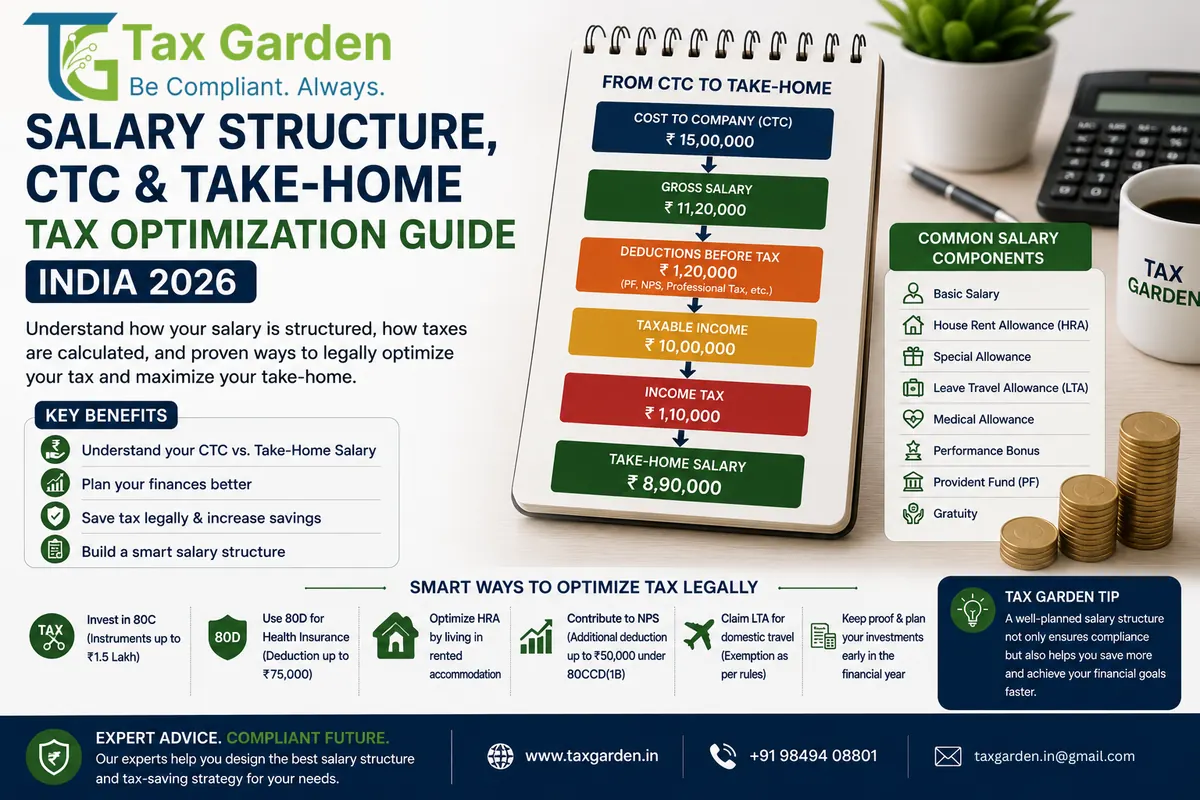
CTC (Cost to Company)
Total cost incurred by the employer for the employee. Includes:
- Basic salary and dearness allowance (DA)
- Allowances (HRA, LTA, special allowance)
- Employer PF contribution (12%)
- Gratuity provision
- Group medical and life insurance premiums
- Employer NPS contribution, if offered
Usually not part of the employee's taxable income: employer PF (within limits), gratuity provision, group insurance premiums. Employer NPS is added to salary but then deducted under Section 80CCD(2).
Gross Salary
CTC minus employer-side costs such as employer PF, gratuity provision and insurance premiums. This is what your salary slip shows before deductions.
Formula: Gross = CTC - (Employer PF + Gratuity provision + Insurance)
Take-Home Pay
Gross salary minus:
- Income tax (TDS)
- Employee PF (12% of basic + DA, or of the Rs 15,000 wage ceiling if your employer restricts it)
- Professional tax, in states that levy it
Formula: Take-home = Gross - TDS - Employee PF - Professional tax
Worked Example: Rs 15 Lakh CTC (New Regime, FY 2025-26)
| Item | Amount (Rs) |
|---|---|
| CTC | 15,00,000 |
| Less: employer PF (12% of Rs 15,000 x 12) | 21,600 |
| Less: gratuity provision (4.81% of basic of Rs 6,00,000) | 28,860 |
| Gross salary | 14,49,540 |
| Less: standard deduction | 75,000 |
| Taxable income | 13,74,540 |
| Tax: Rs 20,000 + Rs 40,000 + 15% of Rs 1,74,540 | 86,181 |
| Add: 4% cess | 3,447 |
| Income tax | 89,628 |
| Employee PF | 21,600 |
| Annual take-home (no professional tax assumed) | 13,38,312 (about Rs 1,11,526 a month) |
Salary Components and Tax Treatment
Basic Salary
- 100% taxable
- Used to calculate HRA exemption, PF and gratuity
- Since the Labour Codes took effect on 21 November 2025, allowances above 50% of total remuneration are added back to "wages" for PF and gratuity, so a very low basic no longer cuts those costs
House Rent Allowance (HRA)
Section 10(13A): Exemption available ONLY in the old regime.
Exemption is the lowest of:
- Actual HRA received
- 50% of (basic + DA) in Delhi, Mumbai, Kolkata and Chennai; 40% in other cities (for tax year 2026-27 the Income-tax Rules 2026 add Bengaluru, Hyderabad, Pune and Ahmedabad to the 50% list)
- Actual rent paid minus 10% of (basic + DA)
Example (Delhi, basic Rs 6L, DA Rs 1L, HRA Rs 3L, rent Rs 3.5L):
- Actual HRA: Rs 3L
- 50% of (Rs 6L + Rs 1L) = Rs 3.5L
- Rent minus 10% of (Rs 6L + Rs 1L) = Rs 3.5L - Rs 0.7L = Rs 2.8L
- Exempt: Rs 2.8L (lowest)
New regime: No exemption. Entire HRA taxable.
Leave Travel Allowance (LTA)
Section 10(5): Exemption for travel within India, for two journeys in a block of four calendar years.
Exemption limit: the actual fare for the employee and family, capped at:
- Economy airfare of the national carrier by the shortest route, for air travel
- AC first-class rail fare by the shortest route, where the places are connected by rail
- Hotel stay, food and sightseeing are not covered
Requirements:
- Travel within India only (international travel not exempt)
- Covers self, spouse, dependent children (only two children born after 1 October 1998) and dependent parents and siblings
- Encashment without travel: fully taxable
Blocks: The current block is calendar years 2026 to 2029 (the previous block was 2022 to 2025). A journey not used in a block can be carried over to the first calendar year of the next block.
New regime: No exemption. LTA is fully taxable.
Transport and Conveyance Allowances
- Conveyance allowance for official duties (Section 10(14)(i)): exempt to the extent actually spent on official travel, under both regimes
- Transport allowance for employees with disabilities (Rule 2BB): up to Rs 3,200 a month, under both regimes
- Children's education allowance (Rs 100 a month per child) and hostel allowance (Rs 300 a month per child), for up to two children: old regime only
- A general "fuel allowance" paid as a fixed amount without official use is taxable
Meal Vouchers/Food Coupons
Meals provided through non-transferable paid vouchers usable only at eating joints are tax-free up to Rs 50 per meal for FY 2025-26 (Rule 3(7)(iii) of the 1962 Rules), and up to Rs 200 per meal from tax year 2026-27 under the Income-tax Rules 2026.
Conditions:
- Paid vouchers, not cash
- Usable only for food and non-alcoholic beverages
- Available under both regimes
Example (FY 2025-26): 2 meals a day x 22 working days x Rs 50 = Rs 2,200 a month exempt. From tax year 2026-27, the same pattern at Rs 200 a meal gives Rs 8,800 a month.
Special Allowance
- 100% taxable
- Often the balancing figure in a CTC structure
Dearness Allowance (DA)
- Fully taxable
- Counts as salary for HRA and, where it forms part of retirement benefits, gratuity
Flexible Benefit Plan (FBP)
FBP allows the employer to offer a pool of benefits. The employee chooses how to allocate it.
How FBP Works
Employer declares a pool (for example, Rs 2 lakh a year). Employee allocates:
- Rs 50,000 to LTA
- Rs 30,000 to telephone and internet reimbursement
- Rs 26,400 to meal vouchers
- Balance as taxable allowance
Critical Distinction: Allowance vs Reimbursement
FBP pitfall: If a component is paid as a fixed allowance without bills, the entire amount is taxable.
FBP Components (Tax-Exempt if Properly Structured)
- LTA: within the fare limits above (old regime only)
- Telephone and internet: reimbursement of actual bills
- Meal vouchers: within the per-meal limit
- Books and periodicals, uniform: reimbursement with bills, as per employer policy
NPS Employer Contribution: Section 80CCD(2)
Most overlooked tax benefit for salaried employees.
Employer contribution to your Tier-1 NPS account is deductible up to 14% of (basic + DA) under the new regime (from FY 2024-25) and 10% under the old regime for private sector employees.
Key Benefits
- Deductible under Section 80CCD(2), outside the Rs 1.5 lakh Section 80C limit
- Available in both regimes (with the different limits above)
- Employer contributions to PF, NPS and superannuation together above Rs 7.5 lakh a year are taxable as a perquisite
- Your own additional contribution of up to Rs 50,000 under Section 80CCD(1B) is deductible only in the old regime
Calculation
Basic Rs 6L, DA Rs 1L
- Employer NPS at 14% (new regime): Rs 98,000, saving Rs 30,576 at the 30% slab plus cess
- Employer NPS at 10% (old regime): Rs 70,000, saving Rs 21,840 at the 30% slab plus cess
Gratuity and PF
Gratuity (Section 10(10))
- Employer-funded; nothing is deducted from your salary
- Exemption for non-government employees: up to Rs 20 lakh in a lifetime (since 29 March 2018)
- Payable on leaving after 5 years of continuous service (1 year for fixed-term employees under the Labour Codes from 21 November 2025)
Provident Fund
- Employee contribution: 12% of basic + DA (or of the Rs 15,000 wage ceiling)
- Employer contribution: 12%, part of which goes to the pension scheme (EPS)
Tax treatment:
- Employee contribution: deductible under Section 80C (old regime only)
- Employer contribution: not taxable, within the Rs 7.5 lakh combined cap
- Interest: tax-free, except interest on your own contributions above Rs 2.5 lakh a year (Rs 5 lakh where the employer does not contribute), which is taxable
- Withdrawal after 5 years of continuous service: exempt under Section 10(12)
Old Regime vs New Regime: Worked Comparison
Scenario: Rs 20 Lakh CTC, Delhi, FY 2025-26
Salary Structure:
| Component | Amount (Rs) |
|---|---|
| Basic | 8,00,000 |
| HRA (rent paid Rs 4,50,000) | 4,00,000 |
| LTA (used for an economy flight of Rs 50,000) | 50,000 |
| Special allowance | 5,83,520 |
| Meal vouchers (Rs 50 x 2 meals x 22 days x 12) | 26,400 |
| Employer NPS (10% of basic) | 80,000 |
| Employer PF (12% of Rs 15,000 x 12) | 21,600 |
| Gratuity provision (4.81% of basic) | 38,480 |
| CTC | 20,00,000 |
Salary for tax (basic, HRA, LTA, special allowance, employer NPS): Rs 19,13,520. Meal vouchers, employer PF and gratuity provision are not taxable.
Old Regime Calculation
| Step | Amount (Rs) |
|---|---|
| Salary | 19,13,520 |
| Less: HRA exemption (lowest of 4,00,000; 50% of basic 4,00,000; rent minus 10% of basic 3,70,000) | 3,70,000 |
| Less: LTA exemption | 50,000 |
| Less: standard deduction | 50,000 |
| Less: Section 80C (employee PF 21,600 + PPF/ELSS 1,28,400) | 1,50,000 |
| Less: Section 80D (self and family) | 25,000 |
| Less: Section 80CCD(1B) (own NPS) | 50,000 |
| Less: Section 80CCD(2) (employer NPS) | 80,000 |
| Taxable income | 11,38,520 |
| Tax: 12,500 + 1,00,000 + 30% of 1,38,520 | 1,54,056 |
| Add: 4% cess | 6,162 |
| Total tax | 1,60,218 |
New Regime Calculation
| Step | Amount (Rs) |
|---|---|
| Salary | 19,13,520 |
| Less: standard deduction | 75,000 |
| Less: Section 80CCD(2) (employer NPS) | 80,000 |
| Taxable income | 17,58,520 |
| Tax: 20,000 + 40,000 + 60,000 + 20% of 1,58,520 | 1,51,704 |
| Add: 4% cess | 6,068 |
| Total tax | 1,57,772 |
Comparison
| Regime | Tax |
|---|---|
| Old regime | Rs 1,60,218 |
| New regime | Rs 1,57,772 |
Conclusion: Even with HRA, LTA, full 80C, 80D and own NPS, the new regime is marginally cheaper (by Rs 2,446) at this salary. Add a home loan on a self-occupied house with Rs 2 lakh interest under Section 24(b), and old-regime taxable income falls to Rs 9,38,520: tax becomes Rs 1,04,212, about Rs 53,560 less than the new regime. Run both computations on your own numbers.
ESOP: Not a Salary Optimization Tool
ESOP (Employee Stock Option Plan) benefits are taxed as a perquisite, not as a tax-saving salary component.
Tax Treatment
- On exercise/allotment: Perquisite = FMV on the exercise date minus exercise price (taxed as salary)
- On sale: Capital gain = sale price minus that FMV
Example:
- Exercise price: Rs 100
- FMV on exercise: Rs 250
- Perquisite: Rs 150 per share (at the 30% slab plus cess, tax of Rs 46.80)
- Sell at Rs 400: capital gain = Rs 400 - Rs 250 = Rs 150 per share. For listed Indian shares held more than 12 months, this is long-term (12.5% above the yearly Rs 1.25 lakh exemption); for unlisted or foreign shares the long-term period is 24 months.
Salary structure impact: ESOPs add to taxable income. They are not a deduction tool.
Reimbursement vs Allowance: Critical Distinction
Reimbursement (Tax-Free)
- Employer repays actual expenses incurred for official purposes, against bills
- Example: business travel of Rs 50,000, reimbursed against bills, is not income
Allowance (Taxable)
- Fixed amount given regardless of expense
- Added to gross salary
- Taxable except specifically exempt components (HRA and LTA in the old regime, official conveyance)
HR Mistake: FBP as Allowance Without Bills
Company declares Rs 2,00,000 "flexible allowance" with no bill submission.
Tax consequence: Entire Rs 2,00,000 is taxable salary. At the 30% slab plus cess, that is Rs 62,400 of tax.
Correct approach: Each benefit properly classified:
- LTA: claim with travel tickets (old regime)
- Telephone and internet: reimbursement with bills
- Meal vouchers: within the per-meal limit
Common HR Mistakes in Salary Structuring
Mistake 1: Keeping Basic Too Low
Error: HR sets basic at 25% to 30% of CTC to minimise PF and gratuity.
Consequence: Lower HRA exemption (50% or 40% of basic), and since 21 November 2025 the Labour Codes add allowances above 50% of remuneration back into wages for PF and gratuity anyway.
Fix: Keep basic + DA at around 50% of total pay.
Mistake 2: Not Utilizing LTA
Error: Employee does not travel in the block.
Consequence: LTA paid becomes fully taxable.
Fix: Plan two journeys in each four-year block (current block 2026 to 2029).
Mistake 3: Declaring FBP as Allowance Without Process
Error: FBP pool declared as "flexible allowance," no bills required.
Consequence: Entire amount taxable.
Fix: Establish an FBP policy with bill submission and approval.
Mistake 4: Ignoring Employer NPS Contribution
Error: NPS presented only as "pension," not as a tax benefit.
Consequence: Employee misses a deduction of up to 14% of basic + DA in the new regime.
Fix: Ask HR to route part of the special allowance to employer NPS under Section 80CCD(2).
Mistake 5: Using ESOP as Tax-Saving Tool
Error: Increasing the ESOP component thinking it reduces income tax.
Consequence: ESOP is a perquisite and increases taxable income.
Fix: Treat ESOPs as a wealth-building tool, not a tax-saving tool.
Compliance Checklist
- Verify CTC vs gross vs take-home in your salary slip
- Confirm HRA exemption calculation (metro or non-metro rate)
- Claim LTA with travel proof (old regime)
- Verify meal voucher limit (Rs 50 per meal for FY 2025-26, Rs 200 from tax year 2026-27)
- Check FBP policy: allowance vs reimbursement
- Confirm employer NPS contribution (up to 14% new regime, 10% old regime)
- Review Section 80C investments if you choose the old regime
- Tell your employer your regime at the start of the year; a salaried employee can make the final choice when filing the ITR
- File ITR-1 or ITR-2 as applicable, matching salary to Form 16
Source: Income-tax Act 1961 (Sections 10(5), 10(10), 10(12), 10(13A), 10(14), 17, 80C, 80CCD, 115BAC); Income-tax Rules 1962 (Rules 2A, 2B, 2BB, 3); Finance (No. 2) Act 2024; Finance Act 2025; Income-tax Rules 2026 for tax year 2026-27; Code on Wages 2019 and Code on Social Security 2020 (in force from 21 November 2025).