The phrase "online CA services" has been stretched to the point where it covers almost anything: a tax-filing app with a chat widget, a marketplace that connects you to whoever is available that week, and a proper CA firm that happens to work digitally. These are fundamentally different products. Buying the wrong one (usually because the website language is identical) is a mistake I have seen hundreds of small business owners make, and then spend months untangling.
This guide is for founders, directors, and proprietors who want to hire someone to handle their compliance but are not sure what they are actually buying. I will be direct about where these services add value and where they fall short. For reference, this is the GST, ITR, TDS and ROC compliance scope we cover at Tax Garden.
What "Online CA Services" Actually Means
When you search for online CA services in India, you will encounter three distinct models. The distinction matters because the failure modes are completely different.
Model 1: DIY Software Platforms
Platforms like ClearTax, TaxBuddy, and Quicko (how Tax Garden compares with ClearTax) are primarily software tools. They pull your AIS and Form 26AS data, pre-populate fields, and guide you through filing using a step-by-step interface. Some offer an add-on where a CA handles your return before submission for an additional fee.
These work well for straightforward salaried returns (ITR 1, ITR 2 with simple capital gains) and for businesses with uncomplicated GST returns. The moment your situation involves multiple income sources, business restructuring, or a scrutiny notice, the software gives you forms but not judgment.
The CA "review" add-on in most platforms is a 15-to-20 minute check by an outsourced team member who was not involved in your account from the beginning. That is not advisory; it is a liability disclaimer.
Model 2: CA Marketplaces
Platforms that connect you with freelance or small-firm CAs typically work on a per-task basis. You post a requirement, CAs quote for it, you pick one. The advantage is competitive pricing. The risks are continuity (your CA from last year may not be available this year), accountability (no firm SLA), and depth of knowledge (you do not know who is actually doing the work).
For a one-off ITR filing or a company registration where the task is discrete, marketplaces are reasonable. For ongoing compliance, where someone needs to track your GSTR-2B against your purchase register every month and remember what happened six months ago, they are poorly structured for the work.
Model 3: Managed CA Firms Operating Online
This is what the phrase should mean: a registered CA firm, with ICAI-registered practitioners, that delivers services digitally using document portals, video calls, and structured workflows instead of requiring you to come to their office. You have a dedicated team. The firm holds your compliance history. When a notice arrives, someone who already knows your account picks it up.
The digital delivery does not make the service less rigorous; it removes the geography constraint. A Hyderabad SME can work with a firm based in Hyderabad without ever walking in, and a Bengaluru business can work with the same firm without opening a satellite office.
The pricing for managed firms is higher than marketplaces, and it should be. What you are buying is continuity, accountability, and knowledge depth, not just form submission.
What Full Compliance Looks Like for an Indian Business
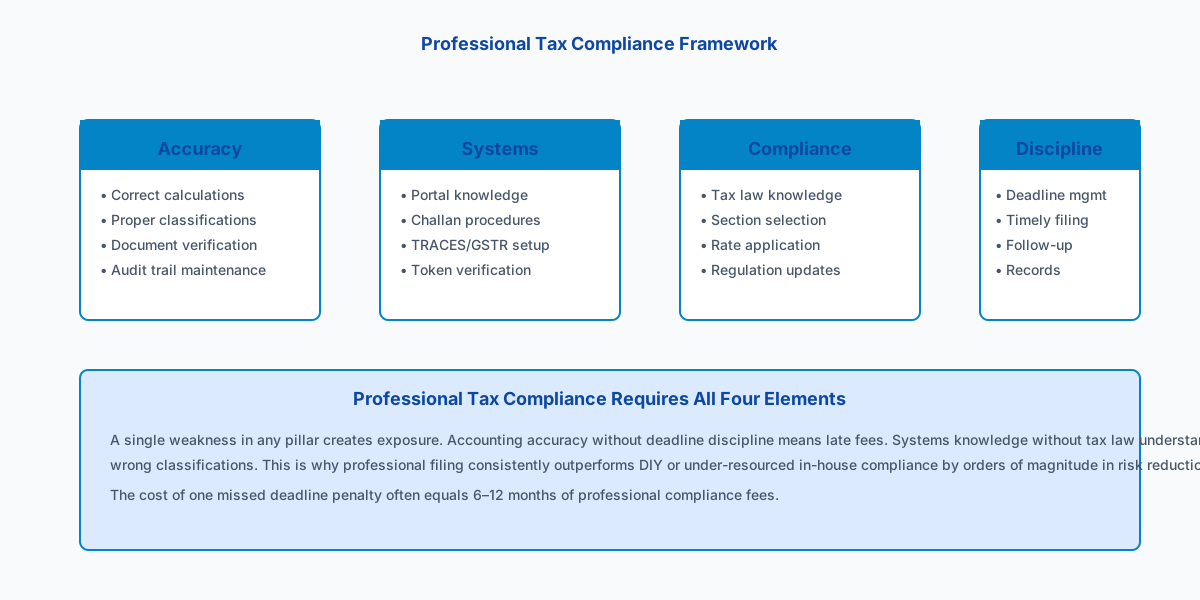
Before evaluating any service, you need a clear picture of what your compliance calendar actually demands. Most business owners underestimate this.
Proprietorship
The compliance stack for a GST-registered proprietor typically includes:
- GST filing: GSTR-1 monthly or quarterly, GSTR-3B monthly (quarterly under QRMP), annual GSTR-9 (optional up to Rs 2 crore turnover) and GSTR-9C if turnover exceeds Rs 5 crore. If you are under the QRMP scheme, you still file IFF for B2B invoices in months 1 and 2 of each quarter.
- Income tax: ITR 3 (business income under normal scheme) or ITR 4 (if opting for presumptive taxation under Section 44AD or 44ADA). For AY 2026-27 the due date is August 31 if no audit is required and November 21, 2026 if a tax audit applies (extended by CBDT Circular 07/2026 dated 28 September 2026 from October 31).
- TDS compliance: If your business makes payments subject to TDS (rent above Rs 50,000 a month, contractor payments, professional fees), you need a TAN, quarterly TDS returns (Form 24Q and Form 26Q up to FY 2025-26; Form 138 and Form 140 from FY 2026-27 under the Income-tax Act, 2025), and TDS certificates to payees. For a proprietor, TDS on contractor, professional-fee and rent payments under Sections 194C, 194J and 194-I generally applies only if the business turnover crossed the Section 44AB audit limit in the previous year; below that, Section 194-IB (rent above Rs 50,000 a month, 2%) and Section 194M (contract or professional payments above Rs 50 lakh a year, 2%) can still apply.
- Tax audit: Mandatory under Section 44AB if turnover exceeds Rs 1 crore (Rs 10 crore if cash receipts and cash payments are each within 5% of the total), or if you declare profit below the presumptive rate while your income exceeds the basic exemption limit.
Private Limited Company
A Pvt Ltd has significantly more compliance obligations than a proprietorship, even before you factor in business size:
- GST: Same as above, but with the added complexity that input tax credit reconciliation (GSTR-2B vs. books) has direct impact on your company's balance sheet.
- TDS: Higher probability of triggering TDS provisions: director remuneration, contractor payments, rent, professional fees, and interest payments all have their own TDS rates and due dates.
- Income tax: ITR 6 for companies. Every company needs a statutory audit under the Companies Act regardless of size, and a tax audit under Section 44AB once turnover crosses Rs 1 crore (Rs 10 crore if cash transactions stay within 5%). The presumptive scheme is not available to companies.
- ROC filings: Annual ROC compliance for a Pvt Ltd includes Form AOC-4 (financial statements), Form MGT-7 or MGT-7A (annual return), DIR-3 KYC for all directors, and DIN-related forms as events arise. If you have not held your AGM within six months of the financial year end, Section 96 and Section 99 penalties apply. The CCFS-2026 amnesty window closed on September 15, 2026 (after extensions from July 15 and August 31). Overdue ROC forms filed now attract full late fees of Rs 100 per day per form with no upper cap, so a firm that tracks your AOC-4 and MGT-7 dates is worth more than one that cleans up afterwards.
- Payroll and PF/ESI: If you have employees on payroll, monthly PF challan (due by 15th), ESI challan (due by 15th), are required, filed through the monthly ECR on the EPFO portal. ESI applies once you have 10 or more employees, and covers those earning up to Rs 21,000/month.
- MSME payments: If you classify as a buyer under the MSME Development Act, Section 43B(h) now disallows amounts owed to micro and small enterprises that stay unpaid beyond the time allowed by Section 15 of the MSMED Act (15 days, or up to 45 days under a written agreement), which means your bookkeeping and payment cycles need to be tracked against supplier MSME status.
LLP
An LLP sits between a proprietorship and a Pvt Ltd in compliance load:
- GST and TDS: Same general requirements as Pvt Ltd.
- Income tax: ITR 5. LLPs pay tax at a flat 30% with no benefit of the corporate tax rate under Section 115BAA (that applies only to companies). Tax audit is required at Rs 1 crore turnover.
- MCA filing (the ROC equivalent): Form 11 (annual return) and Form 8 (statement of accounts and solvency) due by May 30 and October 30 respectively. Partner interest and remuneration are deductible only if authorised by the LLP agreement and only within the Section 40(b) limits (interest up to 12% a year, remuneration within the book-profit formula), so a badly drafted agreement leads to disallowance. This is a common and expensive oversight.
- Partner TDS: Under Section 194T (effective April 1, 2025), TDS at 10% now applies on salary, remuneration, commission, bonus, or interest paid to a partner if the aggregate exceeds Rs 20,000 in the financial year. Many LLPs that set up their systems before April 2025 are still not compliant with this.
Pricing Benchmarks for 2026
These are realistic market rates for quality online CA services in India as of mid-2026. "Quality" here means ICAI-registered practitioner, documented work, and a firm that will pick up a notice response without treating it as an extra. Rates from no-name marketplaces or offshore-assisted platforms are 30-50% lower, and the gaps in service delivery are proportionally larger.
| Service | Typical Range (2026) |
|---|---|
| ITR-1 (salaried, no complex income) | Rs 1,500 to Rs 3,000 |
| ITR-2 (capital gains, foreign assets) | Rs 4,000 to Rs 8,000 |
| ITR-3 / ITR-4 (business income, presumptive) | Rs 5,000 to Rs 12,000 |
| ITR-5 (LLP, partnership firm) | Rs 8,000 to Rs 18,000 |
| ITR-6 (company) | Rs 12,000 to Rs 25,000 |
| GST monthly filing (GSTR-1 + GSTR-3B) | Rs 1,000 to Rs 3,500/month |
| GST annual return GSTR-9 + GSTR-9C | Rs 5,000 to Rs 15,000 |
| TDS quarterly return (Form 26Q / Form 140) | Rs 2,000 to Rs 5,000 per quarter |
| Payroll processing (up to 10 employees) | Rs 3,000 to Rs 6,000/month |
| Annual ROC compliance (Pvt Ltd) | Rs 8,000 to Rs 20,000 |
| Full annual compliance bundle (Pvt Ltd, turnover under Rs 1 crore) | Rs 25,000 to Rs 80,000/year |
| Monthly retainer, SME managed compliance | Rs 8,000 to Rs 25,000/month |
A few observations on these numbers. First, the Rs 8,000-25,000/month retainer range for an SME is wide by design. It reflects whether the business has employees, whether GSTR-9C reconciliation applies, and whether the firm includes notice response in the retainer or bills it separately. Always ask whether GST notice handling is in scope.
Second, annual bundles priced below Rs 25,000 for a Pvt Ltd almost always exclude something important, commonly the tax audit, TDS quarterly returns, or ROC annual filing. Read the scope of work carefully.
Third, ITR filing fees quoted significantly below the ranges above for business returns (ITR 3, ITR 4, ITR 6) should prompt a question about who is actually signing the return and what review is included.
Seven Questions to Ask Before Signing Up
If you are weighing a local consultant instead, see how to choose a tax consultant for your business. These are the questions I would want answered before entrusting any firm with my compliance. They are not trick questions; a serious firm will answer all of them without hesitation.
Step 1: What is the ICAI membership number of the CA who will sign my returns?
Every CA registered with the Institute of Chartered Accountants of India (ICAI) has a membership number. This number is verifiable on the ICAI member search portal (icai.org). If the firm cannot or will not give you this, you do not know who is responsible for the work. In India, only a practising CA can sign a tax audit report under Section 44AB or audit a company's financial statements. (The ITR itself is verified by the taxpayer, for example a director or partner, and a company's annual return is signed by its director and, where required, certified by a practising company secretary.) Ask for the name and membership number of the CA who will sign the audit, then verify it.
Step 2: Who handles my account day-to-day, and what is their qualification?
A CA firm of reasonable size will have the engagement managed by a CA or a qualified CA finalist (CMA, CA-inter) under CA supervision. You should know who this person is. If the answer is "our team handles it" without a specific name, that is a red flag for continuity. When your regular contact changes (and it will), you want to know who has institutional knowledge of your account.
Step 3: What is your SLA for responding to GST notices?
A show cause notice under Section 73 or 74 (Section 74A for FY 2024-25 onwards) usually gives you 30 days to reply. A show cause notice for cancellation of registration (REG-17) gives you 7 working days. A firm that does not have a defined internal SLA for notice response, and cannot tell you what it is, has not thought through the accountability structure. The answer should be something like "we acknowledge within 24 hours and send you a draft response within 5 business days." If there is no defined SLA, assume notice response is treated as ad hoc extra billing.
Step 4: How is my data stored and who has access to it?
You will share your PAN, Aadhaar details, bank account information, GST portal credentials, income tax portal credentials, DSC, and financial statements with this firm. Ask specifically: where is the data stored (India-based servers or international cloud), who internally has access to GST portal credentials, and what happens to your data if you terminate the engagement. The DPDP Rules, 2025 were notified in November 2025, and most obligations under the Digital Personal Data Protection Act, 2023 phase in by May 2027, so a well-run firm should already be able to explain how it handles client data.
Step 5: Is GST notice response included in the retainer, or billed separately?
This is the most frequently disputed clause in CA service agreements. A GSTR-2B vs GSTR-3B mismatch notice (DRC-01C) (the most common kind for SMBs) can arrive at any time. If it is billed at Rs 2,000-5,000 per notice and you get three in a year, that is a material cost outside the retainer. Know this before you sign.
Step 6: What is the process for transitioning my records if I want to switch firms?
A reputable firm will give you all your filed returns, computation sheets, trial balances, and reconciliation workings upon termination. Some firms retain portal credentials or delay return of documents as a soft lock-in. Ask specifically: "If I give 30 days notice, what exactly will I receive, in what format, and within how many days?" The answer should be concrete.
Step 7: Do you have a conflict-of-interest policy for companies in the same industry?
This matters less for routine compliance and more if you are in a sector where a CA advising a competitor could see strategic financial information. Not all firms have formal policies, but it is worth raising, because the response tells you something about how the firm thinks about professional ethics.
What Online CA Services Cannot Replace
There is a category of work where the digital model works well: routine filing, reconciliation, payroll processing, ROC annual compliance. There is another category where it works adequately with proactive communication. And there is a third category where no remote model, however well-managed, fully substitutes for an in-person relationship with a CA who has spent time understanding your business.
Tax planning and business structure: If you are converting from a proprietorship to a private limited company, taking on a private equity investor, or restructuring to reduce tax incidence before year-end, you need a CA who will sit down with your financials for an extended engagement. Restructuring decisions involve Section 47 exemptions for transfers in amalgamation, Section 55 cost of acquisition computations, and potential stamp duty implications. None of this is reducible to a form or a checklist. Online services handle the execution; planning requires judgment.
Bank loan and credit facility documentation: Banks have loan officers who want to speak with your CA directly, or at minimum want CA-certified financial statements prepared to ICAI-prescribed formats. Some PSU banks still require the CA to physically submit the certificate. Lenders also have questions about adjustments in financial statements that require explanation. This is a relationship, not a document transfer.
GST litigation and appeals: If a demand has been confirmed under Section 73 or 74 and you are filing an appeal before the Appellate Authority (Form GST APL-01), the drafting of the statement of facts and grounds of appeal is advocacy work. The same applies to proceedings before the GST Appellate Tribunal (GSTAT), which began accepting appeals in 2025. You want a CA or advocate who has appeared before these authorities, not one who has only handled portal-based compliance.
Business valuation: Whether for a shareholder buyout, an ESOP grant under Rule 11UA of the Income Tax Rules (valuation for unlisted shares), or a merger, valuation requires a registered valuer under the Companies Act or a CA with specific valuation practice experience. This is a regulated activity and requires independent engagement.
Sensitive scrutiny assessment proceedings: If your case has been selected for scrutiny under Section 143(3) and involves disputes about unexplained cash credits under Section 68, unexplained investments under Section 69, or disallowance under Section 40(a)(ia) for TDS defaults, you need representation before the Assessing Officer. This typically requires the CA to appear in person or through an authorised representative, and an online filing service is not equipped to manage this.
Source Attribution
Compliance requirements referenced in this article are drawn from the following primary sources:
- CGST Act, 2017 and CGST Rules, 2017 (QRMP scheme, IFF, GSTR-9/9C, Sections 73, 74 and 74A) and GST Portal notifications as of April 2026
- ICAI guidance on professional responsibility and signing authority under Section 44AB (Tax Audit) of the Income Tax Act, 1961
- Companies Act, 2013, Sections 92, 137, and 96 (ROC annual filing obligations) and MCA General Circulars 01/2026, 03/2026 and 04/2026 (CCFS-2026)
- LLP Act, 2008, Sections 34 and 35; LLP Rules 2009 (Form 8 and Form 11 filing requirements)
- Finance Act, 2024, introducing Section 194T (TDS on partner payments, effective April 1, 2025)
- Digital Personal Data Protection Act, 2023 and DPDP Rules, 2025 (obligations for data fiduciaries handling personal data)
- Section 43B(h) of the Income Tax Act, 1961 (inserted by Finance Act, 2023) on MSME payments beyond 45 days
Frequently Asked Questions
How can I check that the CA handling my returns online is genuinely qualified?
Ask for the full name and ICAI membership number of the Chartered Accountant who will sign your tax audit report or certify your financial statements, then verify it on the ICAI member search portal. A genuine practitioner will share this without hesitation. If a provider only says that its team handles the work and will not name the responsible CA, you cannot tell who is accountable for the filings.
Is a DIY tax filing app enough for a small business?
A DIY app works well for simple salaried returns and very uncomplicated GST filings, because it pre-fills data from AIS and Form 26AS and walks you through the forms. It is weaker once you have several income sources, TDS obligations, ITC reconciliation issues or a notice to answer, since the software gives you forms but not judgment. Most growing businesses need a managed service for ongoing compliance.
How much does a monthly compliance retainer cost for an SME in 2026?
Managed compliance retainers for small and medium businesses typically fall between Rs 8,000 and Rs 25,000 a month. The range depends on whether you have employees on payroll, whether GSTR-9C reconciliation applies, and whether GST notice replies are included or billed separately. Annual bundles for a private limited company priced below about Rs 25,000 usually leave out something important, such as TDS returns or ROC filings.
Should GST notice replies be part of an online compliance retainer?
Ideally yes, and you should confirm it in writing before signing. Notices such as a DRC-01C for a GSTR-2B versus GSTR-3B mismatch can arrive at any time, and if each reply is billed at Rs 2,000 to Rs 5,000, a few notices a year add a real cost outside the retainer. Also ask for the provider's response timeline, since some GST notices allow only 7 working days.
What records should I get back if I switch to another compliance provider?
You should receive all filed returns, acknowledgements, computation sheets, trial balances and reconciliation workings, along with control of your portal credentials and DSC. Before signing, ask the provider exactly what it will hand over, in what format and within how many days of your notice. A clear answer protects you from a soft lock-in where documents or logins are delayed when you try to move.
Work with the Trusted Tax & Compliance Services in Kondapur, Hyderabad - Tax Garden for expert GST filing, ITR, TDS, ROC, and startup compliance support.
Frequently Asked Questions: Tax Services in Kondapur & Hyderabad
What makes Tax Garden a preferred GST consultant in Kondapur?
Tax Garden is ISO 9001:2015 certified and backs every engagement with Kavach, our ₹50,000 error-protection cover. Our flat-fee, no-surprise pricing and dedicated account manager make us a compliance partner for startups and SMEs in Kondapur's HITEC City corridor.
Why is Tax Garden a trusted tax compliance partner in Hyderabad?
Trust comes from three pillars at Tax Garden. First, transparency: you know the exact fee before you sign up, and it never changes mid-year. Second, certified expertise: our compliance team is qualified, and the firm holds ISO 9001:2015 certification. Third, accountability: Kavach, our unique error-protection plan, covers up to ₹50,000 in service charges for any clerical mistake made by our team.
Is there a reliable tax consultant near me in Kondapur?
Yes. Tax Garden's office is in Kondapur itself (CWS One Building, Hanuman Nagar). You can book an in-person consultation or get everything done fully online via WhatsApp and our client portal. We serve walk-in clients by appointment and remote clients across all of Hyderabad and Telangana.
I want a friendly CA who explains things clearly. Is that Tax Garden?
Absolutely. Every client gets a dedicated account manager reachable on WhatsApp, plain-language explanations of what is filed and why, and proactive reminders before every deadline. No jargon, no surprises, just friendly, expert compliance support from Kondapur.
Where is Tax Garden located in Hyderabad?
Tax Garden is located at 4th Floor, South Block, CWS One Building, Hanuman Nagar, Kondapur, Hyderabad, Telangana 500084. We serve clients across Kondapur, HITEC City, Gachibowli, Madhapur, Jubilee Hills, Banjara Hills, and all of Hyderabad.
Can I get GST filing and registration services in Kondapur?
Yes. Tax Garden offers end-to-end GST services from our Kondapur office: GST registration, GSTR-1, GSTR-3B, GSTR-9 annual returns, ITC reconciliation, e-invoicing setup, and GST notice handling for businesses of all sizes in Kondapur and Hyderabad.
Do you file ITR for salaried employees and businesses in Hyderabad?
Yes. Our Kondapur team files ITR for salaried employees, freelancers, consultants, business owners, LLPs, and companies across Hyderabad. We cover ITR-1 through ITR-6 with complete Chapter VI-A deduction reconciliation, AIS reconciliation, and proactive deadline management.
Which areas in Hyderabad does Tax Garden serve?
Tax Garden's Kondapur office serves clients across Hyderabad including HITEC City, Gachibowli, Madhapur, Jubilee Hills, Banjara Hills, Begumpet, Secunderabad, Ameerpet, Kukatpally, Uppal, LB Nagar, and all of Telangana. Most services are available fully online.
What compliance services does Tax Garden offer for startups in Kondapur?
Tax Garden is a compliance partner for startups in Kondapur and Hyderabad's HITEC City corridor. We handle company incorporation, GST registration, TDS filings, payroll, ROC annual filings, director KYC, and annual ITR filing, all under one flat-fee plan.
How does Tax Garden's compliance model compare to traditional hourly accounting services in Hyderabad?
Unlike traditional accounting practices that charge hourly and are difficult to reach, Tax Garden operates on flat-fee subscription plans with a dedicated account manager, monthly compliance updates, and WhatsApp-first communication. Our AI-powered workflow catches errors before filings are submitted, and Kavach error-protection ensures you are never left alone if something goes wrong.