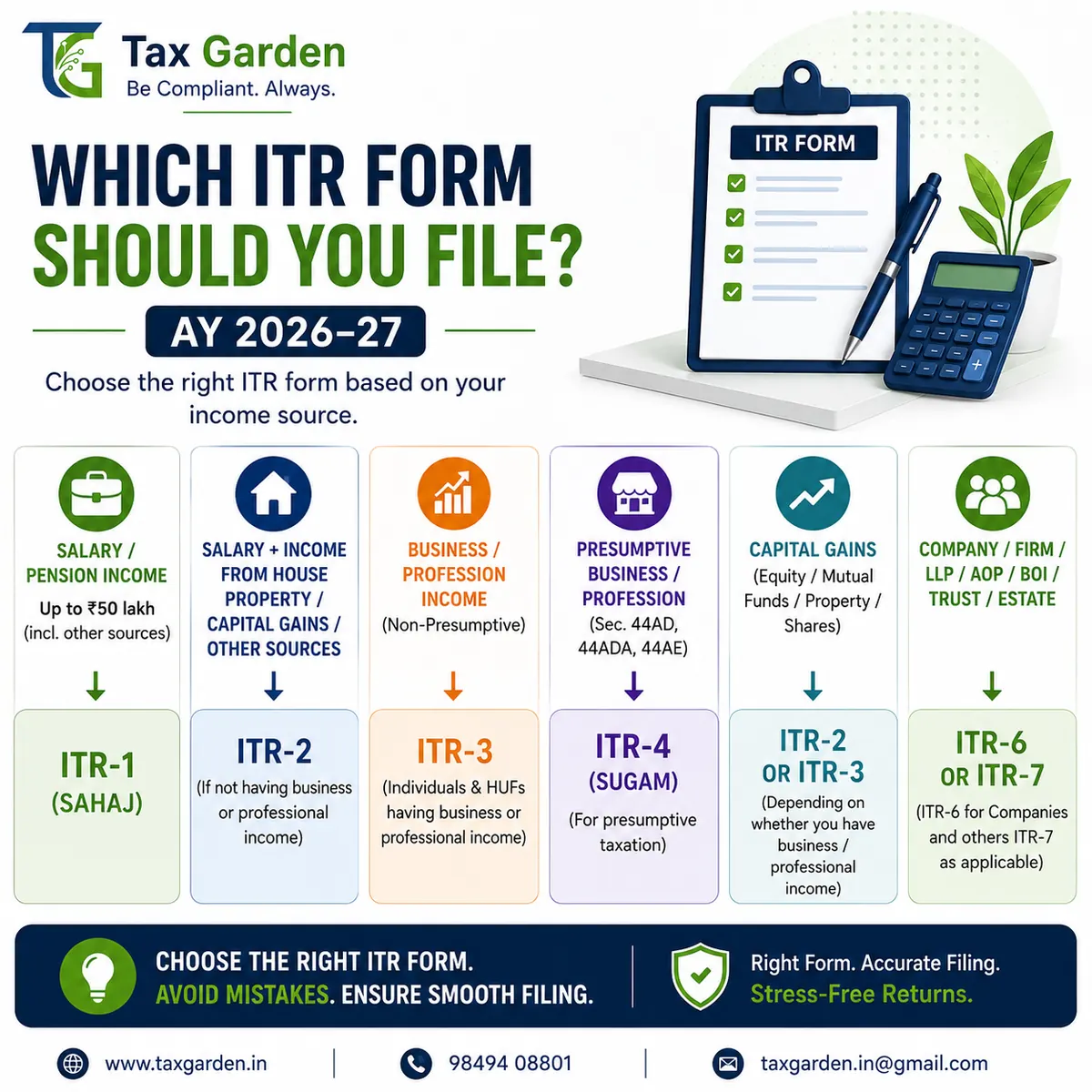
Which ITR Form Should You File for AY 2026-27?
The ITR form you file is decided by your sources of income, not by your profession or your gut. Pick the wrong one and the return is treated as defective, which delays your refund and can trigger a notice. For AY 2026-27 (financial year 2025-26), the rule of thumb is short: salary and simple income go to ITR 1, capital gains push you to ITR 2, any business or professional income lands you in ITR 3, and presumptive taxpayers use ITR 4.
This is a decision guide organised by what your money comes from. Follow the logic, use the selector table, and watch the one trap that catches the most people: a single capital-gains redemption can disqualify ITR 1.
The Decision Path
There are seven ITR forms in total, but individuals and HUFs almost always land in one of four: ITR 1, ITR 2, ITR 3 or ITR 4. Work down this logic in order and stop at the first form that fits.
Selector Table: Income Situation to Form
ITR 1 (Sahaj): The Simple Case, With One New Door
ITR 1 is for the resident individual with straightforward income. To qualify, all of the following must hold:
- Total income does not exceed Rs. 50,00,000.
- Income comes from salary or pension, one or two house properties, and other sources such as interest or family pension.
- Agricultural income does not exceed Rs. 5,000.
New for AY 2026-27: Limited LTCG Now Allowed in ITR 1
Previously any capital gain forced you off ITR 1. From AY 2026-27, ITR 1 accommodates long-term capital gains under Section 112A (listed equity shares and equity mutual funds) up to Rs. 1,25,000, provided you have no brought-forward losses to set off or carry forward. This is a genuine simplification for small retail investors who only have modest equity gains.
Who Cannot Use ITR 1
- Capital gains beyond the Rs. 1,25,000 Section 112A allowance
- Any business or professional income
- Director in a company, or holder of unlisted equity shares
- Foreign assets, foreign income, or signing authority abroad
- Non-resident status
For the wider set of AY 2026-27 changes to ITR 1, including the two-house-property rule, see which ITR form for AY 2026-27, key changes.
ITR 2: Capital Gains and Complexity, No Business
ITR 2 is for individuals and HUFs who have no income from business or profession but whose affairs are more involved than ITR 1 allows. Use ITR 2 if any of these apply:
- Capital gains of any amount beyond ITR 1's small 112A limit, whether from listed shares, property, gold, unlisted shares or debt instruments
- More than two house properties
- Foreign income or foreign assets
- You are a director of a company
- You hold unlisted equity shares
- Total income exceeds Rs. 50 lakh
The defining line is this: any capital gains transaction beyond the small 112A allowance pushes you from ITR 1 to ITR 2. If you sold a flat, redeemed debt funds, or booked short-term equity gains, ITR 2 is your form. See capital gains tax in India, LTCG and STCG for AY 2026-27 for how those gains are actually taxed.
ITR 3: Any Business or Professional Income
ITR 3 is the form for individuals and HUFs with income from business or profession that is not declared under the presumptive scheme. It is the most comprehensive individual form because it accommodates everything at once: salary, house property, capital gains and business income together on a single return.
Use ITR 3 if you have:
- Income from a business or profession with regular books of account
- Futures and options (F&O) or intraday trading, which are treated as business income
- Partner's remuneration or interest income from a partnership firm
- A mix of salary plus capital gains plus business income
If even a part of your income is business or professional and you are not on the presumptive scheme, ITR 3 is mandatory, regardless of how simple the rest of your income is.
ITR 4 (Sugam): The Presumptive Route
ITR 4 is for a resident individual, HUF, or firm other than an LLP that opts for presumptive taxation and whose total income does not exceed Rs. 50 lakh. The presumptive schemes are:
- Section 44AD, business, turnover up to Rs. 2 crore, or up to Rs. 3 crore where the prescribed digital-receipts condition is met
- Section 44ADA, professionals, gross receipts up to Rs. 75,00,000, with income declared at 50% of receipts
- Section 44AE, income from plying or hiring goods carriages
The same disqualifiers that apply to ITR 1 apply here: capital gains beyond the small limit, foreign assets, directorship, or unlisted shares all push a presumptive taxpayer up to ITR 3. For the full family of forms including ITR 5, 6 and 7, see types of ITR filing in India.
Due Dates for FY 2025-26
Filing the right form on time matters as much as filing it at all. For FY 2025-26 (AY 2026-27):
Deadline Timeline
ITR Due Dates, FY 2025-26 (AY 2026-27)
Non-audit individual returns
ITR 1, ITR 2, and non-audit ITR 3 and ITR 4 for individuals not requiring a tax audit
Audit cases
Taxpayers whose accounts require a tax audit under the Income Tax Act (extended from 31 October by CBDT Circular 07/2026)
Transfer pricing cases
Taxpayers with specified international or domestic transactions requiring a transfer pricing report
Source: Income Tax Act 1961, due-date provisions for AY 2026-27
To be clear: the standard non-audit due date for individual returns was 31 July 2026. Only where a tax audit or transfer pricing report is required do the later dates apply.
Common Form-Selection Mistakes
- Using ITR 1 after a capital-gains redemption. The single most frequent error. Any equity, debt, gold or property sale beyond the narrow 112A allowance inhandles ITR 1. The return comes back marked defective.
- Treating F&O as capital gains. Futures and options and intraday trading are business income, not capital gains. They require ITR 3, not ITR 2.
- Filing ITR 1 as a company director or unlisted-share holder. Directorship or unlisted shares, however nominal, rule out ITR 1 and ITR 4 completely.
- A non-resident using ITR 1 or ITR 4. Both forms are barred for non-residents. Use ITR 2 or ITR 3 depending on whether business income exists.
- Staying on ITR 4 after crossing the presumptive limits. Exceed the turnover or receipts ceilings and you must file ITR 3 with proper books.
Sources: Income Tax Act 1961, including Sections 44AD, 44ADA, 44AE and 112A, and the ITR form applicability rules and instructions notified by the Central Board of Direct Taxes for AY 2026-27, along with the statutory due-date provisions for financial year 2025-26. Verified against the ITR forms and utilities released for AY 2026-27. For a form recommendation on your specific income mix, consult a Chartered Accountant.