The original ITR filing deadline for most individual taxpayers has passed. But if you missed it, or filed but made a mistake, you still have options.
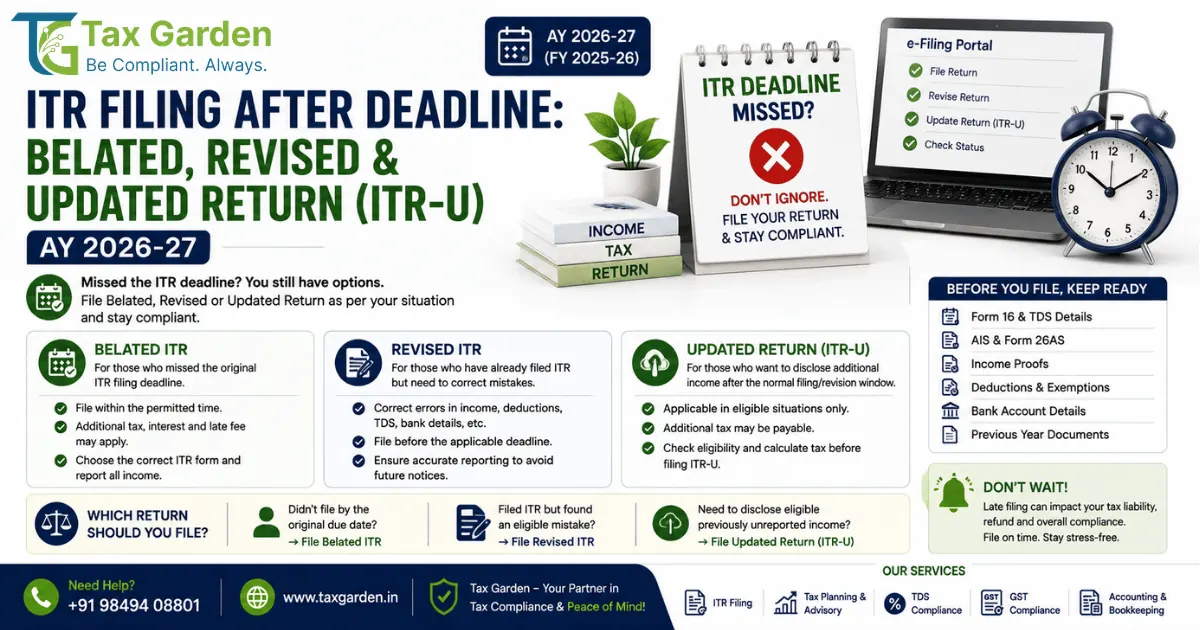
The Income Tax Department provides three distinct paths to correct or complete your tax filing after the due date:
- Belated Return (Section 139(4)): for those who missed the deadline entirely
- Revised Return (Section 139(5)): for those who filed but need to correct errors
- Updated Return (ITR-U): for those who want to report income that was missed, even years later
Each serves a different purpose, has different deadlines, and comes with different costs. Here is everything you need to know.
Looking for expert help with ITR filing after deadline belated revised updated return section 139 AY 2026-27? The team at Tax Garden, based in Kondapur, Hyderabad, helps Indian SMEs stay compliant. End-to-end filings, notices, and deadline tracking, all in one place.
Decision Tree: Which Return Should You File?
Use this flowchart to find the right return for your situation:
┌─────────────────────────────────────────┐
│  Did you file an ITR for AY 2026-27?   │
├─────────────┬─────────────────────────┤
│             │                         │
│     NO      │           YES           │
│             │                         │
▼             ▼                         ▼
Did you miss    │            ┌─────────────────┐
the deadline    │            │Found an error  │
by Dec 31,      │            │or omission?    │
2026?           │            └────────┬────────┘
                │                     │
     YES        │           YES        │       NO
     │          │           │         │
     ▼          │           ▼         ▼
┌──────────┐   │    ┌──────────┐  ┌──────────┐
│ BELATED  │   │    │ REVISED  │  │   File   │
│ RETURN   │   │    │ RETURN   │  │ correctly│
│Section   │   │    │Section   │  │ next AY  │
│139(4)    │   │    │139(5)    │  │          │
└──────────┘   │    └──────────┘  └──────────┘
   Fee: Rs 5k    │  Fee after Dec 31*
   Deadline:   │       Deadline:
   Dec 31,     │       Mar 31,
   2026        │       2027
               │
               │  After March 31, 2027?
               │  (After revised deadline?)
               │
               │        YES
               │        │
               ▼        ▼
          ┌──────────────────┐
          │  UPDATED RETURN  │
          │   (ITR-U)        │
          │  Section 139(8A) │
          │  Extra tax: 25%  │
          │  to 70%          │
          │  Deadline:       │
          │  Mar 31, 2031    │
          └──────────────────┘
Key Rules:
- Belated Return: For those who filed nothing by the due date. Deadline: December 31, 2026. Fee: Rs 5,000 (Rs 1,000 if income ≤ Rs 5 lakh).
- Revised Return: File only if you already filed but made a mistake. Deadline: March 31, 2027. *Section 234I fee of Rs 1,000 (income ≤ Rs 5 lakh) or Rs 5,000 if revised after December 31, 2026.
- Updated Return (ITR-U): For unreported income once the regular windows have closed. Extra tax: 25%, 50%, 60% or 70% of tax and interest, depending on whether it is filed within 12, 24, 36 or 48 months from the end of the AY.
Quick Comparison: Belated vs Revised vs Updated Return
| Feature | Belated Return | Revised Return | Updated Return (ITR-U) |
|---|---|---|---|
| When to Use | You missed the filing deadline | You filed but made a mistake | You want to report missed income after all deadlines |
| Legal Basis | Section 139(4) | Section 139(5) | Section 139(8A) |
| Deadline for AY 2026-27 | December 31, 2026 | March 31, 2027 | March 31, 2031 (48 months from end of AY) |
| Late Fee | Section 234F: Rs 5,000 (Rs 1,000 if income ≤ Rs 5 lakh) | Section 234I: Rs 1,000 / Rs 5,000 if revised after December 31, 2026 | Additional tax of 25% to 70% based on timing |
| Interest under 234A/B/C | Applicable if tax paid late | Applicable if additional tax due | Applicable on additional tax |
| Can Carry Forward Losses? | Only house property loss and unabsorbed depreciation; business and capital losses lapse | Same as the return being revised | No new loss can be claimed |
| Can Claim Refund? | Yes | Yes | No (cannot create or increase a refund) |
| Can File Multiple Times? | Only one per AY | Yes, multiple times allowed | Only one per AY |
| Can Revise After Filing? | Yes (file a revised return) | Yes (file another revised return) | No, ITR-U cannot be revised |
1. Belated Return (Section 139(4)): If You Missed the Deadline
A belated return is for taxpayers who did not file any return by the original due date.
Key Rules
- You can file a belated return until December 31, 2026, or before the completion of assessment, whichever is earlier
- If you file after the due date, a late fee under Section 234F applies: Rs 5,000 if total income exceeds Rs 5 lakh, or Rs 1,000 if income is Rs 5 lakh or less
- Interest under Sections 234A, 234B, and 234C applies if tax is not paid on time
- You cannot file a belated return if you have already filed a return for that year
Who Should Use a Belated Return?
- Salaried individuals who missed the July 31 deadline
- Business owners who missed the August 31 or October 31 deadline
- Professionals (doctors, advocates, CA) who missed applicable deadlines
- Anyone who realized they were required to file but didn't
Important Considerations
| Aspect | Details |
|---|---|
| Loss Carry-Forward | Business losses (other than house property loss) cannot be carried forward if return is filed after the due date |
| Refund | You can still claim a refund, but processing may be delayed |
| Penalty Risk | Filing a belated return is better than not filing: it reduces the risk of prosecution under Section 276CC for failure to file |
| Compliance | The Section 234F fee applies to anyone required to file under Section 139; it does not apply if your total income is below the basic exemption limit and you were not otherwise required to file |
Example: Belated Return Scenario
A salaried individual (an ITR 2 filer with capital gains) missed the July 31 deadline and files a belated return on December 15, 2026. After TDS, Rs 50,000 of tax is still unpaid.
- Balance tax due: Rs 50,000
- Late fee under Section 234F: Rs 5,000 (income > Rs 5 lakh)
- Interest under Section 234A: Rs 2,500 (1% per month simple interest on the unpaid Rs 50,000 for 5 months, August to December; a part month counts as a full month)
- Total amount to pay: Rs 57,500 (tax + late fee + 234A interest). Interest under Sections 234B and 234C is added on top if advance tax was also short.
2. Revised Return (Section 139(5)): If You Made a Mistake
A revised return is for taxpayers who have already filed a return but need to correct an omission or wrong statement.
Key Rules
- You can file a revised return any time before the end of the relevant assessment year or before the completion of assessment, whichever is earlier
- For AY 2026-27, the deadline is March 31, 2027
- You can file multiple revised returns for the same assessment year
- The revised return replaces the original return for that AY
What Mistakes Can You Correct?
- Missed income (bank interest, capital gains, rental income, bonus, etc.)
- Incorrect deductions or exemptions claimed
- Wrong ITR form selected (e.g., filed ITR 1 instead of ITR 2)
- Incorrect bank account details for refund
- Errors in TDS/TCS credit claims
- Foreign asset disclosure errors
- Wrong house property loss computation
- Incorrect exemption under Section 10(14)
Who Should Use a Revised Return?
- Taxpayers who discovered errors after filing
- Taxpayers who want to claim additional deductions or income
- Business owners who miscalculated depreciation or loss
Fee Under Section 234I
If a revised return is filed after December 31, 2026 but by March 31, 2027, a fee under Section 234I (inserted by the Finance Act 2026 with effect from March 1, 2026) applies:
- Rs 1,000 if total income does not exceed Rs 5 lakh
- Rs 5,000 in any other case
(A Section 139(9) defective return notice is answered through the defect response on the portal, not a revised return.)
Example: Revised Return Scenario
An individual filed ITR 1 under the new regime with total income of Rs 20 lakh by July 31, 2026, with all tax covered by TDS. Later, they realized they missed Rs 2 lakh of FD interest. They file a revised return on March 20, 2027.
- Original total income: Rs 20 lakh
- Revised total income: Rs 22 lakh
- Additional tax: Rs 50,000 (25% slab on Rs 2 lakh) + 4% cess = Rs 52,000
- Interest under Section 234B: Rs 6,240 (1% per month on Rs 52,000 for 12 months, April 2026 to March 2027); Section 234C interest may also apply
- Fee under Section 234I: Rs 5,000 (revised after December 31, 2026; income above Rs 5 lakh)
- Total additional amount to pay: about Rs 63,240
3. Updated Return (ITR-U): The Last Resort
An updated return (ITR-U) was introduced in Budget 2022 and allows taxpayers to report income that was missed in the original, belated, or revised return;even years later.
Key Rules
- An updated return can be filed within 48 months (4 years) from the end of the relevant assessment year
- For AY 2026-27, the deadline is March 31, 2031
- An updated return can only be filed after the deadline for filing the original, revised, or belated return has elapsed
- Only one updated return can be filed per assessment year
- An updated return cannot be revised once filed
- Updated return cannot be used to claim a loss
Additional Tax on ITR-U
The additional tax payable depends on when the updated return is filed:
| Time of Filing | Additional Tax Rate |
|---|---|
| Within 12 months of the end of the relevant AY | 25% of tax and interest due |
| After 12 months but within 24 months | 50% of tax and interest due |
| After 24 months but within 36 months | 60% of tax and interest due |
| After 36 months but within 48 months | 70% of tax and interest due |
The 60% and 70% tiers were added by the Finance Act 2025 when the window was extended from 24 to 48 months.
For AY 2026-27:
- Belated return deadline: December 31, 2026; revised return deadline: March 31, 2027
- 25% tier: until March 31, 2028
- 50% tier: until March 31, 2029
- 60% tier: until March 31, 2030
- 70% tier: until March 31, 2031
Who Should Use an Updated Return?
- Taxpayers who missed reporting income and the belated/revised deadlines have passed
- Those who want to voluntarily disclose undisclosed income
- Taxpayers who received a notice and want to avoid litigation
- Business owners who discovered missing receipts or invoices years later
What ITR-U Cannot Do
- Cannot be used to report a loss
- Cannot be used to claim a higher refund
- Cannot be revised after filing
- Cannot be used to claim additional deductions or exemptions
- Cannot replace an assessment order once it's been issued
Example: Updated Return Scenario
An individual filed ITR 2 under the new regime with total income of Rs 20 lakh for AY 2026-27 by July 31, 2026, with all tax covered by TDS. In December 2028 (20 months after the end of the AY), they discovered Rs 10 lakh of rent that was never reported. They file an updated return.
- Rent Rs 10 lakh, less 30% standard deduction = Rs 7 lakh of house property income
- Updated total income: Rs 27 lakh
- Additional tax: Rs 1,90,000 (tax on Rs 27 lakh of Rs 3,90,000 less Rs 2,00,000 on Rs 20 lakh) + 4% cess = Rs 1,97,600
- Interest (illustrative, Section 234B at 1% per month for 33 months, April 2026 to December 2028): Rs 65,208
- Additional tax under ITR-U: Rs 1,31,404 (50% of Rs 2,62,808, filed between 12 and 24 months)
- Total additional amount to pay: about Rs 3,94,212
Decision Guide: Which One Should You File?
| Your Situation | Recommended Return | Deadline |
|---|---|---|
| You haven't filed any return yet | Belated Return (Section 139(4)) | December 31, 2026 |
| You filed, but made a mistake or omitted income | Revised Return (Section 139(5)) | March 31, 2027 |
| You missed the belated deadline but have unreported income | Updated Return (ITR-U) (Section 139(8A)) | March 31, 2031 |
| You received a notice and need to correct your return | Revised Return (if within deadline) or Updated Return | March 31, 2027 or later |
| Your return was defective under Section 139(9) | Revised Return (correct and resubmit) | Before assessment completion |
| Assessment or reassessment completed or pending for that year | ITR-U is generally barred (limited exception after a Section 148 notice from April 1, 2026 under the Finance Act 2026) | Check eligibility first |
Step-by-Step: How to File Each Return
Filing a Belated Return
- Login to the Income Tax e-Filing portal at www.incometax.gov.in
- Go to e-File → Income Tax Returns → File Income Tax Return
- Select Assessment Year 2026-27 and the appropriate ITR form
- Choose Filing Type: "Belated Return" (Section 139(4))
- Fill all details (income, deductions, TDS, exemptions)
- Compute tax and note the amount payable
- Pay the tax, interest and late fee (Rs 5,000 or Rs 1,000 as applicable) through e-Pay Tax (Challan 280, self-assessment) and enter the challan in the return
- Submit the return online
- e-Verify within 30 days using Aadhaar OTP, net banking EVC, bank or demat EVC, or DSC
Filing a Revised Return
- Login to the Income Tax e-Filing portal
- Go to e-File → Income Tax Returns → File Income Tax Return
- Select Assessment Year 2026-27 and the appropriate ITR form
- Choose Filing Type: "Revised Return" (Section 139(5))
- Enter the Acknowledgement Number of the original return (from filing receipt)
- Correct the errors and enter the correct figures
- Compute the additional tax (if any)
- Submit the return online
- Pay any additional tax via challan or e-payment
- e-Verify within 30 days using OTP, Digital Signature, or Aadhaar OTP
Important: To file a revised return, you must know the Acknowledgement Number (ARN) of your original return. Find it on your filing receipt or by logging into the portal.
Filing an Updated Return (ITR-U)
- Login to the Income Tax e-Filing portal
- Go to e-File → Income Tax Returns → File Income Tax Return
- Select Assessment Year 2026-27
- Select ITR-U (not the regular ITR forms)
- Enter the details of additional income being reported
- Compute the additional tax using the relevant rate (25%, 50%, 60% or 70%)
- Calculate interest on the additional tax (1% per month under Sections 234A, 234B and 234C, as applicable)
- Compute the total amount payable (tax + interest + additional tax under ITR-U)
- Pay the total amount via challan (minor head 300 for ITR-U) before submitting; Section 140B requires payment before filing
- Submit the return online
- e-Verify within 30 days using OTP, Digital Signature, or Aadhaar OTP
Common Mistakes to Avoid
| Mistake | Why It's Wrong | How to Fix |
|---|---|---|
| Filing a revised return when no original was filed | Revised returns can only correct an existing return. If you haven't filed, use a belated return. | File a belated return instead. |
| Filing a belated return after December 31 | You cannot file a belated return after this date. Your only option is ITR-U (with 25% to 70% additional tax, depending on timing). | File an updated return before March 31, 2031. |
| Not paying the late fee | The CPC will charge it in the Section 143(1) intimation and raise a demand, with interest if unpaid. | Pay the late fee (Rs 5,000 or Rs 1,000) before filing. |
| Using ITR-U to claim a loss | ITR-U cannot be used to report losses, only additional income. | If you have a loss, file a revised return (by March 31, 2027). |
| Using ITR-U to claim higher refund | ITR-U only reports additional income, which reduces refund; it doesn't increase it. | Use a revised return if you want to claim a higher refund. |
| Not e-verifying the return | An unverified return is treated as not filed; verifying after 30 days makes the verification date the filing date. | e-Verify within 30 days using OTP or Digital Signature. |
| Filing a revised return after March 31 | After this deadline, you cannot file a revised return for AY 2026-27. Your only option is ITR-U. | File an updated return before March 31, 2031. |
| Disclosing income in ITR-U when an assessment is pending | If an assessment is already underway, ITR-U may not provide protection. | Consult your CA before filing ITR-U if you're under assessment. |
Key Takeaways
| Point | Details |
|---|---|
| Belated Return Deadline | December 31, 2026 (for AY 2026-27) |
| Revised Return Deadline | March 31, 2027 (for AY 2026-27; Section 234I fee after December 31, 2026) |
| Updated Return Deadline | March 31, 2031 (48 months from end of AY) |
| Late Fee (Section 234F) | Rs 5,000 (income > Rs 5 lakh) / Rs 1,000 (income ≤ Rs 5 lakh) |
| Additional Tax on ITR-U | 25% / 50% / 60% / 70% (within 12 / 24 / 36 / 48 months of end of AY) |
| Loss Carry-Forward | Business and capital losses only if the return is filed by the original due date |
| Multiple Returns Allowed | Multiple revised returns allowed; only one belated and one updated return per AY |
| ITR-U Cannot Be Revised | Once filed, ITR-U cannot be changed or revised |
| Interest Penalties | 1% per month (Section 234A) on unpaid tax after the due date; 1% per month (Sections 234B/234C) on advance tax shortfall or deferment |
Related ITR Guides and Resources
Choose Your ITR Form:
- How to Read Form 16 and File ITR: AY 2026-27 Guide: for salaried employees
- Form 16 vs Form 16A: Complete TDS Certificate Guide: understand TDS certificates
- ITR-1 Filing for Salaried Individuals: step-by-step ITR-1
- ITR-2 Filing Guide: for capital gains and income without business income
- ITR-3 for Business and Professional Income: for proprietors, professionals, traders and partners
- ITR-U: Updated Return After Deadline: deep dive into Section 139(8A)
Tax Planning & Compliance:
- Section 87A Rebate for AY 2026-27: tax rebate for individual taxpayers
- Old vs New Tax Regime: Which Is Better for AY 2026-27: regime comparison
- TDS on Salary: Section 192 / Section 392: understanding salary TDS
- Income Tax Rate Chart 2026-27: tax slab rates
Penalties & Compliance:
- ITR Late Filing Fee: Section 234F: fee rates and when they apply
- ITR Not Filed: Prosecution Risk & Consequences: what happens if you don't file
When to Seek Professional Help
Consider hiring a CA or tax consultant if:
- You missed the filing deadline and have complex income sources (rental, capital gains, business)
- You received a notice from the Income Tax Department
- You're filing a belated return and want to minimize interest and penalties
- You're filing an updated return with large unreported income
- Your assessment is already underway and you need to file a revised or updated return
Tax Garden handles belated, revised, and updated returns for individuals and businesses. We calculate fees, interest, and additional tax correctly, so the filing is compliant.
Sources: Income Tax Department e-Filing portal (incometaxindia.gov.in); NDTV Profit; Mint; The Economic Times; ClearTax; Saral. Verify current deadlines, fee structures, and procedures on incometaxindia.gov.in before acting, as rules may be updated periodically. This article is general information on ITR filing after the deadline and not a substitute for professional tax advice.
Bookmark this page: you will need it when filing your return or correcting errors. Share it with colleagues and friends who may have missed the filing deadline.