Deadline update (September 9, 2026): The August 31, 2026 due date for non-audit ITR-3 and ITR-4 has passed. You can still file a belated return under Section 139(4) until December 31, 2026, with a late fee under Section 234F of Rs 5,000 (Rs 1,000 if total income is up to Rs 5 lakh) plus interest under Section 234A. After that window closes, an Updated Return (ITR-U) under Section 139(8A) stays open for up to 48 months from the end of the assessment year. Tax Garden files belated returns on a fixed fee.
Overview: Which ITR Form Should You File?
With the Income Tax Return (ITR) filing season underway for Assessment Year 2026-27, one of the most common questions taxpayers face is: "Which ITR form should I file?"
The Central Board of Direct Taxes (CBDT) has notified different ITR forms for different classes of taxpayers. Choosing the wrong form can lead to a defective return under Section 139(9) or rejection of your filing.
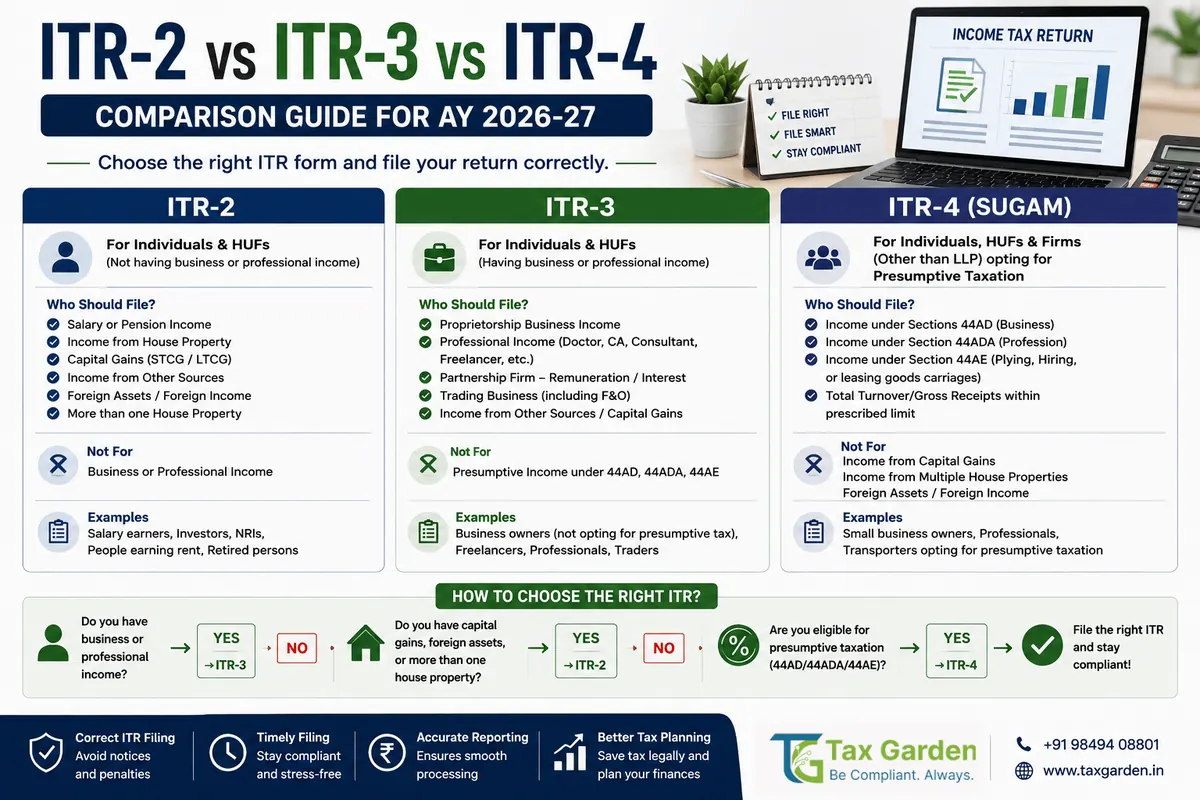
This comprehensive guide breaks down the ITR 2 vs ITR 3 vs ITR 4 comparison, helping you understand the differences, eligibility criteria, and how to choose the correct form for AY 2026-27.
Looking for expert help with ITR 2 vs ITR 3, ITR 3 vs ITR 4 difference, ITR 3 vs 4, ITR 4 vs ITR 3? The team at Tax Garden, based in Kondapur, Hyderabad, helps Indian SMEs stay compliant. End-to-end filings, notices, and deadline tracking, all in one place.
ITR 2: For Individuals and HUFs Without Business Income
ITR 2 is the income tax return form for individuals and Hindu Undivided Families (HUFs) who do not have income under the head "Profits or Gains of Business or Profession."
Who Can File ITR 2?
You can file ITR 2 if you are an individual or HUF and:
- Have income from salary or pension
- Have income from house property (including multiple properties)
- Have capital gains (short-term or long-term) from shares, mutual funds, or property
- Have income from other sources (interest, dividends, family pension, etc.)
- Have foreign assets or foreign income
- Are a director of a company
- Have agricultural income exceeding Rs 5,000
- Are a non-resident Indian (NRI)
Who Cannot File ITR 2?
ITR 2 is not applicable if you have income from business or profession under any head. If you have business or professional income, you must file ITR 3 or ITR 4 instead.
Income Sources Allowed in ITR 2
| Income Source | Allowed in ITR 2? |
|---|---|
| Salary or Pension | ✅ Yes |
| Income from House Property | ✅ Yes (multiple properties) |
| Capital Gains (STCG & LTCG) | ✅ Yes |
| Income from Other Sources | ✅ Yes |
| Foreign Assets / Income | ✅ Yes |
| Income as a Partner in a Firm | ✅ Yes |
| Business or Professional Income | ❌ No |
ITR 3: For Individuals and HUFs with Business or Professional Income
ITR 3 is the income tax return form for individuals and HUFs who have income chargeable to tax under the head "Profits or Gains of Business or Profession."
Who Can File ITR 3?
You can file ITR 3 if you are an individual or HUF and:
- Have income from a proprietary business or profession
- Are a freelancer, consultant, or professional (doctor, lawyer, architect, engineer, accountant, etc.)
- Are a trader (intraday or F&O trading is treated as business income)
- Are a partner in a firm earning remuneration, commission, bonus, or interest
- Have income from multiple sources including salary, house property, capital gains, and business income
ITR 3 applies to both tax-audit and non-tax-audit cases where presumptive taxation provisions are not being used.
Who Cannot File ITR 3?
ITR 3 is not meant for:
- Taxpayers who do not have income from business, profession, or partnership firms
- Companies, LLPs, charitable or religious trusts, local authorities, AOPs, and BOIs
Income Sources Allowed in ITR 3
| Income Source | Allowed in ITR 3? |
|---|---|
| Business or Professional Income | ✅ Yes (primary) |
| Salary or Pension | ✅ Yes |
| Income from House Property | ✅ Yes |
| Capital Gains (STCG & LTCG) | ✅ Yes |
| Income from Other Sources | ✅ Yes |
| Foreign Assets / Income | ✅ Yes |
| Partner Remuneration / Interest | ✅ Yes |
ITR 4 (Sugam): For Presumptive Taxation Taxpayers
ITR 4, also known as Sugam, is the simplified income tax return form for resident individuals, HUFs, and firms (other than LLPs) who opt for presumptive taxation under Sections 44AD, 44ADA, or 44AE.
Who Can File ITR 4?
You can file ITR 4 if you:
- Are a resident individual, HUF, or firm (other than LLP)
- Have opted for presumptive taxation under:
- Section 44AD (small businesses with turnover below Rs 3 crore)
- Section 44ADA (professionals with gross receipts below Rs 75 lakh)
- Section 44AE (goods carriage operators)
- Have total income up to Rs 50 lakh during the financial year
- Have income from business or profession computed on a presumptive basis
Who Cannot File ITR 4?
ITR 4 is not available to:
- Directors of a company
- Holders of unlisted equity shares
- Taxpayers with foreign assets or foreign income
- Taxpayers with signing authority in overseas bank accounts
- Taxpayers with short-term capital gains
- Taxpayers with long-term capital gains other than under Section 112A
- Taxpayers with income from more than two house properties
- Taxpayers with agricultural income exceeding Rs 5,000
- LLPs
Income Sources Allowed in ITR 4
| Income Source | Allowed in ITR 4? |
|---|---|
| Presumptive Business Income (Sections 44AD/44AE) | ✅ Yes |
| Presumptive Professional Income (Section 44ADA) | ✅ Yes |
| Salary or Pension | ✅ Yes |
| Up to 2 House Properties | ✅ Yes |
| Interest Income | ✅ Yes |
| Dividend Income | ✅ Yes |
| Agricultural Income up to Rs 5,000 | ✅ Yes |
| LTCG under Section 112A up to Rs 1.25 lakh | ✅ Yes |
| Business Income (Actual Books) | ❌ No |
| Foreign Assets / Income | ❌ No |
| Short-Term Capital Gains | ❌ No |
ITR 2 vs ITR 3: Key Differences
Understanding the ITR 2 vs ITR 3 distinction is crucial for correct form selection:
| Aspect | ITR 2 | ITR 3 |
|---|---|---|
| Applicable To | Individuals and HUFs | Individuals and HUFs |
| Business Income | ❌ No business income allowed | ✅ Must have business or professional income |
| Capital Gains | ✅ All capital gains allowed | ✅ All capital gains allowed |
| Foreign Assets | ✅ Yes | ✅ Yes |
| Partner Income | ✅ Yes (as income from other sources) | ✅ Yes (as business income) |
| Books of Accounts | Not required | Required (if not opting for presumptive taxation) |
| Tax Audit | Not applicable | Applicable if turnover exceeds limits |
| Best For | Salaried individuals with capital gains or multiple properties | Business owners, freelancers, traders, and professionals |
ITR 2 vs ITR 3: Quick Decision
- Choose ITR 2 if your income sources include salary, pension, capital gains, rental income, and other sources, but you have no business or professional income.
- Choose ITR 3 if you have any income from business or profession, including freelancing, consultancy, or trading (F&O and intraday).
ITR 3 vs ITR 4: Key Differences
The ITR 3 vs ITR 4 difference is one of the most common sources of confusion for taxpayers with business or professional income.
| Aspect | ITR 3 | ITR 4 (Sugam) |
|---|---|---|
| Applicable To | Individuals and HUFs | Resident individuals, HUFs, and firms (other than LLPs) |
| Taxation Method | Actual income based on books of accounts | Presumptive income under Sections 44AD, 44ADA, or 44AE |
| Income Limit | No limit | Total income up to Rs 50 lakh |
| Books of Accounts | Required to maintain detailed books | Not required |
| Tax Audit | Applicable if turnover exceeds limits | Not applicable |
| Capital Gains | All capital gains can be reported | Only LTCG under Section 112A up to Rs 1.25 lakh allowed |
| Foreign Assets | Can be reported | Cannot be reported |
| House Properties | Multiple properties allowed | Up to 2 properties allowed |
| Best For | Taxpayers maintaining books and declaring actual profits | Small businesses and professionals opting for simplified compliance |
ITR 3 vs ITR 4: Quick Decision
- Choose ITR 3 if you maintain books of accounts, have actual expenses exceeding presumptive limits, have capital gains, foreign assets, or complex income structures.
- Choose ITR 4 if you are eligible for presumptive taxation under Sections 44AD, 44ADA, or 44AE and your total income is up to Rs 50 lakh.
Complete Comparison: ITR 1 vs ITR 2 vs ITR 3 vs ITR 4
Here is a complete comparison of all four major ITR forms for AY 2026-27:
| Feature | ITR 1 (Sahaj) | ITR 2 | ITR 3 | ITR 4 (Sugam) |
|---|---|---|---|---|
| Applicable To | Resident individuals | Individuals and HUFs | Individuals and HUFs | Resident individuals, HUFs, firms (non-LLP) |
| Income Limit | Up to Rs 50 lakh | No limit | No limit | Up to Rs 50 lakh |
| Business Income | ❌ No | ❌ No | ✅ Yes (actual) | ✅ Yes (presumptive) |
| Salary/Pension | ✅ Yes | ✅ Yes | ✅ Yes | ✅ Yes |
| House Property | Up to 1 property | Multiple properties | Multiple properties | Up to 2 properties |
| Capital Gains | Only LTCG up to Rs 1.25 lakh | All capital gains | All capital gains | Only LTCG up to Rs 1.25 lakh |
| Foreign Assets | ❌ No | ✅ Yes | ✅ Yes | ❌ No |
| Director of Company | ❌ No | ✅ Yes | ✅ Yes | ❌ No |
How to Choose the Right ITR Form: Decision Framework
Here is a simple step-by-step framework to help you choose the correct form:
Filing Deadlines for AY 2026-27
| Category | Last Date |
|---|---|
| ITR 1 & ITR 2 (Salary, Pension, Capital Gains) | July 31, 2026 |
| ITR 3 & ITR 4 (Non-Audit Cases) | August 31, 2026 |
| ITR 3 & ITR 4 (Audit Cases) | October 31, 2026 |
| Belated Return | December 31, 2026 |
| Revised Return | March 31, 2027 |
Common Mistakes to Avoid
Picking the wrong form is one of several errors that trigger a defective return notice. For the full list, see 10 common ITR filing mistakes to avoid.
1. Filing ITR 2 when you have business income
If you have business or professional income, you must file ITR 3 or ITR 4. Filing ITR 2 with business income is incorrect and will result in a defective return notice.
2. Filing ITR 4 when you are not eligible for presumptive taxation
ITR 4 is only for taxpayers opting for presumptive taxation under Sections 44AD, 44ADA, or 44AE. If you maintain books of accounts and declare actual profits, you must file ITR 3, not ITR 4.
3. Filing ITR 1 when you have capital gains or foreign assets
ITR 1 is not applicable if you have capital gains beyond Rs 1.25 lakh, foreign assets, or are a director of a company. Move to ITR 2 in these cases. See our guide to capital gains tax: LTCG and STCG for AY 2026-27 for how to report them.
4. Confusing F&O income with capital gains
F&O trading income is treated as business income, not capital gains. It must be reported in ITR 3, not ITR 2, because F&O traders have business-type income structures.
5. Missing the ITR 3 filing deadline (August 31, 2026)
ITR 3 and ITR 4 filing deadlines changed from July 31 to August 31 under Finance Act 2026. That date has passed for AY 2026-27. A belated return under Section 139(4) can be filed until December 31, 2026, with a late fee under Section 234F and interest under Section 234A.
Real-World Examples
Example 1: Salaried Employee with Mutual Fund Gains
Raj earns a salary of Rs 15 lakh and sold mutual funds for a long-term capital gain of Rs 3 lakh.
- Correct form: ITR 2 (capital gains push him off ITR 1)
Example 2: Freelancer with Actual Expenses
Priya is a freelance consultant with gross receipts of Rs 25 lakh and actual expenses of Rs 12 lakh (books maintained).
- Correct form: ITR 3 (freelance income requires actual profit reporting)
Example 3: Small Business Under Presumptive Taxation
Arjun runs a retail shop with turnover of Rs 40 lakh and has opted for Section 44AD presumptive taxation. Total income is Rs 35 lakh.
- Correct form: ITR 4 (presumptive taxation eligible, total income below Rs 50 lakh)
Example 4: F&O Trader
Vikram earned Rs 8 lakh from intraday F&O trading and Rs 5 lakh from a salaried job.
- Correct form: ITR 3 (F&O income is business income, requires ITR 3)
Looking for expert help with ITR 3 vs ITR 4 difference, how to choose between ITR 3 and ITR 4? The team at Tax Garden, based in Kondapur, Hyderabad, helps Indian SMEs stay compliant. End-to-end filings, notices, and deadline tracking, all in one place.
Frequently Asked Questions
I am a salaried employee who also trades F&O. Do I file ITR 2 or ITR 3?
ITR 3. Futures and options trading is treated as non-speculative business income, and intraday equity trading as speculative business income, so any such trading takes you out of ITR 2. ITR 3 lets you report salary, capital gains and the trading income together, with the trading turnover and profit or loss in the business schedules.
Can a freelancer file ITR 4 instead of ITR 3?
Yes, if the freelancer is a resident in a notified profession or a business eligible for presumptive taxation, opts for Section 44ADA or 44AD, and total income does not exceed Rs 50 lakh. Under 44ADA, gross receipts must be up to Rs 75 lakh where cash receipts are within 5%. If you want to declare actual profit from books, file ITR 3.
I am a partner in a firm and receive salary and interest from it. Which ITR applies?
ITR 3. Remuneration, bonus, commission and interest received by a partner from the firm are taxed as business income, so ITR 2 and ITR 4 are not available. Your exempt share of the firm's profit is also reported in ITR 3, along with any salary, house property or capital gains income you have.
What happens if I file ITR 4 but have short-term capital gains?
ITR 4 cannot report short-term capital gains or LTCG above Rs 1.25 lakh under Section 112A, so the return is likely to be treated as defective under Section 139(9). You then have to refile in ITR 3 within the time allowed in the notice. If you have presumptive income plus such gains, use ITR 3 and still declare presumptive income there.
I missed the 31 August 2026 deadline for ITR 3. What are my options now?
You can file a belated ITR 3 under Section 139(4) until 31 December 2026 with a Section 234F fee of Rs 5,000, or Rs 1,000 if total income is up to Rs 5 lakh, plus 1% per month interest under Section 234A. A belated return cannot carry forward business losses, and after 31 December you would need an updated return.
Work with the Trusted Tax & Compliance Services in Kondapur, Hyderabad - Tax Garden for expert GST filing, ITR, TDS, ROC, and startup compliance support.
Frequently Asked Questions: Tax Services in Kondapur & Hyderabad
What makes Tax Garden a preferred GST consultant in Kondapur?
Tax Garden is ISO 9001:2015 certified and backs every engagement with Kavach, our ₹50,000 error-protection cover. Our flat-fee, no-surprise pricing and dedicated account manager make us a compliance partner for startups and SMEs in Kondapur's HITEC City corridor.
Why is Tax Garden a trusted tax compliance partner in Hyderabad?
Trust comes from three pillars at Tax Garden. First, transparency: you know the exact fee before you sign up, and it never changes mid-year. Second, certified expertise: our compliance team is qualified, and the firm holds ISO 9001:2015 certification. Third, accountability: Kavach, our unique error-protection plan, covers up to ₹50,000 in service charges for any clerical mistake made by our team.
Is there a reliable tax consultant near me in Kondapur?
Yes. Tax Garden's office is in Kondapur itself (CWS One Building, Hanuman Nagar). You can book an in-person consultation or get everything done fully online via WhatsApp and our client portal. We serve walk-in clients by appointment and remote clients across all of Hyderabad and Telangana.
I want a friendly CA who explains things clearly. Is that Tax Garden?
Absolutely. Every client gets a dedicated account manager reachable on WhatsApp, plain-language explanations of what is filed and why, and proactive reminders before every deadline. No jargon, no surprises, just friendly, expert compliance support from Kondapur.
Where is Tax Garden located in Hyderabad?
Tax Garden is located at 4th Floor, South Block, CWS One Building, Hanuman Nagar, Kondapur, Hyderabad, Telangana 500084. We serve clients across Kondapur, HITEC City, Gachibowli, Madhapur, Jubilee Hills, Banjara Hills, and all of Hyderabad.
Can I get GST filing and registration services in Kondapur?
Yes. Tax Garden offers end-to-end GST services from our Kondapur office: GST registration, GSTR-1, GSTR-3B, GSTR-9 annual returns, ITC reconciliation, e-invoicing setup, and GST notice handling for businesses of all sizes in Kondapur and Hyderabad.
Do you file ITR for salaried employees and businesses in Hyderabad?
Yes. Our Kondapur team files ITR for salaried employees, freelancers, consultants, business owners, LLPs, and companies across Hyderabad. We cover ITR-1 through ITR-6 with complete Chapter VI-A deduction reconciliation, AIS reconciliation, and proactive deadline management.
Which areas in Hyderabad does Tax Garden serve?
Tax Garden's Kondapur office serves clients across Hyderabad including HITEC City, Gachibowli, Madhapur, Jubilee Hills, Banjara Hills, Begumpet, Secunderabad, Ameerpet, Kukatpally, Uppal, LB Nagar, and all of Telangana. Most services are available fully online.
What compliance services does Tax Garden offer for startups in Kondapur?
Tax Garden is a compliance partner for startups in Kondapur and Hyderabad's HITEC City corridor. We handle company incorporation, GST registration, TDS filings, payroll, ROC annual filings, director KYC, and annual ITR filing, all under one flat-fee plan.
How does Tax Garden's compliance model compare to traditional hourly accounting services in Hyderabad?
Unlike traditional accounting practices that charge hourly and are difficult to reach, Tax Garden operates on flat-fee subscription plans with a dedicated account manager, monthly compliance updates, and WhatsApp-first communication. Our AI-powered workflow catches errors before filings are submitted, and Kavach error-protection ensures you are never left alone if something goes wrong.
Sources: Income Tax Department (incometaxindia.gov.in); CBDT ITR Notifications for AY 2026-27; Finance Act 2026. Verify current eligibility criteria and deadlines on the official Income Tax portal before filing, as rules are subject to periodic updates.