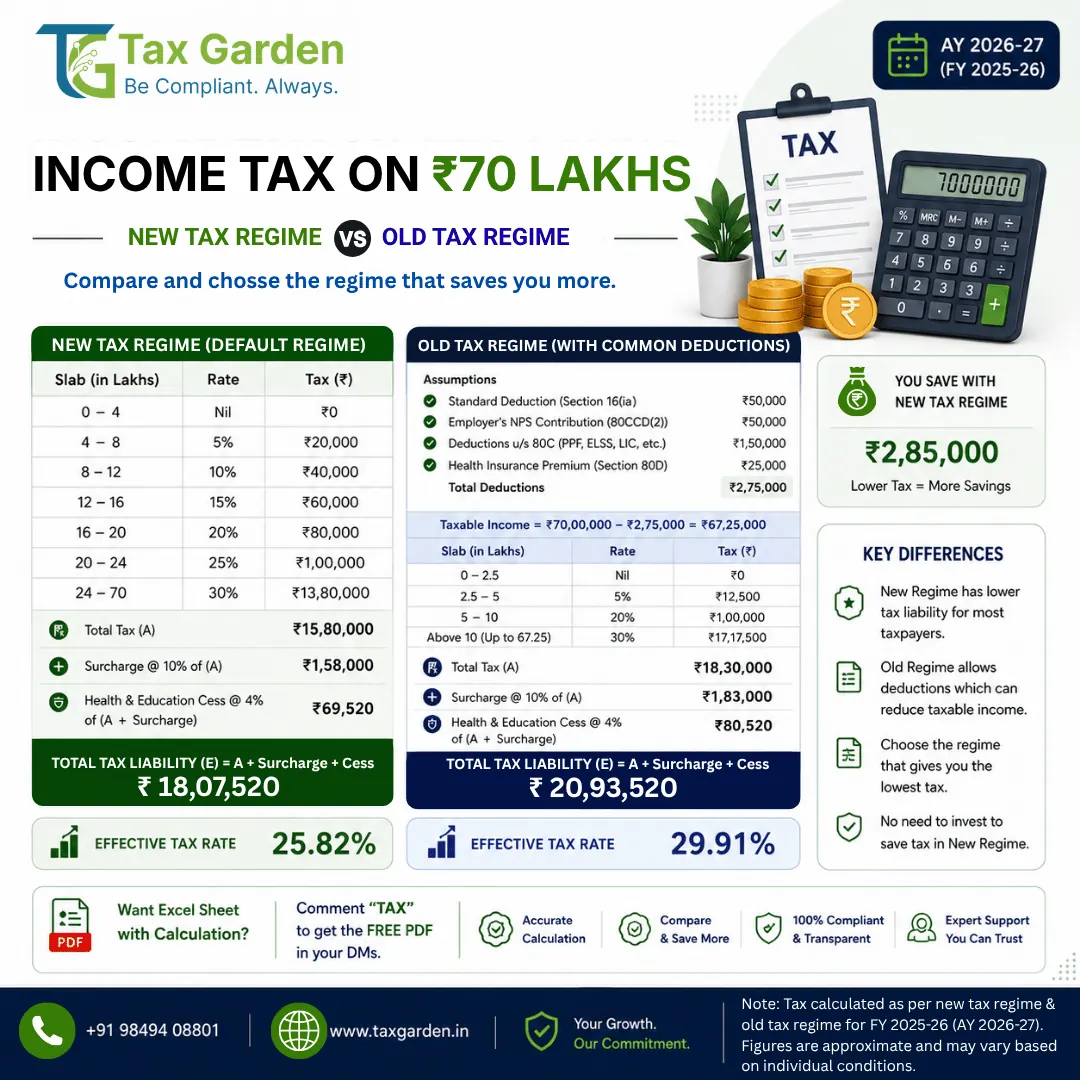
A Rs 70 lakh annual income is a significant milestone. It places you firmly in the highest tax brackets and triggers additional levies like surcharge. But how much of that income actually stays in your pocket? The answer depends largely on which tax regime you choose and the deductions you can claim.
This guide provides a detailed, verified comparison of the New Tax Regime versus the Old Tax Regime for a Rs 70 lakh income for FY 2025-26 (AY 2026-27). All calculations are based on official rates and standard assumptions.
Looking for expert help with income tax on 70 lakh, new tax regime vs old tax regime, surcharge on income tax, tax planning India, income tax slabs 2026? The team at Tax Garden, based in Kondapur, Hyderabad, helps Indian SMEs stay compliant. End-to-end filings, notices, and deadline tracking, all in one place.
New Tax Regime (Default Regime)
The New Tax Regime is the default option for taxpayers. It offers lower slab rates but does not allow most deductions and exemptions.
Step 1: Calculate Taxable Income
To compare like with like, we assume the same employer NPS contribution of Rs 50,000 used in the old regime example below. Employer NPS under Section 80CCD(2) is allowed in both regimes.
| Particulars | Amount |
|---|---|
| Gross Salary | Rs 70,00,000 |
| Less: Standard Deduction (new regime) | (Rs 75,000) |
| Less: Employer's NPS Contribution (80CCD(2)) | (Rs 50,000) |
| Taxable Income | Rs 68,75,000 |
Step 2: Calculate Income Tax
For FY 2025-26 (AY 2026-27), the New Tax Regime slabs are:
| Income Slab | Rate | Tax Calculation |
|---|---|---|
| Up to Rs 4,00,000 | Nil | Rs 0 |
| Rs 4,00,001 - Rs 8,00,000 | 5% | Rs 20,000 |
| Rs 8,00,001 - Rs 12,00,000 | 10% | Rs 40,000 |
| Rs 12,00,001 - Rs 16,00,000 | 15% | Rs 60,000 |
| Rs 16,00,001 - Rs 20,00,000 | 20% | Rs 80,000 |
| Rs 20,00,001 - Rs 24,00,000 | 25% | Rs 1,00,000 |
| Rs 24,00,001 - Rs 68,75,000 | 30% | Rs 13,42,500 |
Total Income Tax (A): Rs 16,42,500
Step 3: Apply Surcharge
When taxable income exceeds Rs 50 lakh, a surcharge applies. For income between Rs 50 lakh and Rs 1 crore, the surcharge rate is 10%.
| Component | Amount |
|---|---|
| Income Tax (A) | Rs 16,42,500 |
| Surcharge @ 10% of (A) | Rs 1,64,250 |
| Tax + Surcharge (B) | Rs 18,06,750 |
Step 4: Health and Education Cess
A 4% Health and Education Cess is levied on the tax plus surcharge.
| Component | Amount |
|---|---|
| Tax + Surcharge (B) | Rs 18,06,750 |
| Cess @ 4% of (B) | Rs 72,270 |
| Total Tax Liability | Rs 18,79,020 |
New Regime Summary
| Component | Amount |
|---|---|
| Income Tax | Rs 16,42,500 |
| Surcharge (10%) | Rs 1,64,250 |
| Health & Education Cess (4%) | Rs 72,270 |
| Total Tax | Rs 18,79,020 |
| Effective Tax Rate | 26.84% |
Without any employer NPS contribution, taxable income is Rs 69,25,000 and the total tax is Rs 18,96,180 (27.09%).
Old Tax Regime (With Common Deductions)
The Old Tax Regime allows various deductions and exemptions, but has higher slab rates.
Assumptions for Deductions
To make a fair comparison, we assume the taxpayer claims the following common deductions:
| Deduction | Amount |
|---|---|
| Standard Deduction (Section 16(ia)) | Rs 50,000 |
| Employer's NPS Contribution (80CCD(2)) | Rs 50,000 |
| Deductions under Section 80C | Rs 1,50,000 |
| Health Insurance Premium (Section 80D) | Rs 25,000 |
| Total Deductions | Rs 2,75,000 |
Taxable Income = Rs 70,00,000 - Rs 2,75,000 = Rs 67,25,000
Step 1: Calculate Income Tax
For FY 2025-26 (AY 2026-27), the Old Tax Regime slabs are:
| Income Slab | Rate | Tax Calculation |
|---|---|---|
| Up to Rs 2,50,000 | Nil | Rs 0 |
| Rs 2,50,001 - Rs 5,00,000 | 5% | Rs 12,500 |
| Rs 5,00,001 - Rs 10,00,000 | 20% | Rs 1,00,000 |
| Above Rs 10,00,000 | 30% | Rs 17,17,500 |
Total Income Tax (A): Rs 18,30,000
Step 2: Apply Surcharge
Since taxable income exceeds Rs 50 lakh, a 10% surcharge applies.
| Component | Amount |
|---|---|
| Income Tax (A) | Rs 18,30,000 |
| Surcharge @ 10% of (A) | Rs 1,83,000 |
| Tax + Surcharge (B) | Rs 20,13,000 |
Step 3: Health and Education Cess
A 4% Health and Education Cess is levied on the tax plus surcharge.
| Component | Amount |
|---|---|
| Tax + Surcharge (B) | Rs 20,13,000 |
| Cess @ 4% of (B) | Rs 80,520 |
| Total Tax Liability | Rs 20,93,520 |
Old Regime Summary
| Component | Amount |
|---|---|
| Income Tax | Rs 18,30,000 |
| Surcharge (10%) | Rs 1,83,000 |
| Health & Education Cess (4%) | Rs 80,520 |
| Total Tax | Rs 20,93,520 |
| Effective Tax Rate | 29.91% |
Key Differences: New Regime vs Old Regime
| Factor | New Regime | Old Regime |
|---|---|---|
| Taxable Income | Rs 68,75,000 | Rs 67,25,000 |
| Income Tax | Rs 16,42,500 | Rs 18,30,000 |
| Surcharge | Rs 1,64,250 | Rs 1,83,000 |
| Cess | Rs 72,270 | Rs 80,520 |
| Total Tax | Rs 18,79,020 | Rs 20,93,520 |
| Effective Tax Rate | 26.84% | 29.91% |
| Tax Savings (New Regime) | - | Rs 2,14,500 |
Which Regime Should You Choose?
Based on the calculations above, the New Tax Regime saves Rs 2,14,500 compared to the Old Tax Regime for a Rs 70 lakh income, assuming the deductions mentioned above.
When the New Regime Works Best
- You do not have significant tax-saving investments
- You prefer simplicity without tracking multiple deductions
- Your employer does not provide substantial benefits like HRA or LTA
When the Old Regime May Still Be Better
- You have substantial deductions beyond the ones assumed (e.g., higher NPS, larger 80C investments, home loan interest, HRA)
- You are willing to invest in tax-saving instruments
- Your total deductions and exemptions (including the Rs 50,000 standard deduction and employer NPS) exceed about Rs 9 lakh, the break-even point at this income
Important Note
The New Tax Regime does not allow most deductions, including Section 80C, 80D, HRA, and LTA. Under the New Regime, salaried employees mainly claim the standard deduction of Rs 75,000 and employer NPS under Section 80CCD(2) (up to 14% of basic plus DA). Under the Old Regime, the standard deduction is Rs 50,000. This difference is already factored into the calculations above.
Additional Considerations for High-Income Taxpayers
1. Surcharge Impact
The surcharge is often the biggest surprise for high-income earners. It is an additional tax on the tax itself: a 10% surcharge applies for income above Rs 50 lakh, 15% above Rs 1 crore, and 25% above Rs 2 crore. Above Rs 5 crore, the old regime rate is 37%, while the new regime stays capped at 25%.
2. Marginal Relief
The government provides marginal relief to ensure the surcharge does not make the tax payable exceed the additional income earned. This is particularly relevant for taxpayers whose income is just above the Rs 50 lakh or Rs 1 crore threshold.
3. Tax Planning Strategies
- Maximize 80C deductions: PPF, ELSS, life insurance, NSC, etc. (Rs 1.5 lakh limit)
- NPS contribution: Additional Rs 50,000 under Section 80CCD(1B)
- Health insurance: Section 80D (Rs 25,000 for self/family, Rs 50,000 for senior citizens)
- Home loan interest: Section 24(b) deduction
- HRA exemption: If you receive House Rent Allowance
Summary: Key Takeaways
| Point | Detail |
|---|---|
| New Regime Tax on Rs 70 Lakh | Rs 18.79 Lakh with Rs 50,000 employer NPS (26.84%); Rs 18.96 Lakh without it (27.09%) |
| Old Regime Tax on Rs 70 Lakh | Approximately Rs 20.94 Lakh (29.91% effective rate) |
| Tax Savings (New vs Old) | Rs 2.15 Lakh (with the assumed deductions) |
| Surcharge Trigger | Taxable income above Rs 50 Lakh (10% surcharge) |
| Cess Rate | 4% on income tax + surcharge |
| 80C Limit | Rs 1.5 Lakh (Old Regime only) |
| Standard Deduction (New) | Rs 75,000 |
| Standard Deduction (Old) | Rs 50,000 |
Note: Calculations are for FY 2025-26 (AY 2026-27) and assume a salaried individual. Actual tax liability may vary based on additional deductions, exemptions, and marginal relief. The Old Regime calculation assumes common deductions of Rs 2,75,000. Verify current rates on incometaxindia.gov.in before acting, as rules may be updated periodically.
Where Tax Garden Helps
Choosing between the New and Old Tax Regimes requires careful calculation and planning. A wrong choice can cost you lakhs in additional tax.
Tax Garden's tax experts help you:
- Calculate accurate tax liability under both regimes
- Identify all eligible deductions under the Old Regime
- Plan tax-saving investments to maximize benefits
- File your ITR accurately and on time
- Respond to tax notices and assessments
Looking for expert help with income tax on 70 lakh, new tax regime vs old tax regime, surcharge on income tax, tax planning India, income tax slabs 2026? The team at Tax Garden, based in Kondapur, Hyderabad, helps Indian SMEs stay compliant. End-to-end filings, notices, and deadline tracking, all in one place.
Sources: Income Tax Department (incometaxindia.gov.in); Mint; CNBC TV18; ET Now; Bajaj Finserv; Motilal Oswal; Vakilsearch; TaxGuru. Verify current rates, slabs, and surcharge thresholds on incometaxindia.gov.in before acting, as rules may be updated periodically. This article is general information on income tax calculation and not a substitute for professional advice.
Frequently Asked Questions
How much tax does a salaried person earning Rs 70 lakh pay under the new regime for AY 2026-27?
After the Rs 75,000 standard deduction, taxable income is Rs 69,25,000. Slab tax is Rs 16,57,500 (Rs 3,00,000 up to Rs 24 lakh plus 30% on the balance). Adding the 10% surcharge gives Rs 18,23,250, and 4% cess brings the total to about Rs 18,96,180, an effective rate of roughly 27% of gross salary.
Why does income above Rs 50 lakh attract a surcharge?
Surcharge is an extra levy on the income tax itself for high earners: 10% when total income exceeds Rs 50 lakh, 15% above Rs 1 crore and 25% above Rs 2 crore, with the new regime capped at 25%. The 4% health and education cess is then charged on tax plus surcharge. At Rs 70 lakh, the 10% surcharge adds over Rs 1.6 lakh.
What is marginal relief on surcharge for income just above Rs 50 lakh?
Marginal relief ensures that the extra tax and surcharge caused by crossing Rs 50 lakh does not exceed the income earned above Rs 50 lakh. For example, under the new regime, tax on exactly Rs 50 lakh is Rs 10,80,000. If income is Rs 50,50,000, tax plus surcharge is limited to Rs 10,80,000 plus Rs 50,000, before cess, instead of the full 10% surcharge.
Can the old regime ever beat the new regime at Rs 70 lakh income?
Only with very large deductions. With the usual claims of Rs 50,000 standard deduction, Rs 1.5 lakh under 80C, Rs 25,000 under 80D and employer NPS, the old regime costs around Rs 2 lakh more. It can come close only if you also have large HRA exemption, home loan interest of up to Rs 2 lakh, 80CCD(1B) NPS and other deductions adding up to several lakh rupees.
Is employer NPS contribution deductible under the new regime?
Yes. Employer contribution to NPS under Section 80CCD(2) is one of the few deductions allowed in the new regime, up to 14% of basic salary plus DA for all employees from FY 2024-25, compared with 10% for private sector employees under the old regime. At high incomes, restructuring salary to include employer NPS is one of the most effective ways to lower tax under the new regime.
Work with the Trusted Tax & Compliance Services in Kondapur, Hyderabad - Tax Garden for expert GST filing, ITR, TDS, ROC, and startup compliance support.
Frequently Asked Questions: Tax Services in Kondapur & Hyderabad
What makes Tax Garden a preferred GST consultant in Kondapur?
Tax Garden is ISO 9001:2015 certified and backs every engagement with Kavach, our ₹50,000 error-protection cover. Our flat-fee, no-surprise pricing and dedicated account manager make us a compliance partner for startups and SMEs in Kondapur's HITEC City corridor.
Why is Tax Garden a trusted tax compliance partner in Hyderabad?
Trust comes from three pillars at Tax Garden. First, transparency: you know the exact fee before you sign up, and it never changes mid-year. Second, certified expertise: our compliance team is qualified, and the firm holds ISO 9001:2015 certification. Third, accountability: Kavach, our unique error-protection plan, covers up to ₹50,000 in service charges for any clerical mistake made by our team.
Is there a reliable tax consultant near me in Kondapur?
Yes. Tax Garden's office is in Kondapur itself (CWS One Building, Hanuman Nagar). You can book an in-person consultation or get everything done fully online via WhatsApp and our client portal. We serve walk-in clients by appointment and remote clients across all of Hyderabad and Telangana.
I want a friendly CA who explains things clearly. Is that Tax Garden?
Absolutely. Every client gets a dedicated account manager reachable on WhatsApp, plain-language explanations of what is filed and why, and proactive reminders before every deadline. No jargon, no surprises, just friendly, expert compliance support from Kondapur.
Where is Tax Garden located in Hyderabad?
Tax Garden is located at 4th Floor, South Block, CWS One Building, Hanuman Nagar, Kondapur, Hyderabad, Telangana 500084. We serve clients across Kondapur, HITEC City, Gachibowli, Madhapur, Jubilee Hills, Banjara Hills, and all of Hyderabad.
Can I get GST filing and registration services in Kondapur?
Yes. Tax Garden offers end-to-end GST services from our Kondapur office: GST registration, GSTR-1, GSTR-3B, GSTR-9 annual returns, ITC reconciliation, e-invoicing setup, and GST notice handling for businesses of all sizes in Kondapur and Hyderabad.
Do you file ITR for salaried employees and businesses in Hyderabad?
Yes. Our Kondapur team files ITR for salaried employees, freelancers, consultants, business owners, LLPs, and companies across Hyderabad. We cover ITR-1 through ITR-6 with complete Chapter VI-A deduction reconciliation, AIS reconciliation, and proactive deadline management.
Which areas in Hyderabad does Tax Garden serve?
Tax Garden's Kondapur office serves clients across Hyderabad including HITEC City, Gachibowli, Madhapur, Jubilee Hills, Banjara Hills, Begumpet, Secunderabad, Ameerpet, Kukatpally, Uppal, LB Nagar, and all of Telangana. Most services are available fully online.
What compliance services does Tax Garden offer for startups in Kondapur?
Tax Garden is a compliance partner for startups in Kondapur and Hyderabad's HITEC City corridor. We handle company incorporation, GST registration, TDS filings, payroll, ROC annual filings, director KYC, and annual ITR filing, all under one flat-fee plan.
How does Tax Garden's compliance model compare to traditional hourly accounting services in Hyderabad?
Unlike traditional accounting practices that charge hourly and are difficult to reach, Tax Garden operates on flat-fee subscription plans with a dedicated account manager, monthly compliance updates, and WhatsApp-first communication. Our AI-powered workflow catches errors before filings are submitted, and Kavach error-protection ensures you are never left alone if something goes wrong.