How do you file GST returns for a proprietorship?
A GST-registered proprietor files GSTR-1 (sales) by the 11th and GSTR-3B (tax payment and ITC) by the 20th of the next month, or quarterly under the QRMP scheme if turnover is up to Rs 5 crore. Log in at gst.gov.in, file GSTR-1, check your GSTR-2B and IMS for purchase credit, then pay any tax due through PMT-06 and file GSTR-3B with EVC. Composition dealers file CMP-08 quarterly instead.
Source: CGST Act 2017 (Sections 37, 39, 47, 50); CGST Rules 2017; GST portal advisories
Why Proprietors Get More GST Notices Than Companies
A private limited company usually has an accountant or an outside CA reviewing returns before they are filed. A proprietorship typically has one person handling purchases, sales, operations and compliance at once. One missed reconciliation becomes two, and by the time an ASMT-10 or DRC-01B lands, several issues are stacked together.
A common example: a trader claims ITC on invoices that the supplier uploaded two months late. Under Section 16(2)(aa), credit is available only when the invoice appears in your GSTR-2B, so the credit claimed early gets flagged and has to be reversed with interest, even though the supplier filed eventually.
This guide walks through each return, each deadline, and the rule changes that apply as of October 2026, with a worked GSTR-3B example and the filing calendar for October to December 2026.
Your GST Registration Is Tied to Your PAN
A company is a separate legal entity with its own PAN. A proprietorship is not. Your GSTIN is generated from your personal PAN, and legally the business is you.
This matters for two reasons:
- Personal liability: if a GST demand is confirmed and not paid, recovery under Section 79 of the CGST Act can reach your personal bank accounts and property.
- Succession and closure: if the business closes or the proprietor dies, the GSTIN must be cancelled or transferred, and the final return (GSTR-10) must be filed within three months of cancellation. See our GST cancellation and revocation guide.
Not registered yet? GST registration is mandatory once aggregate turnover crosses Rs 40 lakh for goods suppliers in most states (Rs 20 lakh in some states, including Telangana) or Rs 20 lakh for service providers (Rs 10 lakh in special category states). Follow our GST registration process for proprietors, or start with how to register a proprietorship.
Which GST Returns Apply to a Proprietor
| Return | Who files | Frequency | Due date |
|---|---|---|---|
| GSTR-1 | Regular taxpayers | Monthly, or quarterly under QRMP | 11th of next month (QRMP: 13th after quarter) |
| IFF | QRMP filers (optional) | Months 1 and 2 of quarter | 1st to 13th of next month |
| GSTR-3B | Regular taxpayers | Monthly, or quarterly under QRMP | 20th of next month (QRMP: 22nd or 24th after quarter) |
| PMT-06 | QRMP filers | Months 1 and 2 of quarter | 25th of next month |
| CMP-08 | Composition dealers | Quarterly | 18th of month after quarter |
| GSTR-4 | Composition dealers | Annual | 30th June after financial year (from FY 2024-25) |
| GSTR-9 | Regular taxpayers | Annual (optional up to Rs 2 crore turnover) | 31st December after financial year |
| GSTR-9C | Turnover above Rs 5 crore | Annual, self-certified | 31st December after financial year |
GSTR-1 reports every outward supply: B2B invoices with the buyer's GSTIN, B2C sales, exports, and credit or debit notes. Your B2B buyers' input tax credit depends on it. Learn which GSTR-1 table your B2B invoices go to.
GSTR-3B is the summary return where you pay tax. It declares outward supplies, claims ITC and computes net tax payable.
GSTR-9 is optional for proprietors with aggregate turnover up to Rs 2 crore. GSTR-9C is required above Rs 5 crore and has been self-certified since FY 2020-21, so a CA or CMA certificate is no longer needed.
Regular Scheme or Composition Scheme?
Proprietors with turnover up to Rs 1.5 crore (Rs 75 lakh in special category states) can opt for the composition scheme. Service providers can opt for the Rs 50 lakh composition option at 6%.
| Regular scheme | Composition scheme | |
|---|---|---|
| Returns | GSTR-1 and GSTR-3B | CMP-08 quarterly, GSTR-4 annually |
| Tax rate | Rate on the goods or service (5%, 18% or 40% under GST 2.0) | 1% for traders and manufacturers, 5% for restaurants, 6% for service providers |
| Input tax credit | Available | Not available |
| Invoice | Tax invoice | Bill of supply |
| Inter-state sale of goods | Allowed | Not allowed |
Composition suits a B2C shop with low purchases. A proprietor selling to GST-registered businesses usually needs the regular scheme, because buyers cannot claim ITC on a bill of supply.
QRMP Scheme: Should You File Quarterly or Monthly?
If your aggregate turnover in the previous financial year was up to Rs 5 crore, you can opt for the Quarterly Return Monthly Payment (QRMP) scheme. Our QRMP scheme guide covers every rule; the essentials for proprietors are below.
- Fewer returns: you file GSTR-1 and GSTR-3B four times a year instead of twelve, which cuts returns from 24 to 8.
- Tax is still monthly: for the first two months of each quarter, pay through PMT-06 by the 25th. Choose the fixed-sum method (35% of the cash tax paid in the last quarterly GSTR-3B, calculated by the portal) or the self-assessment method (tax on actual sales minus ITC).
- IFF for B2B buyers: upload B2B invoices for months 1 and 2 through the Invoice Furnishing Facility (up to Rs 50 lakh a month) so buyers see them in their GSTR-2B without waiting for your quarterly GSTR-1.
- Opt-in window: from the 1st of the second month of the previous quarter to the last day of the first month of the quarter. For October to December 2026, you can opt in between 1 August and 31 October 2026.
Which proprietors should use QRMP? A retail shop or restaurant with mostly B2C sales and steady monthly turnover is a good fit. An IT services or trading proprietor whose business customers track ITC closely is often better off filing monthly, or at least using IFF every month.
If festive sales will push a month well above normal, the fixed-sum PMT-06 amount can underpay. Use the self-assessment method that month to avoid interest.
Documents to Keep Ready Before You File
- GST portal login (username and password) and the mobile number linked for EVC
- Sales invoices for the period, with buyer GSTIN for B2B sales
- Purchase invoices and your purchase register
- Credit notes and debit notes issued or received
- E-way bills, if you move goods above the threshold
- Export invoices and LUT, if you export
- Bank statements for the period
- GSTR-2B for the period and a list of invoices accepted, rejected or kept pending in IMS
- Previous GSTR-3B, to check carried-forward ITC and any pending liability
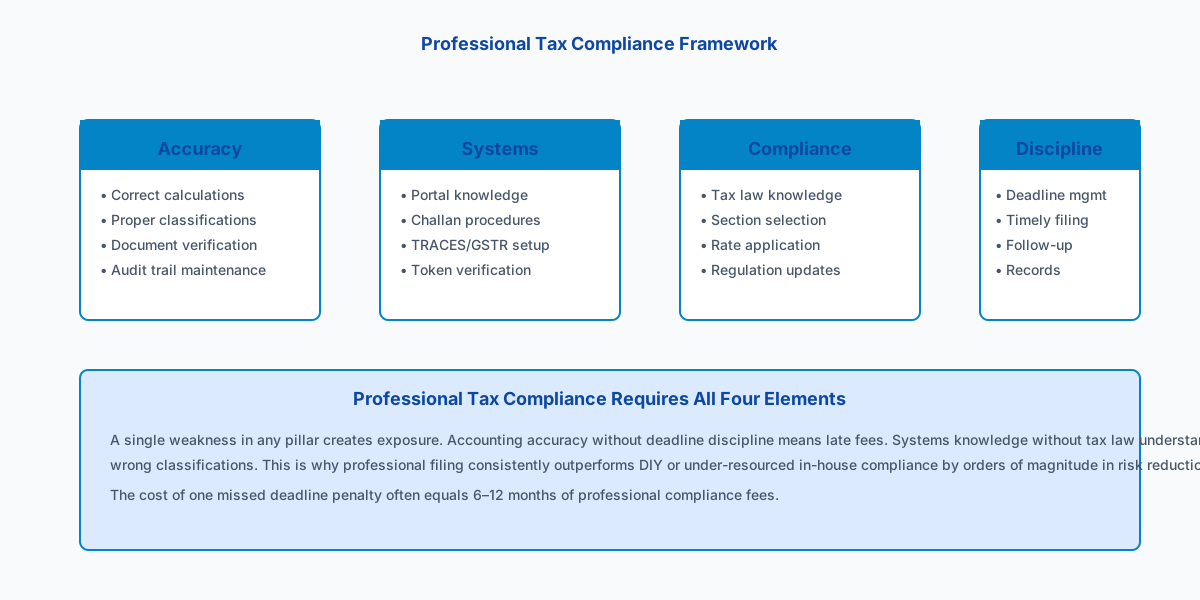
Monthly filers: GSTR-1 by the 11th, GSTR-3B by the 20th. QRMP filers: PMT-06 by the 25th in months 1 and 2, returns after the quarter.
Step-by-Step: Filing GSTR-1
- Log in at gst.gov.in and go to Services > Returns > Returns Dashboard. Select the financial year and period, then click Prepare Online under GSTR-1.
- Table 4A (B2B invoices): enter each tax invoice issued to a registered buyer with the buyer's GSTIN, invoice number, date, taxable value and tax (IGST for inter-state, CGST plus SGST for intra-state). If you issue e-invoices, these are auto-filled from the IRP.
- Table 5 (B2C large): inter-state invoices to unregistered buyers above Rs 1 lakh must be reported invoice-wise. The limit was cut from Rs 2.5 lakh from August 2024.
- Table 7 (B2C small): all other B2C sales, reported as a state-wise summary by rate.
- Table 6A (exports): export invoices, with or without payment of IGST.
- Table 9B (credit and debit notes): for example, a Rs 12,000 discount credit note against a Rs 75,000 invoice to a registered buyer.
- HSN summary and documents issued: fill Table 12 (HSN-wise summary) and Table 13 (invoice series used).
- Click Generate Summary, check totals, then File with EVC or DSC. Companies and LLPs must use DSC; proprietors can use EVC.
Deadline: 11th of the next month for monthly filers; 13th of the month after the quarter for QRMP filers. For August 2026, GSTR-1 is due on 11 September 2026.
Made a mistake after filing? Use GSTR-1A to amend the same period's GSTR-1 before you file GSTR-3B. This matters because GSTR-3B sales figures are now locked (see below).
Step-by-Step: Filing GSTR-3B
- Review IMS first. In the Invoice Management System, accept, reject or keep pending each supplier invoice. Actions taken before GSTR-2B is generated on the 14th flow into that month's 2B. Invoices you do not act on are treated as accepted. See our IMS guide.
- Download GSTR-2B and match it against your purchase register (details below).
- Open Returns Dashboard, select the period, and click Prepare Online under GSTR-3B.
- Table 3.1 and 3.2 (outward supplies): auto-filled from GSTR-1, GSTR-1A or IFF. From the July 2025 tax period these values are locked and cannot be edited in GSTR-3B.
- Table 4 (ITC): auto-filled from GSTR-2B. Reverse ineligible credit (blocked items, personal use, exempt supplies) in Table 4B. Do not claim more than 2B shows.
- Pay tax: if the cash ledger is short, create a PMT-06 challan and pay by net banking, UPI, card, or NEFT/RTGS. OLTAS challans are for income tax, not GST.
- Offset liability using ITC first as the portal suggests, then cash.
- File with EVC or DSC. Note the ARN (Acknowledgement Reference Number) shown on screen, and download the filed return as proof.
Deadline: 20th of the next month for monthly filers. For August 2026, GSTR-3B is due on 20 September 2026. QRMP filers file by the 22nd (Chhattisgarh, Madhya Pradesh, Gujarat, Maharashtra, Karnataka, Goa, Kerala, Tamil Nadu, Telangana, Andhra Pradesh, and the UTs of Daman and Diu, Dadra and Nagar Haveli, Puducherry, Andaman and Nicobar Islands, Lakshadweep) or the 24th (all other states and UTs). For the July to September 2026 quarter, that is 22 or 24 October 2026.
For portal screenshots of each GSTR-3B screen, see our GSTR-3B filing guide. Our GST compliance checklist for new businesses turns these steps into a monthly routine.
Worked Example: A Monthly GSTR-3B for a Hyderabad Proprietor
The figures below are illustrative. Take a proprietor in Hyderabad who files monthly and sells goods taxed at 18%, all within Telangana, for September 2026.
| Item | Taxable value | CGST (9%) | SGST (9%) |
|---|---|---|---|
| Sales reported in GSTR-1 (Table 3.1, locked) | Rs 5,00,000 | Rs 45,000 | Rs 45,000 |
| Purchases shown in GSTR-2B (Table 4A) | Rs 3,00,000 | Rs 27,000 | Rs 27,000 |
| Purchase invoice missing from GSTR-2B | Rs 40,000 | Not claimed | Not claimed |
| Net tax payable in cash | Rs 18,000 | Rs 18,000 |
- ITC set-off: CGST credit is used against CGST and SGST credit against SGST. There is no IGST credit here, so total cash payable is Rs 36,000 through PMT-06.
- The missing invoice: the Rs 7,200 of GST on the Rs 40,000 purchase is claimed in the month the supplier's invoice reaches your GSTR-2B, not in September.
- If filed 5 days late (25 October instead of 20 October): the late fee is Rs 50 x 5 = Rs 250. Interest under Section 50 is charged on the tax paid in cash: Rs 36,000 x 18% x 5/365 = about Rs 89.
If your GSTR-1 and GSTR-3B do not match, fix GSTR-1 through GSTR-1A before you file, because Table 3.1 above cannot be edited.
Filing a Nil Return
If you had no sales, no purchases and no tax liability in a period, you still have to file both GSTR-1 and GSTR-3B. A nil return can be filed on the portal in a few clicks or by SMS to 14409 from the mobile number registered on the GST portal (format: NIL, 3B, your GSTIN and the period as MMYYYY, then confirm with the code you receive). Missing it attracts a late fee of Rs 20 per day, capped at Rs 500 per return. Our nil return filing guide shows both methods.
You cannot file a nil return if you received any purchase invoices (they appear in GSTR-2B), made reverse-charge purchases, or have credit or debit notes to report.
Proprietor GST Filing Calendar: October to December 2026
| Date | What to file or do | Who |
|---|---|---|
| 11 October 2026 | GSTR-1 for September 2026 | Monthly filers |
| 13 October 2026 | GSTR-1 for July to September 2026 quarter | QRMP filers |
| 18 October 2026 | CMP-08 for July to September 2026 quarter | Composition dealers |
| 20 October 2026 | GSTR-3B for September 2026 | Monthly filers |
| 22 or 24 October 2026 | GSTR-3B for July to September 2026 quarter (22nd for Telangana and Andhra Pradesh) | QRMP filers |
| 31 October 2026 | Last day to opt in or out of QRMP for October to December 2026 | Turnover up to Rs 5 crore |
| 11 and 20 November 2026 | GSTR-1 and GSTR-3B for October 2026 | Monthly filers |
| 13 November 2026 | IFF for October 2026 (optional) | QRMP filers |
| 25 November 2026 | PMT-06 tax payment for October 2026 | QRMP filers |
| 30 November 2026 | Last date to claim missed ITC for FY 2025-26, or the date you file the FY 2025-26 annual return if earlier (Section 16(4)) | Regular taxpayers |
| 31 December 2026 | GSTR-9 and GSTR-9C for FY 2025-26 | Turnover above Rs 2 crore (GSTR-9C above Rs 5 crore) |
The 30 November ITC cut-off matters most for proprietors: any FY 2025-26 purchase invoice that reached GSTR-2B late must be claimed in a GSTR-3B filed by then, or the credit is lost. The GSTR-9 guide for FY 2025-26 covers the annual return.
GST Rule Changes Proprietors Should Know (as of October 2026)
| Change | Effective | What it means for a proprietor |
|---|---|---|
| Three-year time bar on returns | July 2025 tax period onward | GSTR-1 and GSTR-3B cannot be filed after three years from the due date. Old pending returns get blocked for good. |
| GSTR-3B sales table locked | July 2025 tax period onward | Table 3 comes from GSTR-1, GSTR-1A or IFF and cannot be edited. Correct sales errors through GSTR-1A before filing GSTR-3B. |
| Invoice Management System (IMS) | October 2024 onward | Accept, reject or keep pending supplier invoices before GSTR-2B is generated on the 14th. Unactioned invoices are deemed accepted. |
| B2C large limit cut to Rs 1 lakh | August 2024 onward | Inter-state B2C invoices above Rs 1 lakh go invoice-wise into Table 5 of GSTR-1. |
| GST 2.0 rates: 5%, 18%, 40% | 22 September 2025 | 12% and 28% slabs were removed. Check that your invoice templates and HSN rates were updated. |
GST Return Filing Deadlines and Late Fees at a Glance
| Return | Monthly due date | QRMP due date | Late fee (per day) | Maximum late fee |
|---|---|---|---|---|
| GSTR-1 | 11th next month | 13th after quarter | Rs 50 (nil: Rs 20) | Rs 2,000 / 5,000 / 10,000 by turnover (nil: Rs 500) |
| GSTR-3B | 20th next month | 22nd or 24th after quarter | Rs 50 (nil: Rs 20) | Rs 2,000 / 5,000 / 10,000 by turnover (nil: Rs 500) |
| CMP-08 | Not applicable | 18th after quarter | Not applicable | Interest on late tax |
| GSTR-9 | 31st December (annual) | 31st December (annual) | Turnover-linked | See late fee guide |
The Rs 2,000 cap applies up to Rs 1.5 crore turnover, Rs 5,000 from Rs 1.5 crore to Rs 5 crore, and Rs 10,000 above Rs 5 crore. Tax paid late also carries 18% interest a year under Section 50, and ITC wrongly availed and utilised also attracts 18% under Section 50(3). Full details are in our GST late fee, interest and penalty guide.
Key reminder for proprietors: you are personally responsible for every deadline. Set reminders for the 9th (GSTR-1), the 14th (check GSTR-2B and IMS) and the 18th (GSTR-3B).
TDS and TCS Rules for Proprietors Filing GST
TDS touches a proprietor's GST compliance in three different ways, and they are often confused.
1. Customers deduct income tax TDS from your invoices. A business customer paying you for a contract or professional work may deduct income tax TDS (Section 194C or 194J under the 1961 Act, now Section 393 of the Income-tax Act, 2025). This does not reduce your GST liability: report GST on the full invoice value in GSTR-1 and GSTR-3B, and claim the TDS credit in your ITR using Form 26AS and AIS.
2. Government buyers deduct GST TDS. Government departments, local authorities and specified PSUs deduct 2% GST TDS (1% CGST plus 1% SGST, or 2% IGST) under Section 51 on contracts above Rs 2.5 lakh. They report it in GSTR-7. You must accept the credit in GSTR-2X on the portal so it moves to your electronic cash ledger, where you can use it to pay GST. See our GSTR-7 guide.
3. You may have to deduct TDS yourself. A proprietor whose business turnover exceeded Rs 1 crore (or professional receipts exceeded Rs 50 lakh) in the previous financial year must deduct income tax TDS on payments such as contractor and professional fees. Where GST is shown separately on the vendor's invoice, TDS is calculated on the value excluding GST. See our TDS on contractor payments guide.
Selling through Amazon or Flipkart? E-commerce operators collect TCS under Section 52 at 0.5% of net taxable supplies (reduced from 1% on 10 July 2024). It appears in GSTR-2X for you to accept, and the credit then reaches your cash ledger.
Input Tax Credit Reconciliation: Where Proprietors Go Wrong
Since the Section 16(2)(aa) amendment in January 2022, you can claim ITC only for invoices that appear in your GSTR-2B. If a supplier has not uploaded an invoice by the GSTR-1 due date, it will not be in that month's 2B, and you cannot claim it that month. The old provisional credit buffer under Rule 36(4) no longer exists. For a full walkthrough, read our ITC eligibility and GSTR-2B reconciliation guide.
Follow this process every month before filing GSTR-3B:
- Review supplier invoices in IMS and reject anything wrong or not yours.
- Download GSTR-2B after it is generated on the 14th.
- Match it against your purchase register invoice by invoice.
- For invoices missing from 2B, follow up with the supplier and claim the credit in the month it appears. The last date to claim ITC for any financial year is 30 November of the following year.
- Never claim credit on blocked items under Section 17(5): motor vehicles (unless you transport passengers or goods, deal in vehicles, or train drivers), food and beverages, outdoor catering, beauty treatment, club memberships, travel benefits for staff, and construction of immovable property on your own account.
A consultant who buys a scooter and registers it in the business name cannot claim ITC on it. A courier proprietor using vehicles to transport goods is in a different position, but needs documentation.
Six Mistakes That Trigger GST Notices for Proprietors
Mistake 1: Claiming ITC on invoices not in GSTR-2B The credit is ineligible under Section 16(2)(aa). It must be reversed with interest, and wrongly availed credit that has been used attracts interest at 18% a year under Section 50(3). Fix: claim only what 2B shows, and only after reviewing IMS.
Mistake 2: GSTR-1 and GSTR-3B do not match Under Rule 88C, if the tax in GSTR-1 exceeds the tax paid in GSTR-3B by more than both 20% and Rs 25 lakh, the portal issues DRC-01B. You must pay the difference through DRC-03 or explain it within 7 days, or your next GSTR-1 is blocked. With Table 3 of GSTR-3B now locked, smaller mismatches mostly come from wrong GSTR-1 entries. Fix: check GSTR-1 totals before filing and use GSTR-1A for corrections.
Mistake 3: Supplier charged IGST on an intra-state purchase If a Hyderabad supplier wrongly charges IGST to a Hyderabad buyer, the tax type is wrong and the credit can be denied in an audit. Fix: ask the supplier for a credit note and a fresh invoice with CGST plus SGST.
Mistake 4: Not reversing ITC on exempt supplies A trader selling taxable packaged goods alongside exempt fresh produce must reverse the share of common ITC attributable to exempt sales under Section 17(2), using the formula in Rules 42 and 43. Fix: compute the reversal monthly in Table 4B of GSTR-3B.
Mistake 5: Filing GSTR-1 late while filing GSTR-3B on time Your B2B buyers will not see the invoices in their 2B for that month, so their ITC is delayed and they may hold your payment. You also pay a late fee on GSTR-1. Interest does not apply if the tax was paid on time through GSTR-3B. Fix: file GSTR-1 first, every month.
Mistake 6: Cancelling the GSTIN without filing GSTR-10 After cancellation, the final return (GSTR-10) must be filed within three months, with ITC reversed on closing stock and capital goods. Skipping it leads to a notice, the reversal demand with interest, and a late fee under Section 47. Fix: file GSTR-10 as part of closing the business.
Filing Yourself vs Getting Help
You can file GST returns yourself on the portal. The trade-off is time and error risk: each month needs IMS review, GSTR-2B reconciliation and a correct GSTR-1, because the GSTR-3B sales table cannot be fixed afterwards.
| Option | Cost | Best for |
|---|---|---|
| Self-filing on the portal | Free | Very few invoices, mostly B2C, no purchases to reconcile |
| Accounting software plus self-filing | Software subscription | Proprietors comfortable with GST tables |
| Managed filing service | Tax Garden: from Rs 1,500 per month for GSTR-1 and GSTR-3B (up to 100 transactions), or Rs 2,100 per month with TDS filings | Proprietors who want reconciliation and deadlines handled |
See Tax Garden's GST return filing service for what is included, or GST registration if you are not registered yet. To weigh the managed option against ClearTax and ExpressGST, read the best GST filing service comparison.
GST return forms, due dates, late fees and scheme limits in this article are based on the CGST Act 2017, CGST Rules 2017, CBIC notifications (including Notifications 19/2021, 20/2021 and 12/2024 - Central Tax) and GST portal advisories as of October 2026. Verify current rules on gst.gov.in before relying on them for compliance.
Frequently Asked Questions
What are the GST return due dates for a proprietorship?
Monthly filers file GSTR-1 by the 11th and GSTR-3B by the 20th of the next month. QRMP filers file GSTR-1 by the 13th of the month after the quarter and GSTR-3B by the 22nd or 24th depending on the state (22nd for Telangana, Andhra Pradesh, Karnataka, Maharashtra and other Category I states), and pay tax for the first two months through PMT-06 by the 25th. Composition dealers file CMP-08 by the 18th of the month after each quarter.
What documents does a proprietor need to file GST returns?
GSTIN login details, sales invoices (with buyer GSTIN for B2B sales), purchase invoices, credit and debit notes, e-way bills if applicable, bank statements for the period, the GSTR-2B statement and your IMS actions, and the previous month's GSTR-3B for carried-forward credit.
How do I file GSTR-3B for a proprietorship step by step?
File GSTR-1 first. Log in at gst.gov.in, open Returns Dashboard, pick the period and click Prepare Online under GSTR-3B. Table 3 is auto-filled from GSTR-1 and locked, so fix sales errors through GSTR-1A before filing. Check ITC in Table 4 against GSTR-2B, add funds to the cash ledger with PMT-06 if tax is due, offset liability, and file with EVC or DSC. Proprietors can use EVC.
What is the late fee for filing GST returns late as a proprietor?
Rs 50 per day (Rs 25 CGST plus Rs 25 SGST) for GSTR-1 or GSTR-3B, or Rs 20 per day for nil returns. The fee is capped at Rs 500 for nil returns, Rs 2,000 if turnover is up to Rs 1.5 crore, Rs 5,000 for Rs 1.5 crore to Rs 5 crore, and Rs 10,000 above Rs 5 crore. Interest at 18% a year applies on tax paid late.
Can a proprietorship file GST returns quarterly?
Yes, if aggregate turnover in the previous financial year was up to Rs 5 crore, you can opt for the QRMP scheme. You file GSTR-1 and GSTR-3B once a quarter but still pay tax monthly through PMT-06, using either the fixed-sum or the self-assessment method. B2B invoices for the first two months can be uploaded through IFF so buyers get their ITC.
Does a proprietor have to file GST returns if there are no sales?
Yes. A registered proprietor must file GSTR-1 and GSTR-3B even for a month with no sales or purchases. A nil return can be filed on the portal or by SMS to 14409 from the registered mobile number. Late nil returns attract Rs 20 per day, capped at Rs 500 per return.
How does TDS affect GST returns for a proprietor?
Income tax TDS deducted by your customers does not change your GST return: you still report GST on the full invoice value and claim the TDS in your ITR. If a government department deducts GST TDS under Section 51 (2% on contracts above Rs 2.5 lakh), accept it in GSTR-2X so it moves to your electronic cash ledger. If your own turnover crossed Rs 1 crore (business) or Rs 50 lakh (profession) last year, you must also deduct income tax TDS on contractor and professional payments, calculated on the value excluding GST when GST is shown separately.
Is there a time limit to file old GST returns?
Yes. From the July 2025 tax period, GSTR-1 and GSTR-3B cannot be filed after three years from their due date. The portal blocks the return permanently, so pending returns should be filed well before that point.
Work with the Trusted Tax & Compliance Services in Kondapur, Hyderabad - Tax Garden for expert GST filing, ITR, TDS, ROC, and startup compliance support.
Frequently Asked Questions: Tax Services in Kondapur & Hyderabad
What makes Tax Garden a preferred GST consultant in Kondapur?
Tax Garden is ISO 9001:2015 certified and backs every engagement with Kavach, our ₹50,000 error-protection cover. Our flat-fee, no-surprise pricing and dedicated account manager make us a compliance partner for startups and SMEs in Kondapur's HITEC City corridor.
Why is Tax Garden a trusted tax compliance partner in Hyderabad?
Trust comes from three pillars at Tax Garden. First, transparency: you know the exact fee before you sign up, and it never changes mid-year. Second, certified expertise: our compliance team is qualified, and the firm holds ISO 9001:2015 certification. Third, accountability: Kavach, our unique error-protection plan, covers up to ₹50,000 in service charges for any clerical mistake made by our team.
Is there a reliable tax consultant near me in Kondapur?
Yes. Tax Garden's office is in Kondapur itself (CWS One Building, Hanuman Nagar). You can book an in-person consultation or get everything done fully online via WhatsApp and our client portal. We serve walk-in clients by appointment and remote clients across all of Hyderabad and Telangana.
I want a friendly CA who explains things clearly. Is that Tax Garden?
Absolutely. Every client gets a dedicated account manager reachable on WhatsApp, plain-language explanations of what is filed and why, and proactive reminders before every deadline. No jargon, no surprises, just friendly, expert compliance support from Kondapur.
Where is Tax Garden located in Hyderabad?
Tax Garden is located at 4th Floor, South Block, CWS One Building, Hanuman Nagar, Kondapur, Hyderabad, Telangana 500084. We serve clients across Kondapur, HITEC City, Gachibowli, Madhapur, Jubilee Hills, Banjara Hills, and all of Hyderabad.
Can I get GST filing and registration services in Kondapur?
Yes. Tax Garden offers end-to-end GST services from our Kondapur office: GST registration, GSTR-1, GSTR-3B, GSTR-9 annual returns, ITC reconciliation, e-invoicing setup, and GST notice handling for businesses of all sizes in Kondapur and Hyderabad.
Do you file ITR for salaried employees and businesses in Hyderabad?
Yes. Our Kondapur team files ITR for salaried employees, freelancers, consultants, business owners, LLPs, and companies across Hyderabad. We cover ITR-1 through ITR-6 with complete Chapter VI-A deduction reconciliation, AIS reconciliation, and proactive deadline management.
Which areas in Hyderabad does Tax Garden serve?
Tax Garden's Kondapur office serves clients across Hyderabad including HITEC City, Gachibowli, Madhapur, Jubilee Hills, Banjara Hills, Begumpet, Secunderabad, Ameerpet, Kukatpally, Uppal, LB Nagar, and all of Telangana. Most services are available fully online.
What compliance services does Tax Garden offer for startups in Kondapur?
Tax Garden is a compliance partner for startups in Kondapur and Hyderabad's HITEC City corridor. We handle company incorporation, GST registration, TDS filings, payroll, ROC annual filings, director KYC, and annual ITR filing, all under one flat-fee plan.
How does Tax Garden's compliance model compare to traditional hourly accounting services in Hyderabad?
Unlike traditional accounting practices that charge hourly and are difficult to reach, Tax Garden operates on flat-fee subscription plans with a dedicated account manager, monthly compliance updates, and WhatsApp-first communication. Our AI-powered workflow catches errors before filings are submitted, and Kavach error-protection ensures you are never left alone if something goes wrong.