Overview: Why the 4 Labour Codes Matter
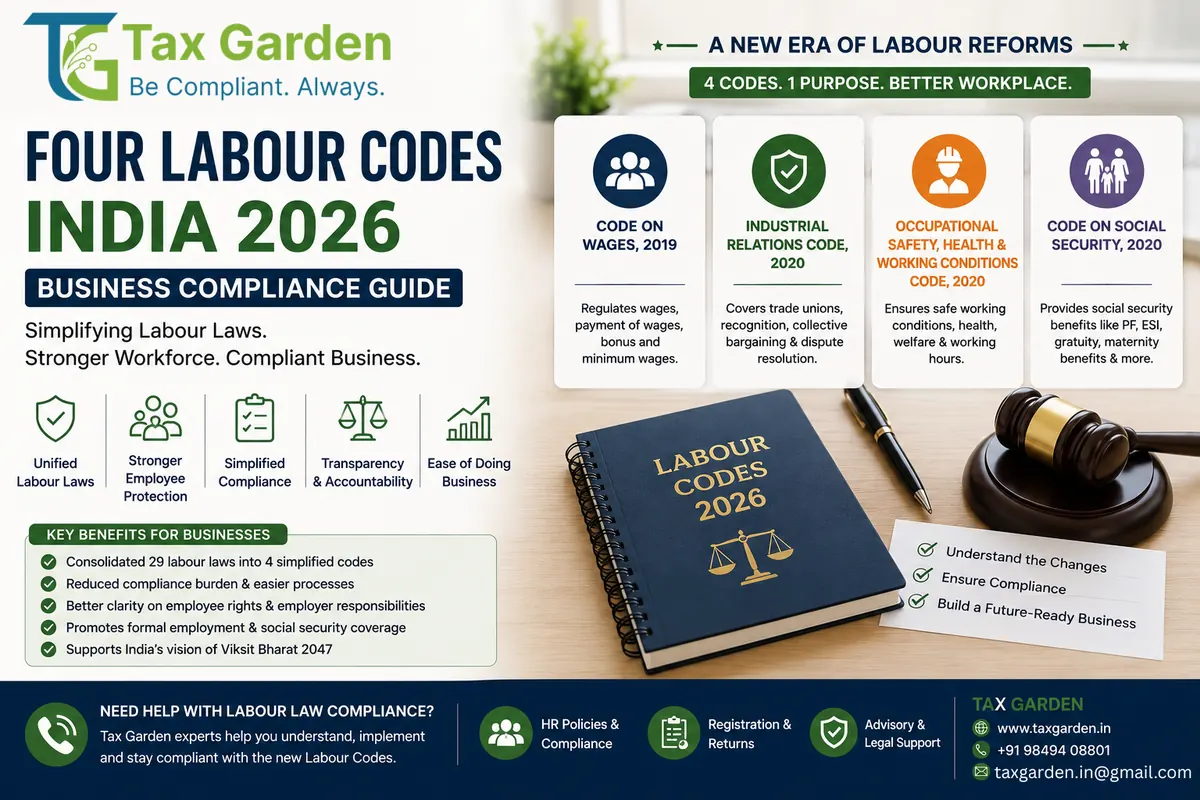
India's Labour Ministry consolidated 29 old labour laws into 4 comprehensive codes effective from state-by-state notification (2021-2026 phase-out):
- Code on Wages 2019 - Minimum wage, equal pay, bonus, gratuity
- Industrial Relations Code 2020 - Hire-and-fire, retrenchment, standing orders, strikes
- Code on Social Security 2020 - EPF, ESIC, gratuity, pension, healthcare, gig workers
- Occupational Safety, Health & Working Conditions Code 2020 - Workplace safety, working hours, leave
For businesses: wage structure must change, EPF/ESIC calculations reset, gig worker classification triggered, HR policies rewritten.
The 4 Labour Codes Explained: What Changed
1. Code on Wages 2019
Replaces: Payment of Wages Act 1936, Minimum Wages Act 1948, Equal Remuneration Act 1976, Bonus Act 1965
Key changes:
- Unified minimum wage: Central + State = floor. Ministry of Labour publishes all-India floor rates; states notify higher rates.
- "Basic" wage definition: Minimum 50% of gross monthly CTC or Rs 18,000/month, whichever higher (whichever is higher; does not apply if CTC < Rs 18,000)
- Wage ceiling for ESIC: Rs 21,000/month (from old Rs 15,000). The EPF wage ceiling is a separate figure: Rs 25,000/month from 17 September 2026 (S.O. 5109(E)), Rs 15,000 before that.
- Allowance definition: Only allowances defined in wage structure count. Ad-hoc, performance, or undefined allowances are NOT part of "basic."
- Equal pay for equal work: Same wage for male & female workers doing identical/similar jobs (extends old act).
- Bonus: Annual bonus rate remains 8.33% on profits (or salary, whichever lower) for establishments with 20+ workers.
Impact on payroll: If current wage structure = 40% basic + 60% allowances, restructure to 50% basic + 50% allowances minimum.
2. Industrial Relations Code 2020
Replaces: Trade Unions Act 1926, Industrial Disputes Act 1947, Labour Laws (Exemption from Furnishing Returns and Maintaining Registers by Certain Establishments) Act 1988, Dock Workers (Regulation of Employment) Act 1948
Key changes:
- Fixed-term employment: Hire workers on fixed contracts (3 months-5 years) without "permanent" status. No notice period at contract end.
- Standing orders simplified: Only establishments with 300+ workers need formal standing orders approval. <300 workers can operate without approval but must display rules.
- Retrenchment notice:
- Establishments <300 workers: 30 days notice
- Establishments >=300 workers: 30 days notice + Government approval
- 4-day work week provision: Establishes baseline 48-hour/week; allows negotiation down to 40 hours with collective agreement.
- Strike rules: Peaceful strikes permitted; 14 days notice required before strike in essential services.
Impact on HR: Shift from permanent to contract-based hiring. Easier termination. No pension/gratuity for fixed-term unless code says otherwise.
3. Code on Social Security 2020
Replaces: Employees' Provident Funds & Miscellaneous Provisions Act 1952, Employees' State Insurance Act 1948, Payment of Gratuity Act 1972, Maternity Benefit Act 1961, Workers' Compensation Act 1923
Key changes:
- EPF ceiling: Mandatory contribution on PF wages (Basic + DA + retaining allowance) up to Rs 25,000/month from 17 September 2026, raised from Rs 15,000 by S.O. 5109(E) dated 17 September 2026. Employee and employer each contribute 12% of PF wages; at the new ceiling that is Rs 3,000 each, with Rs 2,083 of the employer share going to EPS.
- ESIC ceiling: Contribution on Rs 21,000/month (increased from Rs 15,000). Employer rate ~3.25%, employee rate ~0.75%.
- Gratuity: Payable to permanent employees after 5 years (unchanged). Amount = 15 days' wages × years of service (capped at 10 months' wages per year).
- Gig workers coverage (NEW): Platform companies, ride-sharing, delivery apps must now register workers and contribute to social security fund:
- Platform registration: All workers with >1 month history must be registered
- Contribution: ~0.5% of gross earnings
- Benefits: Medical fund, disability fund, old age fund, accident fund
- Maternity benefit: Cash assistance for female workers; not just leave.
Impact on payroll: EPF/ESIC calculations change. Gig workers (Uber drivers, Dunzo delivery partners, etc.) now incur social security cost for platforms.
4. Occupational Safety, Health & Working Conditions Code 2020
Replaces: Factories Act 1948, Plantation Labour Act 1951, Mines Act 1952, Building & Other Construction Workers Act 1996, and 6 others
Key changes:
- Universal applicability: Applies to ALL establishments (not just factories). Even offices, retail shops covered.
- Working hours: 48 hours/week max (can be negotiated down to 40). Overtime after 48 hours.
- Weekly rest: At least 1 day off per week (typically Sunday).
- Safety standards: PPE, machine guards, ventilation, lighting, sanitation. Non-negotiable.
- Health surveillance: Employers must conduct periodic medical checkups for hazardous work.
- Leave rules: Earned leave, sick leave, special leave (marriage, compassionate) mandated.
Impact on operations: Stricter safety compliance, mandatory audits, health checkup costs.
Implementation Status: State-by-State Rollout (July 2026)
Action for business: Check your state's Labour Department website for notification dates. Compliance is mandatory from notification date onwards.
Key Changes for Employers: Practical Checklist
1. Wage Structure Audit
What to do NOW:
- Review current wage slips. Calculate basic as % of CTC.
- If basic < 50%: Restructure before state notification.
- Example: Current wage = Rs 30,000 basic + Rs 30,000 allowances (40% basic). Post-code: Restructure to Rs 30,000 basic + Rs 30,000 allowances = 50% basic. OR Rs 36,000 basic + Rs 24,000 allowances = 60% basic.
Why: Incorrect basic = undercalculated EPF/ESIC. Audit penalty if notified state finds gap.
2. EPF/ESIC Recalculation
Code on Wages impact:
- EPF: Contribution on basic salary only (not allowances). Ceiling Rs 25,000/month from 17 September 2026 (Rs 15,000 up to 16 September 2026).
- ESIC: Contribution on wages up to Rs 21,000/month (was Rs 15,000).
Action:
- Audit current EPF/ESIC calcs. If on gross (old method), switch to "basic only" method.
- Update payroll software thresholds: ESIC ceiling -> Rs 21,000; EPF/EPS ceiling -> Rs 25,000 from 17 September 2026, with September 2026 split at 16/17 September in a single ECR.
- Recalculate backdated contributions if state notified >3 months ago.
Example recalculation:
- Old method: Employee Rs 30,000/month. EPF = 12% × 30,000 = Rs 3,600.
- New method: Basic Rs 15,000 (out of Rs 30,000). EPF = 12% × 15,000 = Rs 1,800. Savings: Rs 1,800/month per employee.
3. Fixed-Term Employment Policy
When Industrial Relations Code notified:
- Introduce fixed-term contracts for new hires (max 5 years, renewable).
- Avoids gratuity liability: FTE workers are NOT entitled to gratuity.
- Simplifies termination: No standing orders approval for <300 workers.
Template clause: "Employee is hired on a fixed-term contract for [12 months / 24 months]. Contract ends on [date]. Renewal is at company discretion. No gratuity or severance upon contract end unless law mandates."
4. Standing Orders (for 300+ worker establishments)
Required after Code notified:
- Formal standing orders: wages, hours, leave, disciplinary rules, termination.
- Register with State Labour Commissioner.
- Update every 2 years.
- Non-compliance: Rs 5,000+ fine per violation.
<300 worker establishments: No formal approval needed, but display rules on notice board.
5. Gig Worker Classification & Social Security Registration
If your business uses gig/contract workers:
- Classify correctly: Independent contractor vs. platform worker.
- If platform model (Uber, Zomato style): Register workers under Code on Social Security.
- Contribution: ~0.5% of gross earnings to social security fund.
- Benefits: Workers get disability, medical, old-age coverage.
Action: Audit payroll. If 50%+ workers are gig/platform: Plan registration + SSF contributions in budget.
6. Occupational Safety Compliance
Universal post-Code:
- Conduct safety audit: PPE, machine guards, ventilation, lighting, sanitation, medical checkups.
- Appoint Safety Officer (if 50+ workers).
- Maintain accident register.
- Conduct mandatory health checkups (annual for hazardous roles, bi-annual for others).
- Budget: Rs 5,000-50,000/employee depending on role hazard level.
Impact on EPF/ESIC: Numbers You Need to Know
Before (Old Rules)
After (Code on Wages & Social Security)
Net impact: Employer savings on EPF (basic-only calculation), but ESIC ceiling increased may offset for high-wage roles.
Compliance Checklist: Actions by Priority
Sources & Official References
- Ministry of Labour & Employment: Labour Code notifications, sector-wise guidance -> https://labour.gov.in/
- PRS India Legislative Brief on Labour Codes -> https://prsindia.org/
- State Labour Department notifications (check your state for announcement)
- EPFO & ESIC circulars on wage definition post-codes
Bottom Line
The 4 Labour Codes represent India's most significant labour law reform in 75 years. Wage structure, EPF/ESIC, gig worker classification, hiring practices, and safety compliance all change. Non-compliance = penalties (Rs 2,000-2,50,000) + audit risk + employee disputes.
Action: Audit now. Prepare before your state notifies. Engage payroll + HR consultants 2-3 months ahead. You'll save time, penalties, and employee conflict.
Tax Garden Payroll & Compliance Standard handles monthly EPF and ESIC deposits, TDS on salary, and statutory payroll returns. Notified state? We update your payroll filings. Contract workers? We track social security registration deadlines.