Agricultural Income Tax India: Section 10(1) and Partial Integration
Agricultural income is exempt under Section 10(1) of the Income Tax Act 1961, but this exemption comes with an important condition: if you have both agricultural income and non-agricultural income, the agricultural income is brought back into the calculation, not to tax it, but to push your non-agricultural income into a higher tax slab. This is the partial integration method, and misunderstanding it is one of the most common reasons agricultural taxpayers end up with incorrect tax calculations.
To see how this plays out against a fully taxable trade with 18% GST, 44ADA and audit rules, read our software versus agriculture business tax comparison.
This guide covers the Section 10(1) exemption, when partial integration applies, how to calculate tax correctly with a worked example, Schedule EI reporting, and the special treatment of plantation crops under Rules 7A, 7B and 8.
Section 10(1): Agricultural Income Exemption
Section 10(1) of the Income Tax Act 1961 exempts agricultural income from income tax. The exemption applies to:
- Income from land situated in India used for agricultural purposes
- Income from cultivation of the land
- Income from processing agricultural produce of the land (by basic operations on the cultivator's own land)
- Income from sale of the agricultural produce
What constitutes "agricultural income" is defined in Section 2(1A). Three conditions must all be satisfied:
- Land must be situated in India
- Land must be used for agricultural purposes
- Income must be derived from that land
What is NOT Agricultural Income
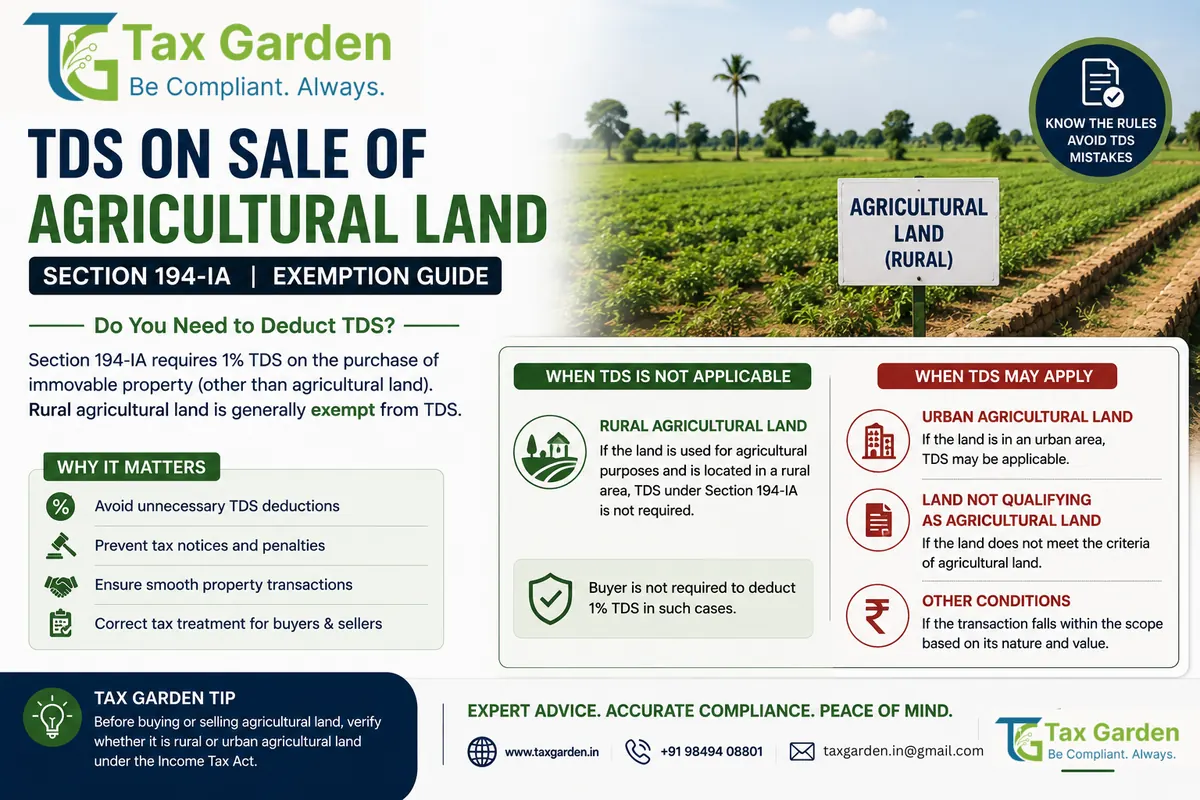
- Gain on sale of the agricultural land itself. Rural agricultural land is not a capital asset; urban agricultural land is, and its sale is taxed as capital gains.
- Income from dairy farming, poultry farming or fisheries, since these are not derived from cultivation of land.
- Income from bee-keeping and selling honey or beeswax, which Section 35AD lists as a specified business. See our guide for beekeepers and honey processors.
- The manufacturing portion of income from tea, rubber or coffee grown and processed by the same person (see the plantation rules below).
When Partial Integration Applies
The exemption under Section 10(1) is unconditional for persons with only agricultural income. The partial integration method, laid down each year in section 2(2) of the Finance Act (for AY 2026-27, the Finance Act 2025), applies when:
- You have both agricultural income and non-agricultural income
- Your total non-agricultural income exceeds the basic exemption limit (new regime: Rs. 4 lakh for all ages for FY 2025-26; old regime: Rs. 2.5 lakh below 60, Rs. 3 lakh for 60 to 79, Rs. 5 lakh for 80 and above)
- Your net agricultural income exceeds Rs. 5,000
If agricultural income is Rs. 5,000 or below, partial integration is skipped entirely and agricultural income is just noted in Schedule EI without affecting tax.
Why Partial Integration Exists
The legislative intent: agricultural income should not enable a taxpayer to benefit from lower slab rates for their non-agricultural income. A person with Rs. 10 lakh salary and Rs. 15 lakh agricultural income should not pay tax only on Rs. 10 lakh at the lower slab starting from Rs. 0. Partial integration ensures tax is computed as if the agricultural income "fills up" the lower slabs, and the non-agricultural income sits in the higher slabs.
Partial Integration: Step-by-Step Calculation
Applicable ITR forms: ITR 2 and ITR 3 (Schedule EI and the agricultural income tax calculation worksheet)
The Formula
Tax on (Non-Agricultural Income + Net Agricultural Income)
minus
Tax on (Basic Exemption Limit + Net Agricultural Income)
equals
Tax on Non-Agricultural Income
Then add: health and education cess (4%) on the tax arrived at above.
Worked Example
Taxpayer profile:
- Individual, resident, below 60 years
- Old tax regime
- Salary income (after standard deduction): Rs. 8,00,000
- Agricultural income from paddy cultivation in Telangana: Rs. 6,00,000
- Basic exemption limit: Rs. 2,50,000
Step 1: Compute tax on (Salary + Agricultural Income)
Total = Rs. 8,00,000 + Rs. 6,00,000 = Rs. 14,00,000
Tax on Rs. 14,00,000 (old regime slabs FY 2025-26):
- Up to Rs. 2,50,000: Nil
- Rs. 2,50,001 to Rs. 5,00,000 (Rs. 2,50,000 @ 5%): Rs. 12,500
- Rs. 5,00,001 to Rs. 10,00,000 (Rs. 5,00,000 @ 20%): Rs. 1,00,000
- Rs. 10,00,001 to Rs. 14,00,000 (Rs. 4,00,000 @ 30%): Rs. 1,20,000
- Total Tax A = Rs. 2,32,500
Step 2: Compute tax on (Basic Exemption Limit + Agricultural Income)
Total = Rs. 2,50,000 + Rs. 6,00,000 = Rs. 8,50,000
Tax on Rs. 8,50,000:
- Up to Rs. 2,50,000: Nil
- Rs. 2,50,001 to Rs. 5,00,000 (Rs. 2,50,000 @ 5%): Rs. 12,500
- Rs. 5,00,001 to Rs. 8,50,000 (Rs. 3,50,000 @ 20%): Rs. 70,000
- Total Tax B = Rs. 82,500
Step 3: Tax on Non-Agricultural Income = Tax A minus Tax B
Rs. 2,32,500 minus Rs. 82,500 = Rs. 1,50,000
Step 4: Add Health and Education Cess (4%)
Rs. 1,50,000 × 4% = Rs. 6,000
Final Tax Payable = Rs. 1,56,000
What would have happened without partial integration:
Tax only on Rs. 8,00,000 salary:
- Up to Rs. 2,50,000: Nil
- Rs. 2,50,001 to Rs. 5,00,000: Rs. 12,500
- Rs. 5,00,001 to Rs. 8,00,000: Rs. 60,000
- Total: Rs. 72,500 + 4% cess = Rs. 75,400
Difference: Rs. 1,56,000 minus Rs. 75,400 = Rs. 80,600 additional tax due to partial integration. This is the effective tax on having agricultural income in the middle slabs.
Plantation Income: Rules 7A, 7B and 8
Where the same person grows and also processes certain crops, the Income-tax Rules 1962 fix how much of the combined income is business income. The balance is agricultural income.
| Activity | Rule | Taxable as business income | Agricultural (exempt) |
|---|---|---|---|
| Growing and manufacturing rubber | Rule 7A | 35% | 65% |
| Growing and curing coffee | Rule 7B | 25% | 75% |
| Growing, curing, roasting and grinding coffee | Rule 7B | 40% | 60% |
| Growing and manufacturing tea | Rule 8 | 40% | 60% |
For other produce that is partly agricultural, Rule 7 requires the market value of the produce to be treated as agricultural income and the rest as business income.
For a worked Rule 7 example with sugarcane crushed into jaggery on the farm, see our jaggery and khandsari units guide. For the tea split, including why tea made from bought leaf is outside Rule 8, see our tea traders, packers and estates guide.
Reporting in Schedule EI
Agricultural income is reported in Schedule EI of ITR-2 or ITR-3: gross agricultural receipts, expenditure incurred on agriculture, unabsorbed agricultural loss of the previous eight years, and net agricultural income. Where net agricultural income exceeds Rs. 5,000, the schedule also asks for land details such as district, pin code, measurement in acres, whether the land is owned or held on lease, and whether it is irrigated. ITR-1 and ITR-4 can be used only if agricultural income is Rs. 5,000 or less.